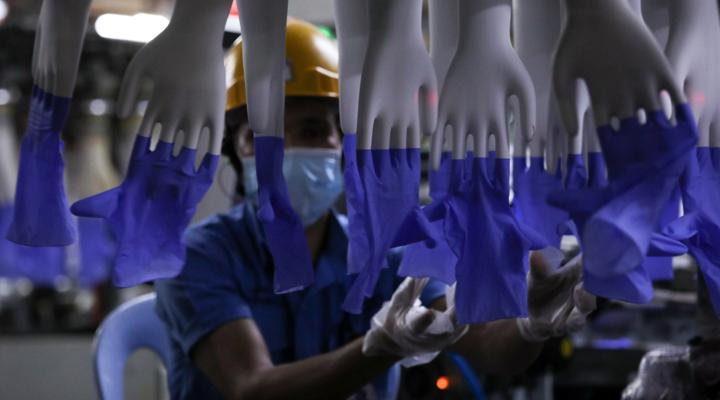
Rubber glove makers have raised prices and warned of production cuts as the Iran war chokes supplies of key inputs, raising concerns for the healthcare sector. Glove makers have already hiked the average price of synthetic rubber gloves by around 40 per cent to as high as $29 for a box of 1,000, according to Oong Chun Sung, an equity research analyst at CimB Securities. Sustained disruption to supply chains from the conflict could lead to glove shortages by late May, analysts at Malaysia’s RHB
™s RHB and CimB Securities said.
“In any procedure that we do in a hospital, we have to wear gloves,” said Dr Kuljit Singh, president of the Association of Private Hospitals of Malaysia. “If there is a shortage, this means there will be some difficulty to deliver some services in the healthcare sector. We are a little cautious and are watching the situation, but at present, our suppliers are supplying the gloves as usual.”
Central to the problem is naphtha, a byproduct of crude oil refining used to make plastics and other petrochemicals – the building blocks of everything from paint and polyester to kitchen containers and car parts.
Naphtha prices have spiked to all-time peaks amid the closure of the crucial Strait of Hormuz, through which a fifth of global oil and gas shipments typically pass.
The US and Iran have shown willingness to negotiate, but even in the event of a near-term peace agreement, analysts warn that supply disruptions and inflationary pressures could persist for months after the war ends.
Fortunately, as a result of lessons learned during the pandemic, both hospitals and glove makers stock several months’ supply, providing a buffer.
Prices to keep rising
Still, Malaysian glove makers, which account for nearly half of global production, have signaled their intention to keep raising prices.
Top Glove, the world’s No. 1 glove maker, told Reuters it is looking to pass through cost increases of approximately 50 per cent from raw materials, mainly driven by higher prices of nitrile latex, used for around 55 per cent of its gloves.
“Glove prices have been adjusted accordingly,” said Hartalega Holdings CEO Kuan Mun Leong, adding that “longer term, we are concerned that if this war continues, there could be an impact on global glove supply.”
Singapore- and Taiwan-listed Medtecs, which makes medical equipment such as face masks and surgical gowns, said it had raised prices by 10 per cent to 40 per cent, depending on product.
Shares of Top Glove and Hartalega climbed around 40 per cent and 50 per cent, respectively, from March 24 to April 10, driven by the potential front-loading of sales and concerns over supply shortages.
However, RHB analysts say the gains are “unsustainable”.
“The current environment is a cost-push inflation cycle, not a demand-driven upcycle,” they said in an email.
“As such, average selling price increases are largely defensive as they are aimed at preserving margins rather than expanding them. Once the market recognizes this, we expect the rally to fade.”
Further reading: The supply chain trends to watch in 2025: Tech, resilience and sustainability