

Risa Goldberg is a self-proclaimed Nordstrom department store loyalist. Visiting the flagship Nordstrom in New York City is as essential to her as speaking to her niece and nephew. “There is a real sense of magic apart from the incredible decorations and general holiday vibe. You really get a sense that something seasonally magical is about to happen,” she says. When Goldberg is asked how much she spends at the retailer, however, her answer is zero. “I don’t actually purchase anything. T
. There isn’t anything to buy,” Goldberg says with a spritely laugh. “If I’m going to spend money, I will head online to look for discounts and customer service. The shopping experience is much better there.”
The mass exodus of foot traffic out of stores and onto digital platforms over the past decade is not specific to Nordstrom. Macy’s has also seen its share of wallet diminish, and in December, it received a $5.8 billion takeover offer from an investor group composed of Arkhouse Management, a real-estate focused investing firm, and Brigade Capital Management, a global asset manager. Macy’s declined to comment on the potential acquisition, which is notably less than the estimated $6 billion value of the retailer’s real-estate portfolio alone.
In the US, department stores in general have seemingly lost their luster. The Advance Monthly Retail Trade Report for October states that revenue for US department store sales was at $10.9 billion that month, down from $11.04 billion in September and $11.37 billion a year ago – an almost 4.14 percent decrease.
While a shift in spending trends has challenged the retail sector post-pandemic, retail executives have given apocalyptic scenarios on earnings calls citing terrible weather and shrinkage as reasons for revenue misses and underperformance. During the Q3 earnings call, Nordstrom CEO Erik Nordstrom warned retail sales and credit-card revenues would drop by between 4 percent and 6 percent. He also noted theft was eating into the bottom line so much it would serve as the reason for more store closures. For Q4, the company reported a 6.8 percent decline in sales.
“Losing almost 10 percent in sales in one quarter is brutal,” says Michael Zakour, founder and chief strategist of retail consultant 5 New Digital. “But I disagree with the [general] idea that retail is dead. Legacy retailers and investing in retail might be dead for now, but e-commerce is set to change the retail landscape in ways we haven’t seen since 2005.”
It’s all about access to capital
Across the nation, mid-sized department and specialty stores are also feeling the squeeze. In 2023, retailers Bed Bath & Beyond (now acquired by Wayfair), David’s Bridal, Tuesday Morning, Serta Simmons, and Party City all filed for Chapter 11. In the past decade, iconic department store companies such as Neiman Marcus Group (NMG), JC Penney and Lord & Taylor also filed. Many have dug themselves out and returned to solvency; however, the biggest issue all of these retailers have in common is access to capital markets.
The ticket to accessing big-time funds is coming to the table with a portfolio of assets, including real-estate holdings, that could be used to secure funding. This was the case for Saks Fifth Avenue when Hudson’s Bay recently sold several pieces of real estate, including family heirlooms, to raise $335 million for the store to pay its vendors.
“At the height of lending, in 2021, retailers saw almost $5 billion in investments,” Zakour said. “Year to date is around $31 million – an almost 96 percent decrease in two years. Unless there is a clear road to profitability, including numbers that indicate CAC [customer acquisition cost] is low and margins are high, companies must have something to put up in case something goes wrong. And not many have those collateral assets.”
The coming year doesn’t look much better for mid-sized retailers. With interest rates continuously rising, inflation still at high levels, and general consumer sentiment slowing, mid-sized retailers will still be in a precarious position in 2024. A survey by consulting group BBDO found that difficulty accessing capital is forcing 91 percent of mid-sized businesses to curb their growth plans. Among the same businesses, 24 percent are being forced to scale back, and 20 percent are struggling to invest in new technology or software to improve their businesses.
Macy’s shrinks to grow
As if the uncertainty of access to capital wasn’t enough of a challenge for the next year, department stores are also faced with rapidly changing consumer behavior. The shift wasn’t sudden. It began as the 2008 recession was taking hold of the American consumer. Shoppers felt the pinch and pulled back on their discretionary purchases immediately, which threw the department-store sector into turmoil.
Fast-forward 15 years and department stores are getting more specific about their merchandising, and more deliberate about space and how their customers use their time to shop. In a study by Forrester on 2024 trends, principal analyst Audrey Chee-Reed said consumers are going to be more cautious when it comes to spending. “In 2024, [consumers] won’t stop spending, but they will expect to maximize economic value. And this isn’t just a shift to shopping at value stores or looking for value brands, but an expectation of value through trials, special offers, bundles, payment plans and more.”
Cautious spending also demands smaller, more efficient merchandising layouts. Macy’s chief stores officer Marc Mastronardi outlined the retailer’s plan for smaller-format stores during its Q3 earnings call in November (prior to the acquisition offer) and said, “As a growth vector for Macy’s, Inc., small-format stores offer a curated shopping experience celebrating discovery and convenience. These stores optimize our physical store footprint and bring us closer to existing and desired customers while encouraging more frequent visits.”
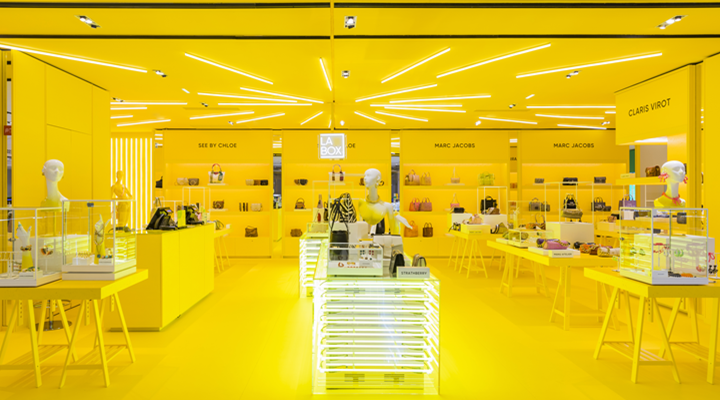
Department stores like Dillard’s, Saks Fifth Avenue, and Bloomingdales are also creating merchandising spaces within their flagship and anchor locations, in an attempt to keep the customer shopping offline. Retail executives got the memo post-pandemic that loyal customers are tired, stretched thin and didn’t want to spend more than a couple minutes to ‘search and discover’ new items. Smaller formats allow customers to experience new brands and products while staying in the same retail space. The result: revenues increased 4-8 percent for these retailers in the last quarter.
“The pop-up ‘store within a store’ is designed for brand awareness, customer engagement, and sales,” said Susan Sandler, CEO and founder of Pop Up Summer, an experiential marketing firm for pop-up retail concepts based in New York City. “So when you think about that kind of value, it makes sense for a larger store to essentially test market their real estate to [try to] keep the customer from leaving without spending something in the space.”
Bergdorf Goodman is a case in point
In New York, Bergdorf Goodman’s race to acquire customers while not increasing customer acquisition costs is on.
The retailer pulled itself out of bankruptcy via a $200 million investment from online platform Farfetch, led by NMG’s current CEO Geoffroy van Raemdonck. But leaked financial documents show the company’s profitability has taken a hit versus 2022. NMG’s EBITDA was $124 million for the quarter ended April 29, which was a drop of almost 25 percent from a year earlier, unnamed sources stated via Bloomberg. Revenue dropped 9 percent, to $1 billion.
In a talk at Parsons School of Design, van Raemdonck alluded to the increase in budgets spent on diversity, equity and inclusion programming, in addition to pouring capital into the bricks-and-mortar in-person experience.
“Our community and loyal customer base has been cultivated for years. Their mindset is driven by having exclusive access and incredible customer service,” van Raemdonck said. “We have a very low turnover rate and some of our top sellers have been with the company for more than 30 years. Investing in human capital is where we see the value in customer acquisition.”
Printemps says bonjour!
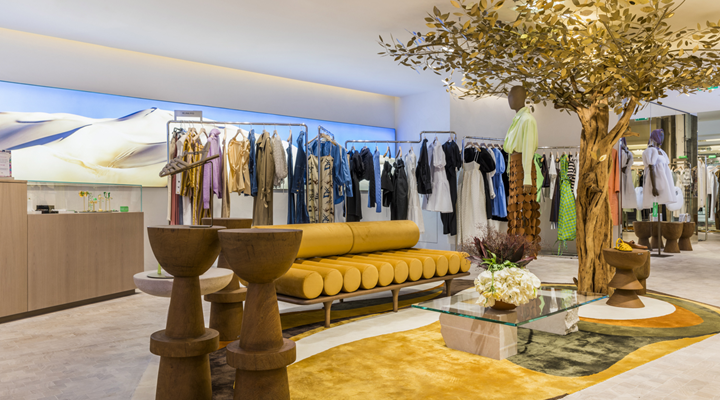
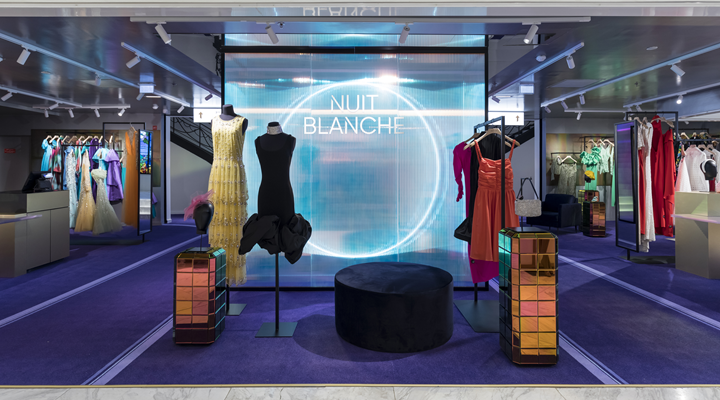
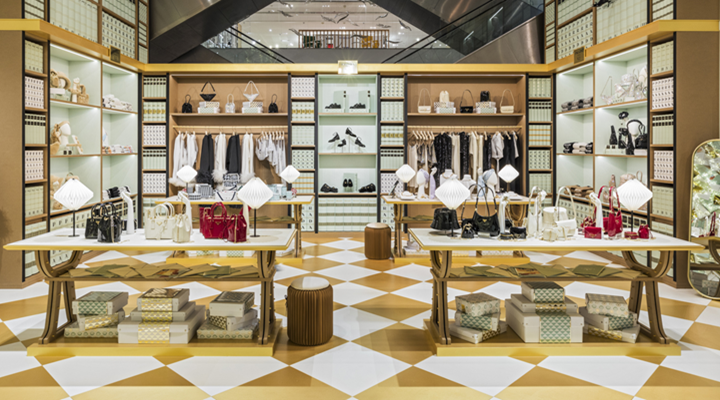
All arrows are pointing to the instability of many US department stores, yet Parisian department store Printemps is all in for its debut on New York City’s Wall Street during the fall of 2024. The goal is to be closer to the rapidly changing e-commerce market. Instead of focusing on omnichannel retailing, Printemps’ interest and focus are on “immersive experiential retailing” the United States can provide.
“The US is essential in our international development strategy and opening in New York offers high visibility and growth potential,” Printemps Groupe CEO Jean-Marc Bellaiche said. “We think we can bring something unique, both to its engaged local consumer base and the strong tourist flows the city welcomes. It is also a strategic e-commerce market for luxury, fashion, home and beauty. We plan to pioneer a new format of experiential retail in this fast-changing and demanding market.”
Pop Up Summer’s Sandler added: “Becoming part of the fashion zeitgeist is not easy in New York and specifically not easy if you are a business trying to build a following of customers from a different country and culture. The play is how they end up using unique bricks-and-mortar merchandising tactics to bring the customer a one-stop shop for luxury home, apparel and beauty.”
Despite the buzz, it remains to be seen how many people would take the trip downtown to shop at a new department store, much less make it a one-stop shop for personal care and entertainment, as well as frequent apparel and housewares purchases.
“There’s no way I would go that far downtown,” regular Nordstrom visitor Goldberg said. “Why drag when you have everything here?”
This story first appeared in the December 2023 issue of Inside Retail US magazine.