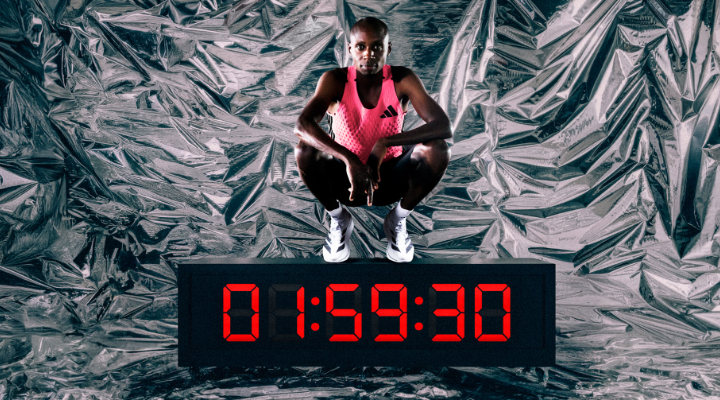
Adidas didn’t just win the London Marathon; it quietly hijacked one of distance running’s most mythic narratives and reframed it in three stripes. By the time Sabastian Sawe stopped the clock at 1:59:30 on the Mall, the brand had converted a decade-long, Nike-led moonshot into an Adidas-branded reality – with a 97-gram supershoe as the protagonist. The sub-two-hour marathon has lived in Nike’s marketing universe since Breaking2, the 2017 Monza experiment that turned Eliud Kipchoge into a
to a global icon and the Vaporfly into a shorthand for marginal gains. That run, and Kipchoge’s later 1:59:40 exhibition in Vienna, were designed as brand theatre: closed circuits, laser-guided pacers and a level of orchestration that made the times unofficial but the storytelling unforgettable.
London 2026 flipped the script. On paper, Sawe’s 1:59:30 and Yomif Kejelcha’s 1:59:41 were simply the logical next step for super-shoe science. In practice, they marked the moment Adidas took ownership of the record books in a sanctioned race, on one of the sport’s most visible stages – the same world where Nike had already done the myth-making. That Sawe broke Kelvin Kiptum’s official world record and the two-hour barrier simultaneously gave Adidas the one thing Nike never had for this story, an asterisk-free line in the history books.
Product seeding as story engine
The hero piece was the Adizero Adios Pro Evo 3, a sub-100g marathon racer unveiled just days before its competitive debut in London. Weighing around 97 grams, with a maximal 39mm heel stack and next-generation “Lightstrike Pro Evo foam”, the shoe is engineered less like traditional footwear and more like a disposable F1 component with its unapologetically race-day-only composition.
Crucially, Adidas seeded the product into a tightly curated roster of athletes with very different profiles but identical visual impact. Sawe, a long-distance specialist and defending London champion; Kejelcha, a track-bred debutant with a 10,000m and indoor mile pedigree; and Tigst Assefa, who added a women’s-only world record of 2:15:41 in London. Each ran in the same silhouette, turning the men’s and women’s races into a rolling billboard for the Evo 3.
Because the shoe line had already banked credibility with Adizero models, capturing roughly half of World Marathon Major wins in 2024, London felt less like a proof of concept and more like the logical crescendo. The sub-two performances became a validation mechanic for an existing product story, successfully positioning the Evo 3 as not a one-night miracle shoe, but the latest chapter in a steadily compounding performance narrative.
Owning the cultural conversation
Adidas also understood that this was a pop-cultural moment, not just a performance milestone. London delivered two men under two hours, a women’s-only world record and back-to-back titles for Assefa, giving the brand a clean sweep of the storylines broadcasters and social media would replay on loop.
Where Nike’s Breaking2 leaned into cinematic control – controlled environment, curated content series and brand-first framing – Adidas’ win arrived inside a mass-participation marathon with all its inherent chaos. That gave the moment a different kind of cultural legitimacy, as history was happening in the same race as charity runners and club athletes, not on a closed circuit designed for a campaign. For consumers increasingly fluent in the language of brand staging, that distinction matters.
The brand’s messaging balanced on a careful line between technological bravado and athlete-led storytelling. Adidas called the Evo 3 a supershoe that “breaks new ground,” while athletes framed it as an enabler rather than a shortcut. Sawe emphasised how light, comfortable and “pushing forward” the shoe felt, while Assefa and Sawe both credited “years of hard work,” team support and innovation helping them go “beyond what we thought was possible.” In doing so, Adidas pre-empted accusations of “mechanical doping” by embedding the shoe in a wider ecosystem of training, coaching and human effort.
A textbook retail playbook in motion
From a retail perspective, the execution was flawless. Adidas unveiled the Evo 3 days before the marathon, seeded it to a small group of headline athletes, and followed the historic performances with a tightly limited, high-priced drop designed to stoke scarcity and halo the broader Adizero range. The historic moment positioned the product as not a mass shoe. Instead, the Evo is a pinnacle object that justifies its price through extreme lightness, visible tech and direct association with world records.
In a category where Nike has long dominated the imagination, Adidas has used London 2026 to pivot from challenger to narrator. The brand now controls the most powerful data point in distance running – the first official sub-two marathon – and has tethered it to a shoe that looks, feels and is marketed like a limited-edition performance artifact. The next chapter will hinge on how it extends that energy into more accessible price points and silhouettes. But for now, Adidas leaves London with cultural custody of the marathon’s defining moment.
Further reading: Has Adidas’s Pro Evo 3 blurred the line into ‘mechanical doping’?