Airport retail has become increasingly sophisticated in recent years, with shopping, food and beverages, and retail services all being made available on a scale and quality that befits an urban shopping mall. Once seen as just a functional add-on to the travel experience, airport retail is now the full mall experience: travellers, and those who see them off and greet them on arrival, have come to expect nothing less. There are some superb examples: Singapore’s Changi, Doha’s Hamad, Dubai Int
ubai International and many more have all strived to make the arrival and departure areas buzzy and shopable. The beauty of these places is not just that there are a lot of shops and restaurants on both the air- and land-sides but that the terminals themselves are well designed.
They are manageably compact from a pedestrian standpoint, and the ambience has been enriched by a skilful combination of decor, lighting, construction materials and greenery. There is a buzziness and an element of congestion, which is a common element of the best malls everywhere.
Another critical feature is that since airports are places that deliver a key function, which is that people are going somewhere whether they are departing or arriving, there needs to be a high standard of services, both in terms of variety and efficiency. Coming or going, the experience needs to be seamless.
On September 9, Techo, the new international airport serving Phnom Penh, commenced operation. It is located about 25 kilometres south of downtown Phnom Penh, in Kandal Province. How does it measure up? The airport delivers on one or two of the critical positives mentioned above, but it falls short in key respects, some of which can be fixed quickly, others that might take more time.
Retail shops
Retailers in the departure area are adequate but could use some beefing up on things like health and beauty, books and personal accessories. The current lineup includes several Aelia Duty Free shops (airside), the duty-free operator and subsidiary of Lagardère Travel Retail that operates duty-free in dozens of airports around the world. It also has a Gallery in Phnom Penh multi-brand apparel store on the airside, housing upscale labels like Polo Ralph Lauren and Marc Jacobs.
Taking care of travel essentials is a Ucare Pharmacy (a domestic Cambodian chain, airside) and Relay (landside and airside). Rounding out the retail offering are Senteur d’Angkor craft boutique (airside), Bodia spa (also a domestic chain, airside), and Eye Love Sunglasses (airside).
The retail highlight, though, is Artisans Angkor, a beautiful open-plan display on the airside that offers departing visitors another chance to purchase handcrafted local pieces before heading to the gate.
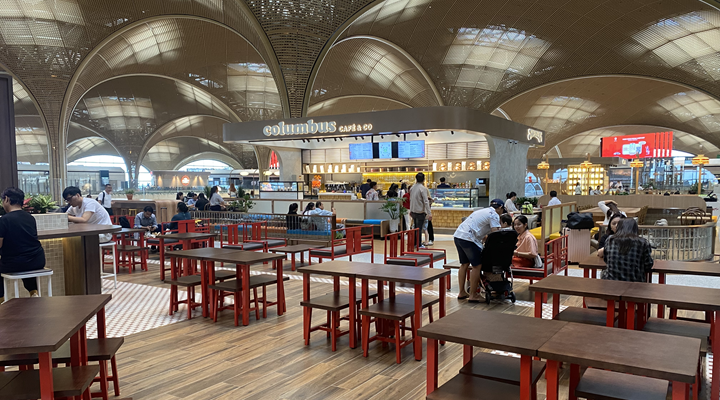
Food and beverage at the airport are covered with a number of eateries on both land- and airside (superior on the latter) that collectively offer a decent variety of food in a pleasing atmosphere.
The airport gets an ‘F’ for services
High-quality services are the oil that makes the wheels of departure and arrival turn without squeaking and creaking. They are the difference between loving an airport and hating it. Getting checked bags on arrival and efficient check-ins are critical parts of the airport’s arrival and departure routines, but travellers need much more than that: they need to change money, access ATMs, get a local SIM card for their phones, have access to hassle-free hotel transfers, and so on.
This is where Techo is, frankly, horrible, and needs drastic improvement, particularly in the arrivals area. To be sure, there is a bank (Canadia) offering money-changing services. However, at the time of this writer’s visit, it was a pure slapstick comedy, featuring about 20 employees, 15 of whom appeared to be doing nothing while the others were engaged in furious activity, making copies of documents, to-and-fro-ing paperwork, paper-clipping this and stapling that, requesting signatures. Finally, at the end of it all, the employee asked this writer if he would accept one of the country’s two national currencies that he didn’t ask for and really didn’t want.
If a traveller makes it to the money changer, though, it means they must have gotten their checked bags off what must surely be the world’s longest and most inefficient airport luggage conveyor belts, and that in itself can be something of a milestone. (It took 45 minutes for that, in this writer’s case.)
On arrival, the building overwhelms the traveller
The airport’s design, by UK architects Foster and Partners, has some wonderful aspects. The building has a strong Cambodian design motif, especially the roof, which consists of a series of interlocking earth-coloured steel shells.
The interior is vast, and walking distances seem unnecessarily long. This works okay on the departure side because the space is occupied by functional areas, retail and restaurants. However, on the arrivals side, the empty distances and weak lighting can be depressing.
The walk from the jetway that connects the plane with the terminal — the jetways themselves are the longest you’ll see anywhere in the world — is a joyless march, devoid of amenities and desperately in need of decorative additions.
The good news is that this can be remedied fairly easily. Getting good banking and telecom services, and hassle-free transportation, though, that might be harder to fix.
Fix the services, and the future is bright
According to the government, Techo Airport is already handling 130 inbound and outbound flights per day, moving 15,000 passengers in and out of Phnom Penh. Most major airlines have now switched to Techo from the old airport, which is reportedly being converted to military uses.
Cambodia already has a thriving tourist industry, and the government hopes that the new airport will stimulate tourism and trade. Indeed, this may well happen, but a few tweaks here and there to the retail and services side of things will help make the departure and arrival experience a lot better for the travellers it serves.
Further reading: Ready for takeoff: How Tumi is tapping into airport stores and travel trends