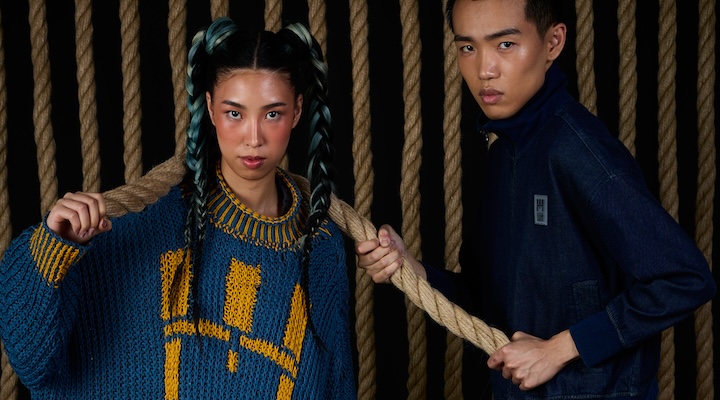
In the middle of Manhattan’s Chinatown, models walked through crowded streets in rugged yet fluid silhouettes, their garments nodding to the immigrant work ethic of generations past. To onlookers, Sum London’s guerrilla runway was a striking spectacle during New York Fashion Week (NYFW). But behind the scenes, the independent British-Asian brand was leveraging cultural storytelling and technical fibers to win the loyalty of conscious consumers. The clothes themselves, designed in collaborati
ation with Austrian fiber producer Lenzing (maker of Tencel) and Chinese mill Advance Denim, blended heritage silhouettes with modern sustainable fabrics.
The Jiā Yóu collection is rooted in history, specifically the overlooked contributions of some 20,000 Asian sailors who served during World War II. For Margaret Sam, Sum London’s founder, it was vital that this story didn’t remain an abstract inspiration but was embedded directly into the garments and the spaces in which they were shown.
Inside Retail sat down with Margaret Sam, founder and creative director of Sum London, and Dennis Hui, global business development manager for denim at Lenzing, to unpack the vision behind the collection, cultural authenticity and supply chain transformation.
Inside Retail: NYFW is crowded with noise. How do you ensure Sum London stands out without compromising authenticity?
Margaret Sam: We are focused on the people who align with us and our values: cultural identity, community and quality Eastern-Utilitarianism. Our NYFW show in Chinatown was rooted in heritage and integrity, not industry noise. That’s why we did it in the heart of Chinatown, Manhattan, NY, where the real community is. To us, that’s integrity – an authentic venue to pay homage to the immigrant work ethic.
There are real people behind Sum London. You can see that I am a physical representation of what Sum London stands for. I set the standards for Sum London, and they are clear to those around me and my team. You can see it in our product and creative output. While we do need to consider our size and resources at this stage of growth, we do not compromise our standards as a brand with a long-term vision for growth and impact.
The Sum London culture is true and rooted in my British-Asian heritage, and will continue to be as we expand, whilst staying adaptable and nimble as the start-up we are.
IR: What was the most emotionally challenging part of bringing this collection to life?
MS: Honoring the lived experiences behind the concept, especially the largely untold history of Chinese sailors and immigrant labor, was emotionally vibrant. Translating that respect into design, actual garments, and a community event required careful listening, research and collaboration.
Organizing NYFW all the way from London as a lean, dedicated team, juggling marketing, invites, preparing our lookbook and two pop-ups, navigating permits, insurance, complying with local authorities, and most importantly, respecting the local Chinatown community, all while time was of the essence, was as much a logistical and practical challenge as it was an emotionally and mentally expansive experience.
IR: Do you see collections like this as limited cultural statements, or do you plan to scale them for wider retail distribution?
MS: Sum London operates as a sustainably made-to-order, DTC brand, focused on nurturing a loyal audience and ensuring every drop reflects our values. We prioritise intentional growth over vanity metrics, building the foundation for a lasting legacy before scaling.
Growth will come selectively through pop-ups and stores in cultural hubs, while we strengthen our online presence. Inspired by models like Dover Street Market and Beams, we balance commercial opportunity with cultural storytelling.
Beyond capsules, our core range celebrates mixed cultural identities. Jiā Yóu is a cultural statement designed to live every season – seasonless, conceptual, and rooted in history.
IR: Many independent designers struggle with scaling beyond capsule collections. How do you plan to sustain momentum beyond this launch?
MS: Capsules and pop-ups are our growth model, not a limitation. They keep us agile, community-driven and true to our values. Partnerships with Tencel and Advance Denim help scale responsibly. Post-NYFW, we’re extending momentum through social media, a London pop-up, Kingpins Amsterdam and a short film. Long term, Sum London will evolve into a heritage brand anchored by a core line, with natural extensions into accessories and collaborations.
IR: What were the biggest design challenges in recreating heritage workwear using Tencel and other modern sustainable fibers?
MS: Partnering with Tencel helped extend our story to the industry, which is exactly what we need to maximize our efforts and propel Sum London globally. The technical challenge was balancing the rugged, lived-in feel of heritage workwear with modern performance and drape, and Tencel Lyocell fibers made that possible. Their versatility across lightweight jersey, mid-weight knits, and heavy raw denim allowed us to stay authentic to heritage while pushing design forward.
IR: Do you think partnerships like this (designer + fiber producer + denim mill) represent a new model for how the fashion industry can innovate?
Dennis Hui: A collaboration model across the value chain represents the future of fashion innovation, where sustainability is the foundation, not an afterthought. At Lenzing, we believe real innovation happens when fiber producers, mills and designers collaborate from the start. By combining responsible fibers like Tencel Lyocell with the expertise of partners such as Advance Denim, we can turn creative visions, like Margaret’s at Sum London, into products that are both authentic and environmentally responsible. These partnerships make premium, sustainable materials more accessible, purposeful, and commercially relevant, creating a model that the wider industry can adopt. When innovation spans from raw material to final execution, it not only strengthens the story behind the product but also maximizes its impact on the industry.
IR: How scalable do you see the use of responsible fibers for young designers? Is it accessible, or still prohibitively costly?
DH: Accessibility is improving as more brands and mills adopt fibers like Tencel, increasing production and lowering costs. The focus now is on collaborative innovation, especially with emerging designers who show cultural relevance and market potential. At Lenzing, we work with supply chain partners, including mills like Advance Denim, to make sustainable alternatives scalable and accessible to both established and new players. By connecting young designers with the right partners, we help accelerate the future of fashion while expanding sustainable innovation across the industry.
IR: Sum London sits at the crossroads of East and West. How do you see that dual identity resonating with global audiences?
Margaret Sam: We already see our brand’s resonance through community support and impact in such a short period of time. We’ve had two large-scale runways since our first pop-up in London last year, with great success with our Williamsburg, NY, pop-up recently. It’s clear there is a growing market for dual-heritage brands that reflect cultural blending, migration and post-colonial shifts. Sum London speaks to second-generation Asians, mixed-heritage communities and globally minded audiences seeking a place to belong and represent their identity.
IR: Beyond this capsule, where do you see the biggest commercial opportunities for Sum London?
MS: Our opportunity is global. We focus on key cultural hubs – London, New York, Shanghai, Tokyo, Hong Kong, Singapore and Los Angeles – where heritage and youth culture meet. Asia is especially exciting as pride in heritage grows, but our British-Asian identity allows us to adapt across regions. We scale through targeted pop-ups, online presence and community-led growth, following models like Dover Street Market for our long-term business focus, but are very much focused on establishing our brand presence through word of mouth within our existing industry and community. The commercial landscape is changing quickly alongside technological innovation. Our pop-ups in key international spots allow us to test and meet new markets and communities. New York seems to be a great spot for us, and Asia is next.
Further reading: We Wear Australian immersive pop-up is landing at New York Fashion Week.