Total revenues from all three of CP Axtra’s businesses – wholesale, retail and mall rental – amounted to 127.1 billion Thai baht ($4.0 billion) in the third quarter of 2025, an increase of 2.1 per cent year-on-year. The sales part of it (that is, excluding its mall rental and services business) grew by 2.6 per cent, comprising 3.3 per cent for wholesale and 1.7 per cent for retail. The company said new store openings, omnichannel, fresh food, and private-label products were instrumental in
driving top-line growth for the wholesale segment (Makro). The new openings had a material impact, since same-store sales for the wholesale business grew by only 0.3 per cent.
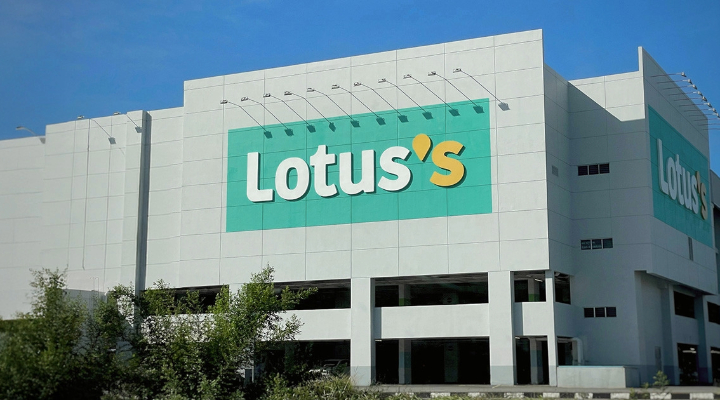
Meanwhile, revenue from the retail business (Lotus’s) expanded by 1.7 per cent YoY, driven by growth in Malaysia, fresh food and omnichannel.
Across both wholesale and retail, omnichannel accounted for just over 22.2 per cent of company sales, up from less than 17 per cent not much more than a year ago.
Revenue from the rental business was flat in the quarter on a year-over-year basis.
Gross margin edged down a tad from a year ago to 14.3 per cent, which was attributed to a shift toward fresh food in the sales mix, and net profit also fell slightly, by 4.5 per cent, to 1.9 billion baht ($58 million).
Store openings do the heavy lifting while same-store sales remain flat.
Company same-store sales were up by 0.3 per cent in the third quarter for Makro and fell by 0.5 per cent for Lotus’s, despite stellar fresh food growth ― fresh food sales again rose by more than 10 per cent across both wholesale and retail ― the decline on the Lotus’s side being attributed to a ‘high bar’ in the base year because of the government’s digital wallet stimulus program.
The company ended the third quarter with 179 wholesale stores, up seven from the same period last year. Of the 179, all but 10 are in Thailand. The stores are big, averaging 5,350 square metres, all on a single level. On the retail side, the company opened a net 81 stores over the last 12 months, comprising 170 openings and 89 closings. It ended the quarter with 2,579 retail stores, including 70 in Malaysia. By the end of the year, CP Axtra is targeting two more Makro openings and 29 Lotus’s, of which 27 will be the Go Fresh mini-supermarket format. Of the 2,509 Lotus’s stores in Thailand, 2,105 are small formats.
Makro continues to take a bigger piece of the company’s revenues.
Wholesale under the various iterations of Makro accounted for 56 per cent of the company’s sales revenue in the first nine months of the year. An ongoing theme at Makro is the decline in tourism arrivals, as roughly a third of its sales come from the HoReCa sector (hotel, restaurant, and catering), which is heavily dependent on both international and domestic tourism. The company says that its sales to that customer segment have been growing at 3-4 per cent this year despite a 7.6 per cent decline in international tourism.
Mall leasing income
CP Axtra leases about 1.2 million square metres of space to small tenants in its community shopping centres and within the Lotus’s hypermarkets that anchor them. They are also trying to drum up a bigger revenue stream by renting space in the vicinity of its Makro stores. The idea is not just to squeeze incremental revenue from existing land, but also to support the company’s ambition to make its centres ‘community hubs’. (Is there a shopping centre operator anywhere in the world right now whose marketing department isn’t hard at work repeating the same slogan?) Overall occupancy is currently around 91 per cent. Rental income from the Lotus’s retail side of the business is almost 6 per cent of total retail revenues. It was down slightly (-1.2 per cent year-on-year in the third quarter), but the company noted in its analysis of results that this was due to “a shift in tenant mix within the shopping centres and ongoing renovation of spaces in Lotus’s Malaysia”.
Although the company is keen to lease more space at its wholesale stores and is having some success doing so, the pickings will ultimately be slimmer than for Lotus’s because Makro doesn’t really anchor malls. Rather, it is typically a freestanding box. (Americans and Australians would immediately associate it with Costco, since the stores have the same size, look, feel and concept.) Rental income from this leasing in the Makro stores increased by more than 34 per cent year-on-year in the third quarter, driven by new store openings and the expansion of small-tenant leasing space in the existing Makro units. Still, there is an opportunity for significantly more growth in this part of the business, with total revenues for the quarter a modest 164 million baht ($5 million), accounting for well under 1 per cent of wholesale revenues.
What is the competition up to?
CP Axtra and Central Retail have been fixtures of Thailand’s retail scene for a long time, and both are used to each other, but Central has now expanded beyond retail and mall leasing in an attempt to pinch some of Makro’s bread and butter in the wholesale market with its Go Wholesale format. Currently, there are only 13 of them after the initial launch two years ago, but Central is ambitious and has the balance sheet to back it up. In early December, it will formally divest itself of a nine-unit department store chain in Italy (La Rinascente) to focus on its key markets in Southeast Asia, with Thailand at its centre. Part of the renewed focus on the local region will be to fix problems and enhance aspects of its existing formats; part will be to make acquisitions (possibly in Vietnam); and part will be to grow the wholesale business. It is this latter that will be of interest to Makro, which has long been the dominant Thailand wholesaler, indeed the only really consequential one. It will not take kindly to a turf invasion: interesting times are ahead.
Further reading: Central Retail: New stores and tourism drive sales growth