
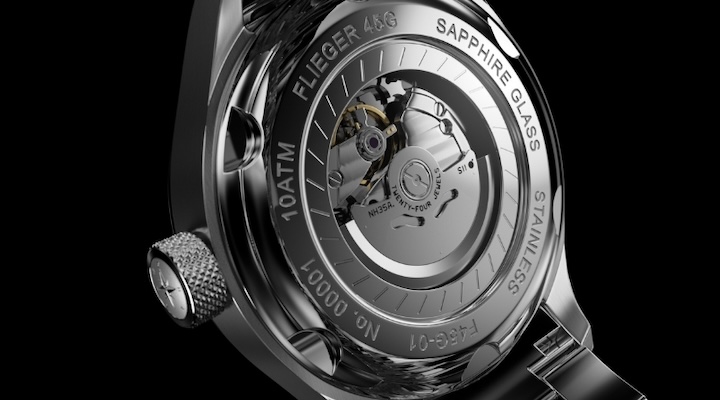
Independent Australian watchmaker Panzera has been defying conventions in the watch category since 2009, going head-to-head with Swiss heritage brands. Last month, Panzera announced one of the rarest kinds of retail collaborations, an unpaid partnership. It was selected by pilots of the United States Air Force’s Aggressor Squadron to produce a custom timepiece. This unsolicited collaboration was described by founders Roger Cooper and Andrew Herman as a “coup” for Panzera – giving i
ving its modern pilot’s watch an official military endorsement.
Over the past five years, the brand has recorded 35 per cent average year-on-year growth, with 85 per cent of sales generated offshore. More than half of these overseas sales come from the US.
Inside Retail spoke with Herman to understand what a US military endorsement means for an Australian watch brand and why consumers prefer their watches tested by pilots and astronauts.
Inside Retail: Has Panzerra’s direct-to-consumer model been a challenge or an opportunity?
Andrew Herman: The biggest problem with direct-to-consumer models is that watches are not traditionally something people buy without seeing. Getting people to have the confidence to buy a watch without seeing it, in Australia, which is often a long way away from most of where the customers live, is the biggest challenge we have.
What’s really helped us is we’ve set up a mailing list where we offer people information about the brand because the sales cycle for a watch that people have not seen is a lot longer than most other direct-to-consumer products. We need to coach them along.
IR: How did the collaboration with the United States Air Force’s Aggressor Squadron come about?
AH: We didn’t go and chase that. It was an interesting one because we market so much in the US – it’s one of our biggest markets. One or two of the Air Force pilots purchased some of our watches. They were looking to build an exclusive Aggressors Squadron watch, and we said, yes. We worked out a logo they wanted on the front, and we changed the back plate and customised our pilot’s watch, the Flieger 45G, to meet their requirements.
We actually went over and met them last month, and they took us out flying in some light aircraft and put us through some flight simulators and things. We’re really appreciative of the story and the ability to say that real pilots are wearing our watches now. So it’s been a real win-win situation for us.
IR: Why is a partnership like this important to Panzera?
AH: The biggest takeaway is that it’s a compliment that US Air Force pilots would want to select our watch as their preferred watch for their squadron. But secondly, from a marketing viewpoint, we don’t spend a lot on channel in terms of distribution and retail stores. We don’t spend huge amounts on our advertising because it would take away from the efficiency of being able to provide these watches at cost-effective prices, which is a big challenge.
So, to get something like an Air Force squadron [partnership], and to be able to let the public know that they’ve selected our watches, is a really big PR coup. These guys actually selected it themselves – it’s a really nice story and helps the brand credibility.
IR: Why do you think watch brands have historically sought out endorsements from the military, aviation and space?
AH: I think it’s a heritage thing. If you look at watches, people like to show off how rugged their timepieces are. For our brand, there are three different types of watches; we call them land, sea and air.
A timepiece for a pilot used to be mandatory; they couldn’t fly without one, and it had to be quite reliable, because it was one of the ways you’d navigate if something failed in the plane. So, to have real pilots wearing it shows that it is a useful watch. Also, it’s very rugged, especially for military pilots who do very aggressive maneuvers. And lastly, it’s also very aspirational, because people like to think of owning a watch like the Air Force pilots are wearing, or a watch like the US Navy SEALs are wearing. It’s a bit of an endorsement and also aspirational.
IR: How has the watch market shifted since Panzera was founded in 2009?
AH: There’s been a lot of changes, but the main thing was the advent of the smartwatch, and everybody saying, ‘Well, that’s the end of the traditional watch timepieces.’
Now, I think watches have moved away from being a functional device that tells time to being more of a symbol or a statement about yourself – a piece of men’s jewellery or women’s jewellery.
Traditional timepieces are more popular than ever. The smartwatch has really driven people to start wearing watches again at a younger age. But I think at a certain point, they want to wear something different [than] the same Apple Watch that everybody else is wearing. That’s where watches have progressed, and that’s what we try to achieve at Panzera.