
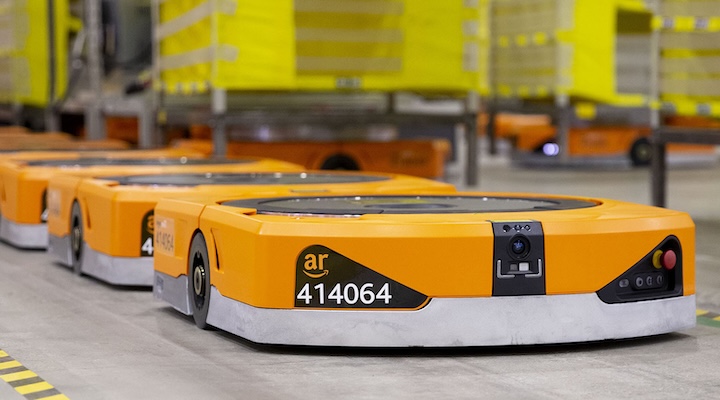
Amazon has earned a reputation for its same-day delivery and impressive logistics, but over the last decade, the e-commerce giant has been working towards building fulfilment centres of the future through its robotics arm. In 2012, Amazon acquired a robotics company called Kiva. This was a US$775 million bet on the role automation would play in fulfilment centres of the future. Fast forward to this month, when Amazon Robotics announced it had deployed its millionth robot to its Chiba fulfi
fulfilment centre in Tokyo, reflecting the rapid scaling of its robot workforce from single digits to seven digits over a decade.
According to chief robotics officer Tye Brady, Amazon Robotics solicits ideas from its employees at any level, at any time. “Our frontline employees are our customers,” Brady told Inside Retail.
Ideas can come from anywhere
Brady explained that employees are invited to draft a six-page memo outlining a problem or solution for Amazon Robotics to review.
“It’s simple, but it’s very powerful. If you’re a good writer and you have a good idea, it really jumps out at you. Now, if you’re a good writer and you have a bad idea, that also jumps out at you really quickly,” he elaborated.
It’s this in-house feedback loop that powers a lot of Amazon Robotics’ innovations, including the Proteus robot, Amazon’s first autonomous robot, which works independently alongside employees in the company’s fulfilment centres.
“We have an amazing world-class team, but we could still get so enamored with what it is that we’re building, and convince ourselves in the lab that this is a good idea,” shared Brady.
“But we have this tremendous advantage – it’s something that makes it very practical and real – we have this huge network we call the Amazon fulfilment network, where we can put it in the real environment,” he added.
A workforce fit for the future
Much has been discussed about the potential displacement of a human workforce with the rise of AI automation and physical robots, but Amazon is quick to counter that narrative.
Since 2019, Amazon has upskilled more than 700,000 employees through various training initiatives, many focused on working with advanced technologies. The company aims to create new career pathways for employees that align with technical roles in systems operations.
Amazon Robotics initially set out to help employees access inventory more efficiently, resulting in a type of robot that could move inventory shelves across warehouse floors.
“My aim is to eliminate the menial and the mundane. If you were to walk through even our latest generation fulfilment centre, there are still lots of opportunities inside there, and it’s not at the expense of our employees,” Brady explained.
For example, he said automation can be leveraged to lift heavy totes or boxes that weigh over 35 pounds, as well as to load and unload trucks.
“I would love to be able to automate that in a way that, again, doesn’t displace our employees, but they can monitor the system that’s unloading the truck so they don’t have to carry heavy loads on their body,” he elaborated.
It’s about function, not form
Amazon is hyperfixated on the function of robots, not their form. When asked if Amazon had an interest in developing humanoid robots, a robot designed with a body shape resembling a human, Brady answered, “I’m open to it, but I would caution folks from starting first with form, unless that is your product.
“For us, it’s more about an everyday, utilitarian application of robotics.”
From Brady’s perspective, a lot of the moral panic around physical AI systems is unfounded, and he believes people need to reframe their mindset regarding machines. He believes this is just the starting point for people to become comfortable with robotics.
“I’m also proud of the work that our team is doing in physical AI – this is like a new paradigm, that we have these physical agents that are more adaptable, more capable, kind of bringing the mind and the body together in robotics,” Brady stated.
“I think that over time, that’s going to become more commonplace. And in our next generation fulfilment centre, the menial, the mundane, will start to be automated,” he concluded. “But I also believe over time that we will be creating more jobs, because we’ll be more productive.”




![[Left to right] Bennett Fox-Glassman, Macy’s SVP of customer journey, Sara Kleinma, Ruggable’s North American general manager and Primark US’s head of marketing sitting next to Tara Paxton, the founder and CEO of Huemanize on the Shoptalk Fall stage.](https://insideretail.us/wp-content/uploads/2025/09/shoptalk-fall-2025-chicago-day-three-530x294.png)