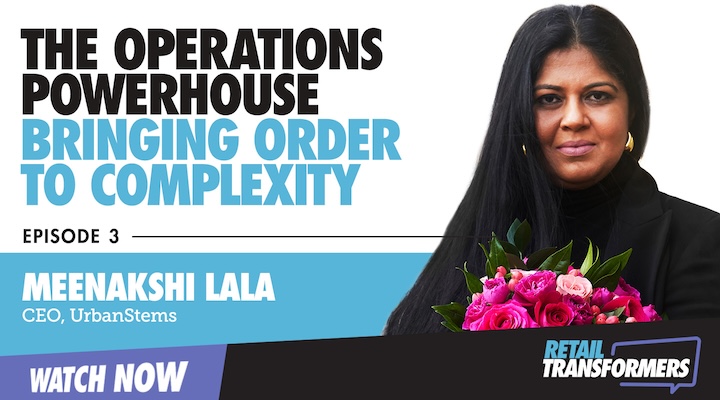
For more than two decades, Meenakshi Lala built her career mastering the art and science of operations in fashion retail – a world defined by rapid trend cycles, complex supply chains and constant pressure to deliver beauty at speed.
Today, as CEO of Urban Stems, she’s bringing that same discipline and design sensibility to disrupt an industry that’s long been left to wilt: Online flower delivery.
What struck Lala when she joined wasn’t just the business model but the company’s emotional core.
“The passion and sentiment of spreading joy really stood out,” she told Inside Retail’s Amie Larter for the Retail Transformers video series. “Taking the sender’s emotions and transporting them to someone hundreds of miles away with the same care and affection – that’s what we do.”
Urban Stems was founded to modernise how people send flowers, turning what was once a transactional act into something deeply personal. The company calls itself “a seamless, one-of-a-kind flower delivery service helping to make anyone’s day from coast to coast,” but behind the artful arrangements lies a logistics network with fashion-level precision.
Flowers are perishable, which means Urban Stems operates on razor-thin timelines. Lala’s years in fashion taught her how to forecast trends, manage tight margins and anticipate customer needs — lessons that transfer neatly to florals.
“There’s no TJ Maxxing in flowers,” she jokes. “We buy, we sell, or it’s done with.”
Customers can order for same-day delivery or plan weeks ahead, a luxury that creates complexity for the company. “For the customer, that’s ideal. For us, it adds huge complexity – forecasting, purchasing, ensuring we bring in the right type of inventory at the right moment.”
The challenge, Lala says, is striking a balance between speed and precision. “The buy now, wear now philosophy of fashion inspired our send now, feel now approach,” she explains. Urban Stems designs its collections around emotional rhythms of the year – love in February, gratitude in May, celebration in June – echoing fashion’s seasonal storytelling.
From fast fashion to fast flowers
Lala sees clear parallels between the acceleration of fashion and the expectations shaping online gifting. “Fast fashion taught luxury fashion brands that the consumer knows what they want and when they want it,” she says. “That comes down to building a supply chain that’s both agile and intelligent.”
At Urban Stems, that agility is powered by data. Forecasting tools predict which varieties will be in season – and in fashion. Designers track runway palettes and cultural trends to ensure bouquets feel contemporary and relevant.
“Our customer lives and breathes in a trend-driven world,” Lala explains. “If peach is the colour of the year, or mocha is trending, our collections reflect that.”
This alignment with trend and timing isn’t simply aesthetic. Urban Stems’ core demographic – urban, design-conscious consumers – expect products that match their lifestyle.
“They see us as an edgy New York City brand,” she says. “Even if they don’t live there, that’s the style they want to imbibe. So we follow their journey – the brands they shop, the coffee they drink, the places they live.”
Understanding those customers – and removing friction for them – is at the heart of Lala’s strategy.
“Listen to the customer. Listen to what they want. They’ve told us they want ease of ordering and ease of delivery.”
That focus on simplicity drives the entire user experience. “Bringing in those elements of ease in the ordering process, in communication, in how you’re informed about deliveries – making the site experience as easy as possible,” she says. Regular buyers can upload address books and check out in seconds.
Behind the scenes, however, the process is anything but simple.
“What happens behind the scenes is unimaginable,” Lala admits. “Your order could bounce between half a dozen fulfilment centres or come straight from a farm overseas. The key is that the customer never sees the friction.”
That seamlessness – making operational complexity invisible – is one of Urban Stems’ competitive advantages. “When it gets to you,” she says, “the experience has to feel effortless.”
Building a brand-first flower company
Where most flower delivery services compete on convenience, Lala has shaped Urban Stems to compete on brand. She views it not as a logistics company but as a lifestyle brand defined by quality, design and emotional intelligence.
“Fashion retail is a brand-first vertical. It’s all about the brand, the quality, brand positioning. And that is something Urban Stems is truly innovating in the floral space. Besides being a delivery solution and a high-quality floral offering, Urban Stems is also bringing high design and a brand play into the mix. We are trying to be disruptors in this space.”
Some might consider that disruption to be overdue. The flower industry has long lagged in digital sophistication, with many players acting as middlemen between farms and florists. Urban Stems’ vertically integrated model – sourcing, design, fulfilment and delivery – allows it to control freshness, quality and presentation end-to-end.
The global garden
Behind every bouquet lies a world-spanning supply chain. “A particular peony might be native to Holland, a rose to Ecuador,” Lala notes. “There are over 700 varieties of roses worldwide – understanding which offer the best quality and durability is critical.”
Sourcing flowers means navigating a web of climates, ecosystems and trade relationships. Urban Stems partners directly with growers to secure consistent, ethically sourced stems while maintaining the freshness customers expect.
Here is where Lala’s fashion retail operational background comes into play. Her experience in fashion taught her that invisible systems – the supply chain, the forecasting, the fit – create a magical customer experience.
Lala says the secret to success is making the experience joyful for the customer and hiding the complexity. You shouldn’t have to think about how it all works. You should just open the order and feel something.
- Watch the interview online as Lala explains the operational and planning challenges of meeting seasonal demand peaks with a product that has a short shelf life, how AI can make a difference in a business like Urban Stems, and the relentless challenge of meeting consumers’ growing demand for rapid delivery against a background of international supply chain disruptions.