In July, thousands of Hongkongers queued outside McDonald’s outlets to get their hands on a Happy Meal that came with small plastic figurines: Chiikawa, the hamster-like star of a Japanese manga series, and its companions Hachiware and Usagi. At one point, about 20,000 people were reportedly logged onto McDonald’s reservation website trying to secure the toys, while others waited outside stores for hours. For retailers across Asia, the Chiikawa craze is starting to look less like a fad and m
and more like a commercial force they can’t afford to overlook.
Who is Chiikawa?
Chiikawa, roughly translated to “something small and cute”, was created by Japanese illustrator Nagano in 2020. The character was initially part of a webcomic on Twitter, which follows Chiikawa and its friends as they confront the minor struggles of work, friendship and inequality, balancing a deceptively simple aesthetic with surprisingly poignant storytelling.
By 2022, the series had been adapted into a TV anime in Japan. And like Pokémon or Hello Kitty before it, Chiikawa has transcended its origins, moving into restaurants, retail collaborations, pop-ups and exhibitions across Asia.
The results speak for themselves. When Chinese lifestyle retailer Miniso opened a Chiikawa-themed pop-up in Shanghai last year, sales reached $1.1 million in just three days. At one point, the line of customers trying to get in grew to 7000 people long, forcing local police to disperse the crowd. But the frenzy hardly slowed, pop-ups quickly spread to Beijing, Hong Kong, Taiwan, Malaysia and South Korea. Even in the US, New York and Las Vegas saw long queues and sell-outs at Chiikawa events.
“At first, I wasn’t interested, but its popularity sparked my curiosity. The more I learned, the more I understood why so many, including myself, are drawn to it,” Stephen Leung, former group chief information officer at Hong Kong-based Bank of East Asia, said about his first impression of Chiikawa in a LinkedIn post.
“Chiikawa’s world is cozy yet touches on serious themes like work, social inequality and friendship… What makes Chiikawa truly innovative is its ability to connect deeply through minimalistic design and storytelling, proving that meaningful narratives don’t need flashy technology,” he added.
That resonance has helped fuel Chiikawa’s explosive growth online.
On X (formerly Twitter), the manga’s official account now boasts more than 4 million followers, quadruple the following of Sanrio. Chiikawa Park, the franchise’s themed attraction, has become the latest frontier in this expansion of cuteness. Demand is already running hot with tickets being distributed via lottery at least one month in advance.
The IP collaboration machine
Similar to other popular intellectual properties (IPs), Chiikawa has quickly emerged as one of the most potent names to partner with.
Known for splashy tie-ups with Yayoi Kusama and Alexander Wang, the brand had been quiet on the co-branding front until August, when it unveiled a collaboration with Chiikawa.
The campaign sent social media into overdrive. On Weibo, hashtags for ‘HeyTea Chiikawa’ and ‘HeyTea Sold Out’ amassed more than 60 million reads. Fans snapped up limited-edition cups, stickers and character-themed merchandise, while images of Chiikawa mascots in HeyTea uniforms spread virally. The collaboration, launched through Alibaba’s licensing service Alifish, reinforced Chiikawa’s status as one of the hottest IPs in China.
Hong Kong has emerged as a key testing ground.
In April, Harbour City hosted the city’s first official Chiikawa pop-up, presented by local lifestyle brand Niko-Niko. Spanning 3000 sqft, the shop carried more than 400 items imported from Japan, including limited-edition T-shirts, alongside three photo zones and a ‘Chiikawa Wishing Garden’.
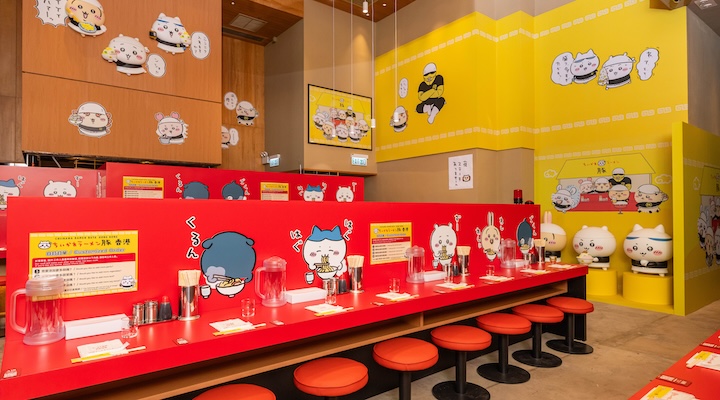
Last month, Flames Concepts launched “Chiikawa Ramen Buta” at Langham Place, the largest themed restaurant for the IP to date. Meanwhile, the “Chiikawa Days” exhibition organised by Hong Kong studio AllRightReserved boosted mall foot traffic by nearly 20 per cent year-on-year. Spin-off initiatives, such as the ‘Chiikawa Days Special Edition Octopus’ transport card and ‘Light Rail Travel Pass Package’, also recorded strong sales.
The pattern is consistent: wherever Chiikawa appears, consumer interest follows. For retailers facing slower growth and tighter margins, the appeal is obvious.
Risks and overexposure
The rise of Chiikawa speaks to a deeper structural challenge in Asian retail. Differentiation is increasingly difficult. In China especially, where price wars rage across e-commerce platforms and consumption growth is slowing, brands are searching for ways to stand out without resorting to endless discounting.
IP offers a solution. Rather than competing purely on price, retailers can compete on cultural relevance.
Retailers like Miniso, Oh!Some and KKV have leaned heavily into this model, positioning themselves as an IP-driven lifestyle retailer. Miniso’s $1.1 million haul from its Shanghai Chiikawa pop-up is a vivid reminder of how IP can turbocharge otherwise commoditised retail.
The strategy is not without hazards.
Oversaturation can quickly diminish consumer excitement, as seen in the wave of cookie-cutter collaborations that followed the peak of Line Friends and Kakao Friends in Korea.
Futher reading: How experience‑led lifestyle brands are growing in emerging Asia.