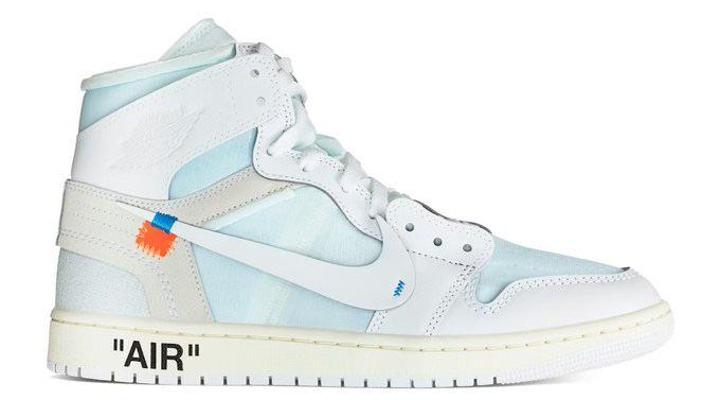
There is a shoe release that so many are talking about right now, but it has nothing to do with shoes. The Air Jordan 1 High OG x V.A.A. – the first product collaboration between Nike and the Virgil Abloh Archive – just dropped through a series of global pop-up events across Los Angeles, Chicago, New York, Paris, Hong Kong and Tokyo before its worldwide Nike release on April 3. The shoe is nearly identical to a rare 2018 European exclusive. The only visible change is the text stamped on the
he medial side: where it once read “Off-White for Nike”, it now reads “V.A.A. for Nike.”
That small text change actually carries a very large question.
Who was Virgil, and why does it matter?
To understand what Nike is attempting here, you need to understand what Virgil Abloh actually built.
Abloh launched “The Ten” collection with Nike in 2017 during my 10 years with Nike. It was like no other launch I have ever had the pleasure of being a part of. Ten deconstructed, reimagined Nike classics that sold out in minutes before dominating the secondary market for years, and genuinely changed how the industry thought about collaboration. As a self-described kid who “would sleep with a Jordan 5 at the end of the bed just so I could see it in the morning,” he brought something rare to the Swoosh: authentic love.
His design philosophy was the so-called “three per cent rule”, making minimal but precise changes that reveal the object’s deeper truth. Exposed foam. Zip ties. Helvetica text in quotation marks. He didn’t just put his name on a shoe; he showed you how it worked, what it meant, and why it mattered.
That transparency was the real product, and it created something that most brands spend decades and billions of US$ trying to manufacture: genuine consumer trust.
By 2018, he was the artistic director of Louis Vuitton’s menswear, the first Black creative director in that role, and was named to Time Magazine’s 100 Most Influential People. Japanese artist Takashi Murakami wrote of him: “The foundation of his value, or branding, is humanity itself, not a superficial trick.”
Abloh died in November 2021, aged 41, from a rare form of heart cancer he had kept very private. The sneaker world, the fashion world, and a generation of creatives who saw themselves in his story – the immigrant kid from Rockford, Illinois, who taught himself design – stopped.
Nike’s problem: the trust deficit
Ok, so here’s the context Nike is operating in when it brings this shoe to market.
Between 2017 and 2025, we all watched as Nike lost its way. A strategic pivot away from wholesale, a digital-first obsession, the sidelining of its creative directors, massive layoffs, and a relentless focus on short-term financial returns gutted the brand’s cultural capital. As someone who loved Nike and spent so many years with the brand, it was very hard to watch. As a result, the revenue dropped 10 per cent year-on-year by 2025. Profit fell 44 per cent. On a single day in June 2024, the stock dropped 21 per cent, which was the worst trading day in the company’s history.
For me, more damaging than the numbers was the cultural verdict. Nike had stopped being cool. It had retreated from boutique sneaker stores, from tastemakers, from the kind of community-building that Abloh had once completely embodied. Competitors like On Running, Hoka, and New Balance filled the space it vacated, and consumers no longer saw themselves in the brand.
There was one brand-tracking firm that put it pretty plainly: the most powerful driver of purchase intent in sportswear is the feeling that a brand is for people like me. Unfortunately, Nike had lost that.
So when the brand and the Virgil Abloh Archive announced this collaboration and the global World’s Fair activations, the archive membership, the Virgil Reader publication, it was received as way more than a product launch.
To me, it almost felt like an apology.
What Nike is really selling
This shoe is not about the shoe. It is about reassurance.
Reassurance that the creative soul of the brand is still alive. That the people who built their relationship with Nike through Abloh’s work haven’t been forgotten, and that there is still a version of Nike that operates from emotional intelligence rather than financial engineering.
Shannon Abloh, who stewards the Virgil Abloh Archive alongside the foundation, framed the partnership in pretty deliberate terms: “V.A.A.’s mission is to keep Virgil’s ideas alive. The Archive exists not only to preserve Virgil’s work, but to share it with great care and intention.”
That language – that care, intention, accessibility – is a direct echo of what Virgil himself practised. His “Free Game” platform methodically shared how to get started as a creative. He peeled back the curtain on his process in ways that made consumers feel like insiders, and built trust through radical transparency.
The pop-up activations across six cities, an online raffle designed for fairness, a giveaway of 100 pairs to creatives, donations to the Virgil Abloh Foundation for underrepresented young creatives – this is behaviour-led trust building at its finest. Not messaging. Not marketing copy. Just behaviour.
And that matters massively because trust is not built by what a brand says. It’s built by what a brand consistently does, over time. What I love is that the activation strategy clearly suggests someone in this partnership understands that.
The unanswerable question
But here’s the tension that no amount of careful strategy can really resolve.
Virgil’s trust was super personal before it was institutional. It was built through him, through his voice, his process, his presence, his willingness to receive what authenticity actually demands: social exposure. He shared unfinished things. He made himself legible to his audience. He was, in that sense, the brand.
You cannot inherit that. You can only preserve it, honour it, maybe build around it, but ultimately the source is gone.
Nike and V.A.A. are attempting something genuinely unprecedented, in my opinion – the institutional transfer of personal trust. It reminds me of what Nike did with Kobe Bryant’s estate after his death, working with his widow Vanessa on new colourways and models the player never wore. That partnership has been handled with notable care and has absolutely maintained consumer respect. It is possible to do this well.
But it requires something that most brands consistently underestimate: emotional coherence. The product, the activation, the partnerships, the charitable commitment, the Archive’s public membership and all of it must tell the same story. Any dissonance or a little doubt between what V.A.A. says it stands for and what either party does commercially will be felt immediately by a fanbase that was built on the promise of transparency.
The Air Jordan 1 “Alaska” will almost certainly sell out, and I do not doubt that. The demand has been building for four years. The shoe is a near-perfect replica of one of the rarest pairs in sneaker history, and the commercial opportunity is very obvious.
But commercial success is not the same as trust rebuilt.
The retail lesson
For retailers and brand strategists watching this unfold, the lesson is not about sneakers.
It is about the limits of nostalgia as a strategy, and the difference between emotional equity and emotional coherence.
Nostalgia can drive a launch. It generates heat, headlines and sell-outs. But it can’t sustain a relationship. What sustains a relationship is consistent, coherent behaviour and the ongoing demonstration that a brand knows what it stands for and acts accordingly, even when it is commercially inconvenient or challenging.
Nike’s challenge in 2026 is not to replicate the 2017 feeling. It is to earn the right to be trusted again and to demonstrate that the values Virgil embodied are genuinely embedded in how both partners operate going forward, not just in the product they release.
The shoe will sell. That part is easy.
The harder question is what comes next.
Nick Gray is the Founder and CEO of IGU Global, a Sydney-based retail strategy consultancy specialising in brand trust, consumer psychology and the emotional dimensions of retail.