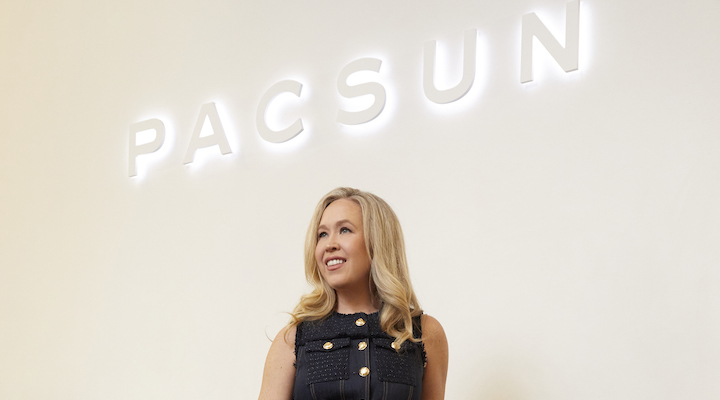
Longtime retail executive Brieane Olson started with Pacsun when it was still called Pacific Sunwear in 2007. Back then, she was the senior design director of the women’s division, before gradually working her way up the corporate ladder to become the CEO in 2023. Over those years, Pacsun slowly shifted away from its roots as a major national mall retailer synonymous with all things skating, sand, surf and sun, and became a brand that was struggling to define a clear identity for itself. In mo
In more recent years, Pacsun, under Olson’s guidance, has shifted to become a modern, more culture-influenced label that tweens, teens and young adults are actively engaging with as both consumers and content curators.
Inside Retail: You have been with Pacsun for almost two decades. What is it about the brand that has inspired such loyalty and made you really want to stick with it from the very beginning to where it is right now?
Brieane Olson: The first piece is the talent of the people who work at Pacsun; they are the cornerstone of what makes the brand so special. What has also kept me at Pacsun is a strong connection to youth and the opportunity to be part of a transformation.
The brand has clearly transformed over the last 10, 15, 20 years, and that journey is something I talk about in my book, Co-Creation: The Cultural Strategy That Redefined Pacsun.
The cultural strategy was one that had the brand grow from a legacy retailer that was at a crossroads into one of the most culturally relevant brands for Gen Z and Gen Alpha today, which wasn’t at all a linear path.
There were many moments when we either lacked clarity or we had held on to our heritage too tightly. We had to rethink the brand in its entirety, but I also had to rethink my role and the organization’s purpose.
Today, Pacsun is anchored in a clear purpose: building community at the intersection of fashion, music, art and sports. Those pillars have created a direction that has allowed the brand to evolve alongside culture.
Being able to help define and rebuild the brand has been the core reason that I have stayed for such a long time.
IR: When was the exact point you realized that Pacsun needed to dig in and reclarify its place in the retail market?
BO: The realization came when it was clear the brand was disconnected from the consumer. We were still anchored in surf and skate, while the customer had evolved, and we were reacting to trends that were happening in the marketplace without a clear point of view. So internally, there was a quiet recognition that we weren’t standing for enough.
The shift had to be made from an inside-out model to one of co-creation, which is how we operate now.
It goes beyond listening, because while listening and social listening are very important tools for understanding the consumer, building with the consumer across every point of the business, as opposed to for them, is the real strategic pivot.
That shows up in product decisions that are driven by real-time feedback, it shows up in marketing, where the community shapes the brand’s narrative and it shows up in our partnerships that are grounded in authentic connection.
Most importantly, it shows up in how our teams are structured to move quickly on insights. We needed to shift the culture, both externally and internally, and we had to start treating the customer as a collaborator not just as our audience.
IR: This isn’t Pacsun’s first round in trying to reinvent itself, as you mentioned in your book that the brand had previously tried to tap other popular apparel labels, while still attempting to hold on to the surf-and-skate collective.
You also stated that instead of the brand making a product and trying to influence customers into thinking it’s cool, Pacsun switched gears. It shifted to a model that had more of a customer-first focus, versus product first.
Can you discuss why the earlier reinvention attempts weren’t as productive and how the company’s current approach is more effective?
BO: The earlier approach didn’t fully deliver because it was layered on top of an unclear foundation.
We were introducing new brands that were culturally relevant, like Kendall + Kylie, but we were still holding on to legacy assumptions about the business and, therefore, the assortment that we were presenting in stores and online lacked cohesion.
That period was marked by partial transformation, as we were making changes. But it wasn’t at the level required to truly shift the trajectory of the brand and the business was still operating in a reactive way, as opposed to adopting a clear, forward-looking strategy.
The difference today is that there is a much higher level of discipline and intentionality both internally and externally with our culture and community. We are far more focused on building a cohesive assortment that reflects a clear point of view, and that includes a stronger emphasis on our own brand.
Now, 50 per cent of Pacsun’s overall assortment is our own, where 10 years ago, it wasn’t even a brand that existed in our store, and we have a tighter curation with our external partners.
There has also been a shift in terms of thinking – short-term relevance to long-term brand building. Decisions are made based on where the customer is moving, not just what happens to be trending at the moment, and this has resulted in a more focused, controlled and, ultimately, more scalable model.
IR: Over the last few years, Pacsun has been delving into product development from a collaborative perspective, from working with celebrities like A$AP Rocky and Emma Chamberlain, to institutions like the Metropolitan Museum of Art. Can you talk a bit more about the brand’s approach to collaborations and how they develop?
BO: All of our collaborations and our product assortment go back to our four pillars: music, sports, art and fashion. We look to build lasting relationships that are relevant both culturally and socially. We also want collaborations that can evoke a sense of self-expression in the consumer and provide a point of view that is unique among everything that exists in the market.
One important piece in how we develop our collaborations is that we share the same values as our collaborator.
For example, when we chose to partner with A$AP Rocky, it was based on many meetings with him where he shared this deep nostalgia for shopping in the mall at Pacsun growing up. He had a real, deep desire and an authentic wish to bring the youth consumer to the mall with his creative vision.
When you have such authentic ties – Emma Chamberlain talking about how she loved shopping at Pacsun when she was younger is another example – you can see that there’s a value connection that underscores everything we do, and I think that authenticity comes through in the end with the collection.
With the Metropolitan Museum of Art, they approached our team and wanted to work with us because they were looking to connect art to youth audiences in a more impactful way.
On the surface, it didn’t necessarily seem like it would be the most obvious collaboration. But in the end, the teams have worked so symbiotically together, year after year, on finding ways to engage the young audience with art and tying it back to self-expression.
We’ve created things like the Pacsun Collective and the artist collective series, which amplify youth voices that don’t otherwise have a platform to bring their art to life. In our new PC Community Hub, we are trying to create a foundation to collaborate with our community more effectively.
IR: In your book and in various interviews, you’ve mentioned that community and co-creation have been a big part of Pacsun’s strategy, which can be seen with Pacsun Community and the PC Community Hub. How do these initiatives play into your social strategy today?
BO: Pacsun’s PC Community Hub builds on our overall foundation of co-creation.
It has created a more direct and continuous dialogue with our community, where ideas can be shared, tested and developed in a more structured way, and it’s where community, commerce and culture unite.
It takes what’s happening across social platforms and changes the structure of influence, not just the speed of it, and our communities shape it in real time.
We were led to this idea by investing early on in platforms like TikTok and YouTube, where we were developing this infrastructure of the co-creation philosophy and the creator economy.
One of the examples I shared in the book is the story of Lyla Biggs, a creator who was not contracted by Pacsun, but was a huge fan of the brand. She had just reached 5,000 followers on TikTok. She went to our store and purchased a pair of our Casey Low Rise Baggy Jeans. She posted a very simple video in her bedroom wearing our denim and it drove such significant demand across channels that she sold over 11,000 pairs of jeans right away.
It was a validation of this co-creation model, that when the community leads, the impact is more authentic and scalable.
We went on to sell over 200,000 pairs of those jeans, and now we’ve sold over a million pairs of jeans and denim on TikTok.
Now Lyla Biggs sits on our Youth Advisory Council, so she’s much an active participant in shaping the future of the brand.
In general, these insights and these examples shape how we operate today.
We’re thinking about culture as our operating system and how to operationalize that, and that’s very different from how we were operating 10 or 15 years ago.
IR: You have accomplished what many retailers are trying to accomplish today, in that you’ve taken a legacy brand that was struggling to keep up with customers and reinvented it.
What is the one thing to keep in mind when a retailer is trying to take a legacy name and make sure that it stays relevant for the next few generations moving forward?
BO: I think clarity of purpose for both your internal stakeholders and your external community is ultimately what will be a guiding light that can help your brand stand the test of time and help with reinvention.
Clarity of purpose, the power of co-creation and putting your community at the center of your decision-making are the things that any legacy retailer or brand should consider when looking at their brand transformation strategy.
This story first appeared in Inside Retail’s US magazine. To find out more and subscribe, click here.