Much sought-after retail drops are precisely how Last Crumb, a high-end DTC-native sweets brand, built brand visibility and intrigue that eventually translated into several million dollars in annual sales. It’s also a key strategy that has given the brand enough momentum to launch its first brick-and-mortar location in Williamsburg this spring, just six years after launching. As Derek Jaeger, co-founder of Last Crumb, explained to Inside Retail, the idea of launching weekly cookie drops c
rops came from streetwear-focused brands like Kith and Supreme.
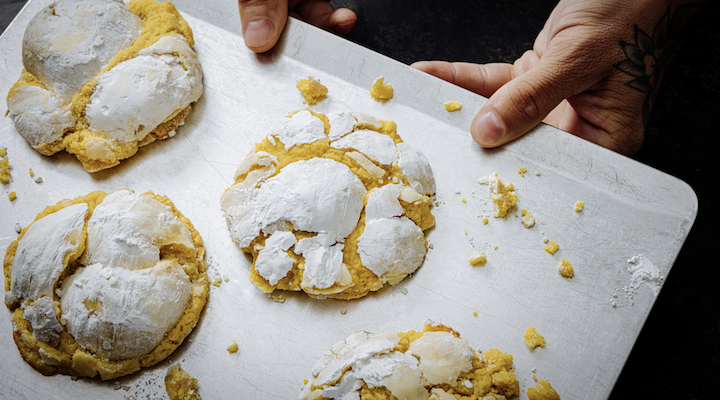
Much like a sought-after sneaker, Last Crumb’s customers, including model and cooking influencer Chrissy Teigen, scrambled to get their hands on hot new drops like Donkey Kong, a banana cream pie-flavored treat, and show off their haul in eye-catching social media posts, which helped generate further attention for the brand.
Since 2023, the brand has transitioned to a more evergreen model, allowing customers to order a six- or 12-cookie box for $90 or $140, respectively.
Yet, the hype around these cookies doesn’t just come from their exclusivity or apparel-inspired drop model.
Every cookie is built from scratch with its own dough, its own compound butter formulation and its own bake temperature. This means there is no shared base dough, which is standard practice for most cookie operations. Cookies are also baked the same day and served from individual warmers calibrated per flavor.
The full process takes three days, and all caramels, creams, fruit compounds and pastes are made in-house. Here, Derek Jaeger explains how hype marketing, scarcity and social media helped build Last Crumb.
Building hype through scarcity
Inside Retail: How did you come up with the initial concept for your brand?
Derek Jaeger: We started about five years ago in Los Angeles, and it was more like a side project.
I’ve been baking and in and out of kitchens for 20 years, but my real background was in marketing.
It was during the pandemic that I was getting a little antsy and really putting together a business plan. The goal was to bring something to cookies that nobody had done before. I took a lot of inspiration from fashion brands like Kith and Supreme and really liked the drop model.
We were the first food brand to take a drop model directly to the consumer.
The inspiration was also to build the highest-quality cookie brand on the market, from packaging to ingredients to flavors, and that’s where it all started.
We did our first drop in 2021, and it took off pretty quickly from there.
IR: Before launching the first drop, how did you build momentum for the brand?
DJ: What we saw with most brands out there was that everything felt very mom-and-pop, all blues and pinks and these very “feel-good” brands. We wanted to be completely off-the-cuff and edgy from the beginning.
Our cookies take three days to make. They are very intricate and detailed, and we stood behind that with confidence. If people were tripping out about our price point, we knew we could stand behind a great product.
We had a very small kitchen in the beginning, less than 1,000sqft, so we could only make about 100 boxes a week. We initially gained traction in week three when Chrissy Teigen found out about our cookies, got her hands on a box and organically posted about it.
In the next few weeks, we would sell out within seconds. In week 10, we left almost over 1,000 orders in the cart because we couldn’t fulfill them. It was a crazy time, and nobody really knew what we were doing.
People were posting their receipts showing they got a box from Last Crumb, and that’s when we knew we had a pretty viral moment on our hands and needed to capitalize on it.
Expanding beyond the drop model
IR: How did you get past those logistical issues in the beginning?
DJ: It was just about getting our supplies in line and expanding the team in the small kitchen we had.
Even though we left some money in the cart, we were happy to continue with the momentum we had built and were eventually able to move into a bigger space.
By that point, more people had started adopting the drop model, and that’s when Last Crumb started pivoting and thinking of new ways to expand the brand.
For example, gifting is our biggest pillar today; approximately 60–70 per cent of our boxes are given as gifts. We were also able to expand our corporate sales division and slowly grow with a more evergreen model.
Why New York became the next step
IR: Why did you decide now was the right time to launch a brick-and-mortar store?
DJ: We wanted to open a store for a while. I knew I didn’t want to open the first one in Los Angeles.
To me, New York has always been the place where I wanted to set up the first store.
New York has one of the most food-centric communities in the world, and brands go there just to make a name for themselves.
If New Yorkers don’t like a product, they will tell you immediately, and it is those types of people who honestly deserve to have the first Last Crumb store.
We moved our whole production facility from Los Angeles to Brooklyn in 2025 and ended up finding a store that’s just a mile away from it, so we’re pretty excited to have the first store there.
IR: What piece of advice would you give to the day-one version of yourself on your brand-building journey?
DJ: Not to listen to the noise.
Once there are more people involved, you can kind of stray away from your own goals.
My advice would be to trust yourself from day one, as you’re around the brand more than anybody else, and to stay confident in your decisions.