
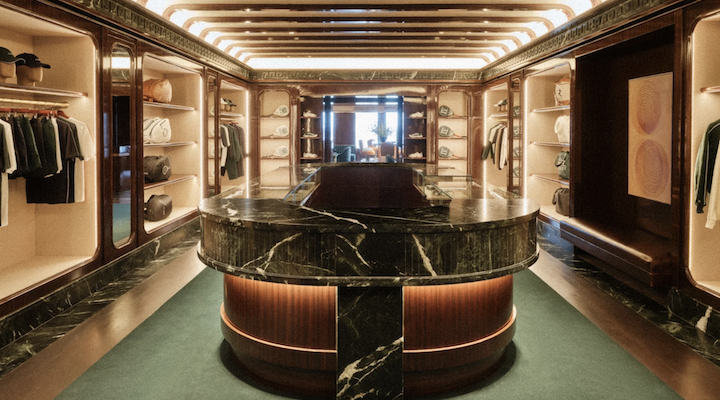
From personalized shopping sessions to hosting money can’t buy-level experiences, luxury retailers have been throwing out one strategy after another to capture the attention of the increasingly elusive one per cent shopper. One measure working more effectively than others is private membership clubs, with reports suggesting that there are nearly 3,900 operating in the US alone, generating $32.6 billion in annual revenue. Now luxury shopping districts and high-end retail players are get
re getting in on the act, launching their own exclusive paid-membership programs to attract high-end shoppers.
Examples include the Moore Club in Miami’s Design District, which has a one-time initiation fee and annual dues of $5,000 each, and New York-based fashion and lifestyle brand Kith’s launch of the Kith Ivy program earlier this year, with a rumoured one-time initiation fee of around $36,000 plus $7,000 in annual dues.
Charlie Koniver, a partner at Odyssey Retail Advisors, a luxury retail advisory group, delved into the reasoning behind why more consumers are gravitating to these high-priced membership programs.
“Private-membership clubs have flourished because they offer something the broader luxury retail market is struggling to deliver right now: consistency, community and exclusivity,” he told Inside Retail.
Over the past three years, as luxury brands faced inventory and traffic challenges, Koniver added that members’ clubs have quietly become traffic drivers, pulling high-net-worth individuals into prime shopping districts and creating reliable patterns of engagement for landlords and retailers alike.
As such, landlords in markets like Dallas, Miami, and Los Angeles have started treating these private-membership clubs like the next-gen department store, designing entire tenant mixes around who’s sipping martinis behind the members-only doors.
Why private-member clubs are the key to the luxury consumer’s heart
“Traditional retail is under pressure from shifting consumer habits and global uncertainty, but clubs flip the script by providing curated, intimate spaces that wealthy consumers can trust.”
To corroborate Koniver’s claims, research conducted by Curamando, a management consulting company, revealed that 86 per cent of affluent consumers surveyed engaged in at least one member program and have a higher redemption rate than other income brackets.
Additionally, theresearch showed that 78 per cent of affluent individuals consider member programs a vital aspect of their brand relationships, surpassing the average among all consumers.
“For today’s high-net-worth individuals, exclusivity has become a form of currency. Membership provides both status and a private escape from the public sphere,” said Koniver.
“Clubs like The Moore Club in Miami demonstrate how pairing accessible spaces, such as restaurants or galleries, with exclusive member-only areas creates cultural buzz while still maintaining the sense of privilege that members are seeking.”
This September, meanwhile, Kith announced that it would be launching a private membership program located in the heart of New York City’s West Village at 120 Leroy Street.
Billing itself as a “wellness and padel club”, Kith Ivy plans to offer a shop with its own product line, as well as members-only merch, rooftop pickleball padel courts, a spa designed by Georgio Armani and an Erewhon juice bar. (The first to be located outside of the Erewhon locations, which are currently solely based in California.)
Kith Ivy marks the brand’s first-ever formal foray into the hospitality space, and judging by the attention it has already generated from publications like Forbes, Hypebeast and Highsnobiety, it would seem that the New York-based space will be the first of several to open in the years ahead.
Koniver predicts that private-membership spaces will continue to flourish within the retail sector, as they consistently attract high-net-worth individuals to prime shopping districts and create reliable patterns of engagement for landlords and retailers alike.
What factors go into a top-tier private-membership retail program
Koniver broke down several key elements that are behind a successful private-membership retail program, including:
Location
“Private clubs thrive when they are embedded within strong retail or cultural districts, where they not only draw from existing foot traffic but also elevate the ecosystem around them,” said Koniver.
“Membership clubs perform best in luxury shopping centers, cultural districts and destination neighborhoods – areas where affluent consumers already shop, dine, and socialize.”
For example, locations like Highland Park Village in Dallas and the Miami Design District demonstrate how clubs can transform transitional or underperforming spaces into high-value destinations. Ultimately, the ideal setting balances accessibility with curation, attracting steady traffic while preserving the exclusivity that defines the club experience, said Koniver.
Programming
“Members aren’t simply looking for a lounge. They expect layered experiences that include fine dining, cultural events, art, wellness offerings and a sense of insider access. Soho House set the standard here, while clubs like Park House in Dallas and The Moore Club in Miami are redefining the model through architecture and design.”
Balancing community with exclusivity
“The most effective clubs strike a delicate balance between public and private. By incorporating public-facing elements such as a ground-floor restaurant or gallery, they create visibility and community integration, while the exclusive upstairs spaces preserve the sense of cachet that members crave.”
The retailers and landlords who embrace this formula – spaces that are both aspirational and functional – are the ones seeing or expecting to see the most success in attracting and sustaining high-net-worth traffic.