
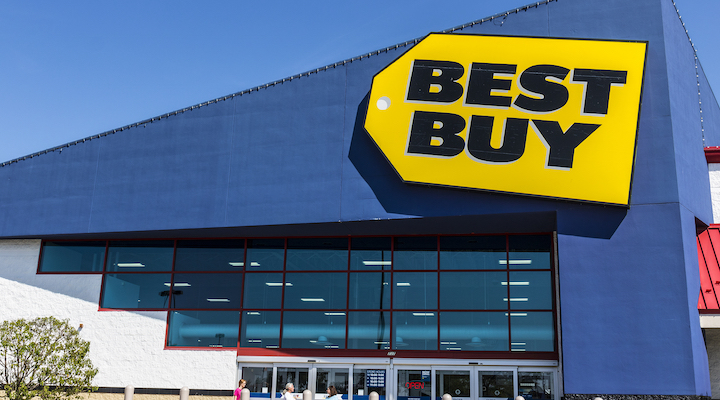
Best Buy has reported a 7.1 per cent decline in US sales in the second quarter to July 29 to $8.89 billion.
The decline was primarily from falling demand for appliances, home theater equipment, computers and mobile phones, falls offset in part by growth in gaming.
The company’s domestic gross profit ratio was 23.1 per cent compared with 22 per cent a year ago due to higher product margin rates and improved financial performance of its membership products.
International revenue of $693 million was down by 8.8 per cent year on year, comprising a 5.4 per cent decline in sales and a negative currency effect, while operating income of $19 million was down by $9 million at the same time last year.
While Best Buy CEO Corie Barry said the results were at the higher end of the company’s outlook and “better than expectations”, analyst Neil Saunders, MD at GlobalData, said that “does very little to make them less gloomy”.
Saunders said this quarter’s sales decline came off the back of a big decline in the prior year and that over two years, second-quarter revenue has declined by almost a fifth.
“There is one small crumb of comfort in the fact that compared to the same period in pre-pandemic 2019, sales are up by 0.5 per cent. This, however, is a very modest gain and given the inflation in costs and overheads, it essentially means that the company has gone backward.”
While acknowledging the electronics retailer’s problems were largely outside of its control, he said the company needed to make its large stores work better financially – “and that means making a greater effort to draw in more shoppers”.
A ‘tight spot’
“Best Buy in a tight spot. The company is well-operated and run, so the impact on finances, while bad, has not been catastrophic. However, Best Buy needs to work harder – particularly through its shops – to create more interest and excitement, especially around new and emerging technologies.”
Barry said Best Buy’s figures reflect a consumer electronics industry that remains challenging due to the pull-forward of demand in prior years and the various macroeconomic factors that we are all too familiar with.
“That said, we continue to expect that this year will be the low point in tech demand after two years of sales declines. Next year the consumer electronics industry should see stabilization and possibly growth driven by the natural upgrade and replacement cycles and the normalization of tech innovation.”
Saunders identified several “particularly significant forces” that are conspiring against the company.
“Foremost among these is the cost-of-living crisis which has reduced the spending power of consumers. While it is easy enough for households to squeeze in clothing or beauty purchases as an indulgence, the same is not true of electronics. The blunt truth is that many consumers have neither the time nor the confidence to buy big-ticket items like televisions, even if they wanted to.
“Unfortunately, this looks like it will persist for the foreseeable future and may get more pronounced in the second half of the year as student loan payments resume and interest rates continue to rise. Best Buy’s view that demand will start to strengthen as the company moves into next year is possible, but perhaps a shade optimistic.”
He said the other economic problem comes from the housing market which, in terms of the number of people moving, remains in the doldrums, dampening demand for appliances as fewer people undertake remodeling projects.
“This is one of the reasons appliance sales are down by a sharp 16.1 per cent within the US part of Best Buy’s business. That said, we also believe there has been a loss of market share here as while sales of appliances are also down at Home Depot and Lowe’s their decline is not quite so sharp.”
These factors were leading to a reduction in footfall because with consumers not in the market to buy electronics, there is little reason to visit Best Buy.
“So Best Buy not only loses out on the big-ticket buys but sales in smaller value areas like accessories and cables also weakens,” said Saunders.
“Other non-specialists selling electronics, like Amazon, Target, and Lowe’s, at least drive traffic for other reasons and have a greater possibility of converting someone to buying electronics products.”
Best Buy also faced the challenge that the purchasing cycle for electronics was knocked out of kilter during the pandemic as people pulled forward purchases. “We agree with management’s view that this will lead to a natural pickup in demand at some point in the future, but we are more cautious about the timing,” he concluded.