
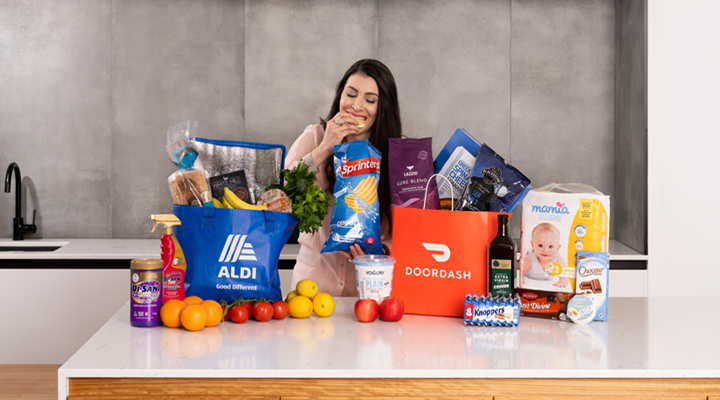
Aldi has long stood apart in Australia’s fiercely competitive supermarket sector by boasting low prices and no frills, minimal marketing. But the German-founded supermarket chain is entering a new era that embraces convenience, without compromising its core identity. In a move few would have predicted a decade ago, Aldi Australia has launched its debut grocery delivery trial, partnering with DoorDash to offer on-demand shopping for Canberra customers. Starting July 8, consumers in the ACT ca
ACT can use the DoorDash app or website to order from a range of more than 1800 Aldi products – from fresh produce and meat to household essentials – and have them delivered directly to their door.
While limited in scope for now, the trial marks a significant strategic shift for a business that has historically kept digital channels at arm’s length. It also raises a bigger question: how does a brand like Aldi, famed for its simplicity, adapt to a world where omnichannel is no longer optional?
“Since entering the Australian market, Aldi’s mission has been to deliver high quality groceries at the lowest prices for Australian households, and this ambition remains as strong as ever,” said Jordan Lack, chief commercial officer at Aldi Australia, in a press release.
“We’re thrilled that customers in Canberra will be able to shop with Aldi from the comfort of their homes, bringing our ‘Good Different’ shopping experience to more and more people in the tap of an app,” he added.
Convenience without breaking the model
Aldi’s approach to the trial is measured. Rather than build out costly logistics infrastructure or e-commerce capabilities in-house, the retailer has outsourced the complexity to DoorDash. Dashers (DoorDash’s delivery contractors) will pick, pack and deliver orders from local stores, a model that allows Aldi to maintain operational efficiency and cost control.
This third-party approach is capital-light but also means the trial can scale quickly if successful, without the burden of warehousing or internal fulfilment logistics.
“We know Australians will rejoice at the news of Aldi taking our first step in offering customers this convenient shopping format,” said Lack. “We will be watching our Canberra trial very closely with plans to scale in the near future.”
A broader evolution in motion
Teresa Sperti, founder and director of digital consultancy Arktic Fox, says Aldi’s foray into e-commerce reflects broader shifts in how Australians shop for groceries and what they’ve come to expect from retailers.
“With online grocery retail sales now representing a double-digit share of total grocery sales in Australia, the market has reached a tipping point — pushing brands like Aldi to develop an e-commerce proposition to remain relevant,” she said.
While Aldi’s decision to partner with DoorDash preserves its famously lean cost base, Sperti said the model poses both strengths and strategic limitations.
“True to its low-cost DNA, Aldi has opted to partner rather than invest in building its own e-commerce capabilities – leveraging DoorDash to facilitate online shopping. While this approach preserves Aldi’s lean operating model, it comes with both advantages and drawbacks,” she said.
According to Sperti, Aldi’s model is unlikely to build the same customer loyalty as major supermarkets, which use first-party data to personalise experiences. Shoppers often begin online orders with past baskets, helping retailers understand preferences and drive repeat sales.
“In Aldi’s case, DoorDash owns the basket and the customer relationship, not Aldi. While deeper integration may evolve over time, it represents a significant missed opportunity to build direct loyalty and data assets,” she said.
There are also potential challenges around pricing transparency, which is a crucial cornerstone of Aldi’s brand.
“There are also lessons from early online grocery retailing that Aldi will need to navigate carefully. One of the most important being price parity,” Sperti said.
“Historically, grocery and supermarkets here and abroad offered different pricing in-store vs online, which eroded customer trust. Aldi’s products on DoorDash come with higher prices, plus delivery and service fees. While Aldi maintains that its base pricing advantage still makes it the most affordable option for online grocery shoppers, this claim may not stand up to scrutiny. Over time, it risks diluting Aldi’s hard-won reputation for low prices – potentially impacting broader brand perceptions and eroding trust in purchasing their products online,” she added.
Unlike its rivals, Coles and Woolworths, who spent years building expansive e-commerce and delivery arms, Aldi’s evolution has been slower but seemingly deliberate. Each digital move, from checkout upgrades to delivery trials, has been tightly scoped and operationally efficient.
The trial follows Aldi’s adoption of self-checkout kiosks, starting in 2021 with 10 stores across New South Wales. The company stated it would “closely” monitor the trial before deciding on a national rollout.
This marks another move once considered off-brand for a retailer defined by thin margins and high staff productivity; not a departure from its identity, but a reshaping to meet modern expectations.
In this light, ‘Good Different’ is about choosing the right change.
Testing customer appetite
For a brand that’s built loyalty through consistency, Aldi’s shift into digital territory may seem surprising. But viewed through a strategic lens, it’s both pragmatic and prescient.
Last-mile delivery could open the door to new customer segments such as busy professionals, young families and urban dwellers who value Aldi’s low prices but lack the time to visit in person.
Moreover, it allows the company to compete on convenience while retaining its cost-efficient setup. By partnering with DoorDash rather than building in-house capabilities, Aldi gains flexibility without the financial burden of infrastructure, a playbook pioneered by Aldi and favoured by cost-conscious retailers globally.
The ACT trial will test not just operational feasibility, but customer appetite, and the question remains if Aldi can maintain the magic of its in-store treasure hunt online, or preserve its low prices while sharing the margin with DoorDash.
The answers will shape the next chapter of Aldi’s Australian story. But if the delivery trial succeeds, it will prove that even a brand rooted in convention can be agile on its own terms.