
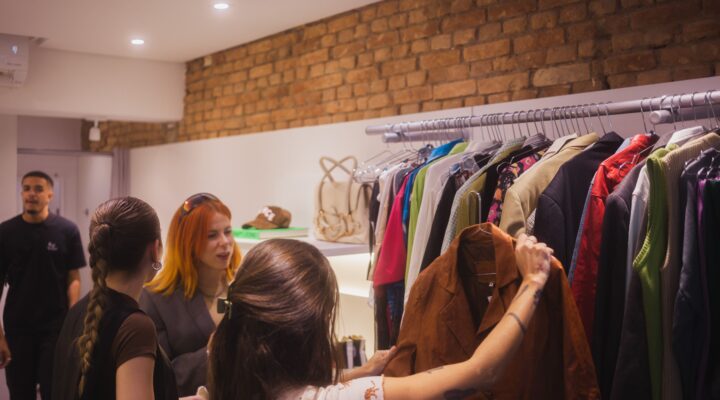
I am an avid Depop shopper. I started as a thrift shopper, thanks to my mom, who passed on her love of all things second-hand. In many ways, I’m like a regular shopper. I buy things I love, wear them, but instead of passing them on to the thrift store when the love is gone, I’ll sell them on Depop. Or, if it’s my kids’ stuff, on Facebook Marketplace, sometimes Ebay if we’re talking basketball gear. Second-hand shopping has become my default. And I’m not alone. According to a study by
udy by Ebay, nearly half of those surveyed reported increased purchases of pre-loved fashion, which is great for the planet but also carries a message for retailers.
Resale is big business. And it’s only getting bigger, with the cost of living continuing to bite into all of our wallets.
So what can mainstream retail brands take away from all this?
The feel-good factor
Buying second-hand has a feel-good factor. It’s virtuous and gives shoppers bragging rights. You feel good because you’re not contributing to overproduction, and you are extending the life of something that already exists.
Brands such as Spell have already cottoned on to this with reSPELL, a peer-to-peer resale platform where fans can buy and sell pre-loved pieces, with each listing verified through the platform.
Similarly, Assembly Label’s Re-Worn program takes back old pieces and channels them through the brand. Lorna Jane Preloved lets customers send in used activewear, which the brand reviews and relists. Nudie Jeans takes back worn denim, repairs it, and resells it. Country Road runs a fashion trade program in partnership with the Australian Red Cross, offering customers a $10 voucher for donating pre-loved pieces.
There’s a massive opportunity for brands to own this space for their own products. But that’s not the only lesson Depop can share with retailers.
The strategy behind the Depop discount
As any Depop user can tell you, it pays to like products on the platform – literally. When a user “likes” something, the seller is notified and can offer a discount. Sellers can set this up to be automatic. List the product for $50, but anyone who likes it automatically gets an offer to buy it for $45. This means a $50 top becomes a $45 top, and suddenly, it looks even more appealing.
Liking products teaches Depop’s algorithm what you’re looking for, what size you are, and the simple act offers you more of the same in your feed. The more you like, the more you can discover. So it’s a win for the shopper and the seller.
It’s a clever approach that retailers could also adopt for product wish lists that shoppers compile. A targeted, automated nudge along the lines of: “You saved this three weeks ago, here’s 10 per cent off while stock lasts” would go a long way toward converting consideration into purchase.
Assembly Label already notifies wish list users when items are low in stock or have gone on sale, which is a step in the right direction. But the more powerful move is the proactive discount trigger: acting on expressed interest before the customer walks away. The wish list data is already there. The technology to act on it exists. The question is: why aren’t more brands using it?
Putting scarcity bias to work
In behavioral science expert Dan Monheit’s book The Why, he discusses how we have a psychological tendency to place greater value on things that are rare or limited. You only need to look as far as the Labubu trend to see that it is one of the most powerful forces in consumer behavior.
Most of the products on Depop are one-offs because they’re someone’s second-hand things. You can’t guarantee there will be another. So the buyer starts off the shopping journey in a scarcity mindset.
Depop goes one further and makes the prospect of not getting “the thing” visible: you can see how many people have already made an offer on a listing, and how many have it sitting in their cart right now.
Some mainstream retailers already employ this tactic to show remaining stock and how many people have purchased the item. But another way to put scarcity bias to work would be to take a risk on some products and make fewer of them. It’s better for the planet and great for the brand to have special, scarce editions.
The meteoric rise of platforms like Depop isn’t just a fluke of the internet. When you break it down, it’s a masterclass in consumer psychology. By tapping into the emotional high of sustainable shopping, using data to nudge buyers proactively, and leveraging the powerful urge of scarcity, resale platforms are rewriting the modern retail playbook.
Mainstream retailers don’t need to fear this shift, but they can learn from it. The tools, the data, and the eager audiences are already there. It’s time for brands to take a page out of the second-hand book and turn these psychological insights into their next big win.
Lucy Seward is the head of marketing at media agency Hatched.