A plush stuffed bagel retails for $30 and has a mile-long waitlist. A pastel-wave mirror with chunky, candy-colored curves has spawned an Amazon dupe category and landed its designer a global Ikea collaboration. What, may you ask, do these products have in common? They both epitomize a growing trend in retail known as “whimsymaxxing” – the deliberate maximization of playfulness, wonder and childlike joy across fashion, home and lifestyle. This trend has moved from a niche TikTok hashtag to
to one of the most commercially significant consumer orientations in retail today.
Once ironic, now sincere
Whimsymaxxing fuses a cultural embrace of whimsy with the “maxxing” suffix associated with online self-optimization culture. The term started circulating on TikTok around 2023 in ironic meme contexts before turning sincere by 2025.
The critical element is that whimsymaxxing isn’t a look, it’s a lens.
In comparison to other popular aesthetics like “cottagecore”, which prescribes a rural-romantic lens, or other trends like “maximalism” and “dopamine dressing”, which focus on visual density and creating a color-driven mood-enhancing strategy, respectively, whimsymaxxing, in contrast, refuses aesthetic boundaries entirely.
The unifying thread among these trends is intentional enchantment – treating everyday life as a canvas for wonder. Essentially, it’s optimizing the un-optimizable.
Why it’s happening now
Whimsymaxxing sits at the intersection of structural forces, which is why it’s more durable than the typical microtrend.
Post-Covid, a rediscovery of play has hardened into permanent consumption patterns. Additionally, economic precarity has driven Gen Z toward micro-joy consumption, such as buying themselves a “small treat” at least once a week and often regarding these purchases as a form of self-care.
The home has also become a new canvas: Pinterest’s 2026 trend report flagged “Circus House” as a defining interior design direction, with “vintage circus aesthetic” up 70 per cent, year on year, and “circus interior” up 130 per cent in searches from the year prior.
WGSN, one of the world’s leading consumer trend forecasting agencies, has noted an increasing interest in search terms like “awe”, “imagination”, “glimmers”, “strategic joy” and “return on joy”, a playful spin on the corporate term “return on investment”, or ROI, in the past few years.
In August 2025, Mintel, a leading global market intelligence agency, found that 47 per cent of US consumers believed that the emotional value of an item was just as important as its functional value, such as quality and price, when making purchasing decisions.
Here, we list the brands getting it right.
Jellycat: experience as product
Let’s look at Jellycat, a London-based luxury plush toy brand known for both standard fare items, like bunnies and bears, and more food-inspired SKUs, such as a plush birthday cake or piece of brie.
Jellycat has managed to capture the hearts and wallets of adults and children alike, with revenue hitting £333 million (about $449 million) in 2024, up 66 per cent from the year prior.
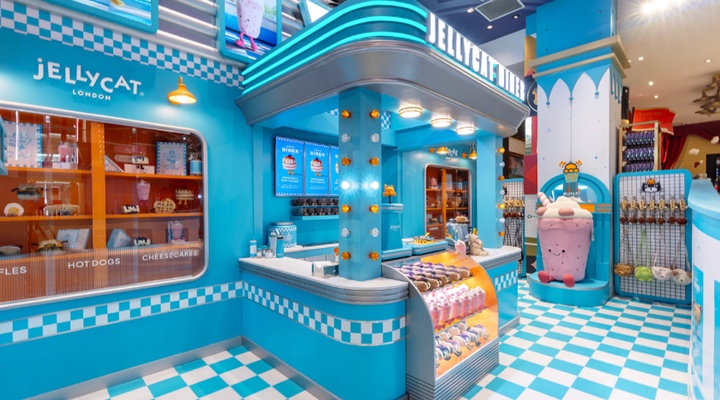
The vehicle for this impressive sales growth was the brand’s approach to live activations: the Jellycat Diner, a theatrical pop-up format launched at toy store FAO Schwarz that has since expanded globally to include a fish-and-chips shop at Selfridges and a patisserie in Paris.
Jellycat’s staff perform elaborate theatrical “cooking” of plush food items, turning the purchase into an enjoyable performance.
Location-exclusive products that help create a sales-inducing form of FOMO, and the in-store activities that create moments engineered to be filmed, help turn the brand’s 150,000-plus TikTok creator base into a remarkably successful marketing department.
Additionally, by placing pop-ups in adult retail environments rather than child-oriented toy stores, Jellycat has given adults a sense of cultural permission to buy plush toys for themselves.
Crocs: whimsy as a platform
At the more accessible end of the pricing spectrum, Crocs offers the most instructive case for retailers looking to tap into the whimsymaxxing trend.
On its face, the brand’s underlying product is a rather unfashionable utilitarian clog. Yet the brand has built itself into a multibillion-dollar business by treating that clog not just as a shoe but as a canvas. The Jibbitz charm system – snap-in pieces that personalize each pair – converted a closed product into an open one and a one-time purchase into an ongoing purchasing cycle.
While the brand’s wide range of collaborations, ranging from Balenciaga to McDonald’s to “Shrek”, offers a fresh permission slip for self-expression, it also gives customers a fresh reason to repurchase.
Crocs’ customers don’t justify the purchase of these products solely through their utility; that’s the point.
This footwear brand has proved that whimsy isn’t a luxury positioning or simply a way for adults to purchase products within the children’s category – it’s a horizontal strategy that works at scale for retailers across the shopping spectrum.
Gustaf Westman: when whimsy moves indoors
Gustaf Westman, the Stockholm architect-turned-designer whose studio opened in 2020, has become the reference point. His chunky, candy-colored mirrors, blob-shaped sofas and oversized ceramics are the visual lexicon of the moment, replicated everywhere from Pinterest boards to TikTok room tours to entire Amazon dupe categories.
In 2025, Westman closed his first mass-market collaboration with Ikea – a 12-piece tableware collection – alongside a Mercedes-Benz “Chunky Car” pop-up in London. A made-to-order studio with cult-collector pricing now feeds a global aesthetic at every price tier beneath it.
Trends like “Circus House”, “afrobohemian” and “magical wildness” aren’t separate; they’re variations on the same instruction – to stop being neutral.
Retailers in furniture, tabletop and lighting are seeing what fashion saw 18 months ago: emotional value products outperforming functional equivalents at every price point.
Westman’s pieces are designed to be photographed and read in a thumbnail. They have deliberately been placed next to fashion, automotive and hospitality, rather than inside conventional home retail – the same context-as-permission move Jellycat made with adult stores.
What retailers need to do
Whimsymaxxing is not a mandate to slap pastel colors on the packaging. It signals that the emotional value equation in retail has fundamentally shifted.
To tap into this trend effectively, retailers will need to:
Redesign the ROI framework to include a “Return on Joy”.
Mintel’s finding that 47 per cent of consumers equate emotional and functional value is a purchasing behavior data point, not a soft observation. Audit your assortment through a joy lens: Does this product spark delight? Does this store moment create a shareable memory?
Build for shareability, not just shoppability.
Every brand winning here is designed for documentation and sharing. Identify your camera moment – the point in the customer journey where someone instinctively reaches for their phone. If it doesn’t exist, create it.
Let creative conviction show.
The worst version of this trend is a brand committee deciding bows and pastels will resonate with Gen Z. The best version is finding a creative voice that genuinely believes in playfulness and trusting it enough to be uncomfortable.
Make context grant permission.
Context signals permission; store design, merchandising adjacencies and brand partnerships create environments where adult playfulness feels natural rather than infantilizing.
The unserious economy is serious business
Global marketing research firm NielsenIQ confirmed that Gen Z’s spending power is projected to reach $12 trillion by 2030 and is expected to eclipse that of boomers by the end of 2029. This generation doesn’t separate emotional value from economic value. For them, feeling something is the product.
In an era of algorithmic fatigue and economic anxiety, the scarcest resource isn’t attention – it’s enchantment. Jellycat, Crocs and Westman aren’t selling plush toys, foam clogs or chunky mirrors. They’re selling permission to feel wonder.
Retailers that internalize whimsymaxxing won’t just ride a trend cycle – they’ll build the kind of emotional loyalty that survives long after the algorithm moves on.
Naomi Omamuli Emiko is the founder and owner of TNGE, a growth studio built to accelerate beauty and wellness brands.