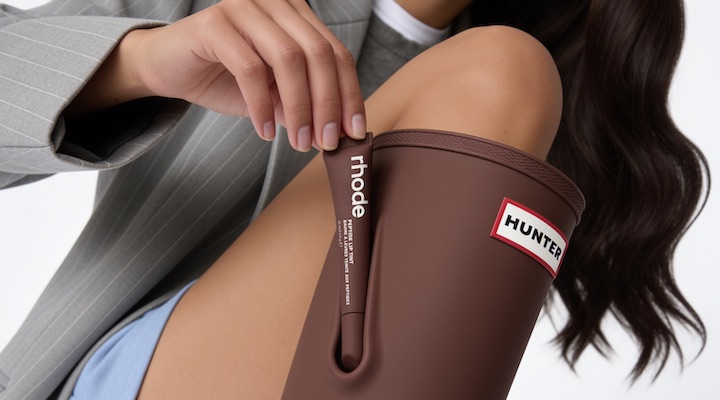
When AI studio Clauré Studio shared a concept of Hunter boots with a holder for Rhode lip gloss this week, some consumers actually wanted to buy it. For retailers, that enthusiasm presents both an opportunity and a problem. AI-generated concepts can reveal what shoppers want, but social media buzz is no guarantee of sales – and imaginary products can create expectations real ones struggle to meet. Why the imaginary pairing works Retail brand strategist and marketing consultant Bethany Paris R
y Paris Ramsay said the imagined Rhode x Hunter collaboration gives people something unexpected but recognizable. A rain boot with a lip gloss holder initially gets a “What are we doing?” reaction, but plenty of people had a similar response to Rhode’s phone case.
The idea may seem excessive at first. But unexpected details can make a product instantly recognizable and give people a reason to talk about it.
“My read is that the interest reflects how closely beauty and personal style have become connected,” Ramsay told Inside Retail. “People enjoy seeing a favorite beauty brand show up beyond their bathroom or makeup bag, especially through something playful that they can wear or carry. This concept gives them a new way to imagine participating in Rhode’s world.”
AI makes these imagined pairings easier to bring to life, but Ramsay said there is still a creative idea to assess.
“Designers have been making mockups and imagining brand collaborations for a long time,” she said. “AI makes those concepts easier to produce and convincing enough that people can mistake them for an actual launch, but there’s still a creative idea to evaluate: does the pairing make sense, does it feel true to both brands and does it get people excited?”
The appetite for imaginary products has a parallel in beauty. In 2025, makeup brand Colourpop Cosmetics ran an April Fools’ Day prank teasing the release of a dill pickle-flavored lip balm. It went viral, prompting customers to request a real version. ELF Cosmetics and Burt’s Bees delivered their own limited-edition releases in 2026.
For retailers assessing an AI concept, Ramsay recommended examining what consumers are responding to: are people asking where to buy it? Do they love the pairing, the colors or the novelty of the holder These details can help brands decide whether there’s a real opportunity. “The most interesting response would be to bring the creator into that exploration and see how far the idea can go,” said Ramsay.
Turning interest into demand
Frankie Margotta, strategy director at consulting firm Triptk, sees these concepts as a way to gauge consumer interest. “The AI of it all is a good use case for how quickly brands and consumers can now concept and visualize ideas to gauge interest,” said Margotta. “In that sense, these viral mockups become another form of unsolicited research and signal capture.”
“The caution is mistaking interest for intent,” he added. “Liking or sharing an image is very different from joining a waitlist or putting money behind a preorder, and the ease of generating these concepts may eventually make those signals even softer. Consumers who know something was AI-generated may treat it more casually because they understand how quickly it could have come together.”
Some attention also comes from people finding the concepts amusing or ridiculous, Ramsay cautioned. “For retailers, the opportunity isn’t to jump on every viral AI concept,” Margotta said. “It’s to listen to what those concepts reveal about consumer interest, validate whether that interest translates into real demand, and then decide whether there’s an opportunity to turn imagination into something tangible.”
There is also a risk that real products will fall short of the digital fantasy. When the Swatch x Audemars Piguet “Royal Pop” collaboration was unveiled, many consumers were disappointed by the designs compared with the AI-generated predictions.
For consumers who don’t know a concept is AI-generated, Margotta said, discovering that the product never existed could cause disappointment and affect their willingness to engage next time. Clear policies and communication around AI-generated material are therefore vital, whether retailers create the content themselves or respond to concepts created by others.
“Generative AI can visualize almost anything, including products that can’t actually be manufactured as represented,” Margotta warned. “Retailers need some understanding of how they’ll respond when those concepts gain traction, especially if they decide to participate in the virality. If a brand signals that something could become real, it needs to know there’s a credible path toward making it real. Otherwise, the attention comes with a risk of leaving consumers feeling hoodwinked and eroding trust.”
“As more of these concepts enter the feed, they’ll contribute to an already noisy landscape that consumers have to filter,” he added. “Creating an impressive AI mockup isn’t particularly differentiating when everyone can do it, and consumers will have less reason to assume that what they’re seeing is real or even possible.”
That will place a greater premium on actual prototyping and innovation. As visualizing an idea becomes easier, proving that a brand can build the physical product will become more meaningful.
Further reading: Why AI may make retail’s frontline employees more valuable, not less