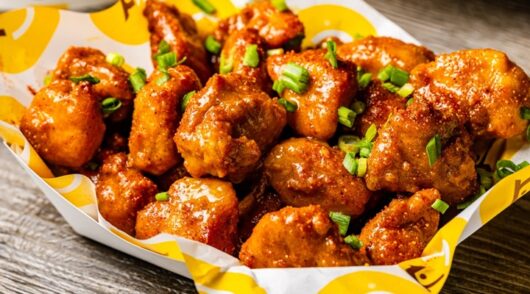
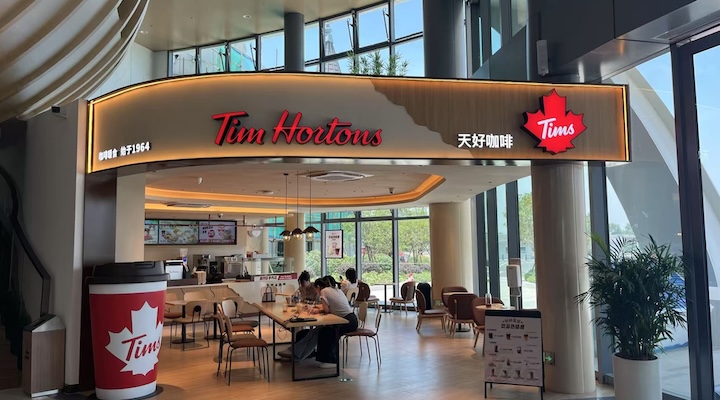
The operator of Tim Hortons in Mainland China, Tims China, has reported mixed third-quarter results as higher system sales and franchise growth helped offset softer revenue from company-operated stores. Revenue for the quarter slipped 0.4 per cent year on year to RMB358 million ($50.3 million) due to store closures. Meanwhile, same-store sales turned positive again for company-owned outlets, up 3.3 per cent. In comparison, food revenue contribution hit a record 36.5 per cent, buoyed by the bra
he brand’s expanding lunch platform and differentiated ‘Coffee + Freshly Prepared Food’ strategy.
Amid intensifying competition, rising delivery costs and consumers who are simultaneously more price-sensitive and more demanding, Tims China is now focusing on tightening operational discipline and scaling the business through franchising rather than corporate expansion.
A market at peak competition
During the company’s earnings call, Tims China CEO Yongchen Lu described a summer season defined by “record high temperatures” and a fiercely contested beverage market. Not only are coffee chains battling for share, but China’s leading tea brands are moving aggressively into coffee, creating a two-front competition for caffeine and wallet share.
Against this backdrop, Tims China positioned the third quarter as an “offensive strategy,” rolling out trending beverage innovations such as Cold Brew Blue and leveraging milk innovations like Water Buffalo Milk blends to reinforce its coffee credentials. But importantly, the company also introduced non-coffee SKUs to compete directly for tea drinkers. As Lu emphasized, “This dual-track approach resonated strongly with our target demographic.”
“Following six months of focused product development, we proactively adapted our food strategy in the third quarter to counter seasonal softness by introducing six new SKUs featuring chilled and indiscernible options to stimulate consumer interest and maintain meal relevance.”
July became the company’s highest sales month of the year, and the Bagel Festival, timed with a Gen Z celebrity collaboration, generated double-digit same-store sales growth in September.
Food becomes the differentiating factor
While China’s beverage players compete over increasingly narrow price and flavor ranges, Tims China sees an opportunity in meal occasions. Over “half of all orders now include food,” Lu noted, and food revenues grew 24.2 per cent year-over-year.
That is a material deviation from the model of most coffee chains in China, where food remains an afterthought or a low-margin add-on.
The ‘Light & Fit Lunch Box’ platform, launched earlier this year, appears to have been a turning point. It elevated meals as a core driver of traffic during the critical lunch window, a window many coffee chains fail to capture.
“As a result, food revenue contribution as a percentage of sales reached our historical high of 36.5 per cent,” Lu said.
This focus on food is also influencing store format decisions. With more than half of orders containing food and the company pushing into prepared-meal relevance, the model is shifting toward “made-to-order” (MTO) stores.
As of the end of September, 730 of Tims China’s 1030 stores were MTO, up from 84 in mid-2024.
Digital dependence
Ninety-one per cent of all orders in the third quarter were placed digitally, up from 86.6 per cent a year ago. This makes Tims one of the most digitally dependent beverage chains in the country, reflecting China’s deeply mobile-first consumer behaviors.
However, delivery has become a disproportionately large share of orders, up 20.9 per cent year-on-year. Delivery costs as a percentage of company-owned store revenues surged from 10.3 per cent to 13.2 per cent.
Shifting toward franchising
The company ended September with 479 franchised stores, up from 382 a year earlier, driving a 25 per cent increase in franchised and retail business revenues. Sub-franchisee profits increased 58.2 per cent, and franchisee applications exceeded 8400 since the program’s 2023 launch.
Unlike company-owned stores, which experienced a 5.5 per cent decline in revenues, franchised stores contribute to cash flow without dragging down corporate margins through operating costs, depreciation and delivery expenses.
The company highlights that sub-franchise payback periods average two to three years, a timeframe that is attractive enough to draw interest in lower-tier cities where beverage consumption is expanding rapidly. Tims China entered several new markets in the quarter, including Yanji, Yangzhou and Wuhu, extending its footprint to 91 cities.
Further reading: How Tims China is using food and loyalty to win over Chinese consumers.