
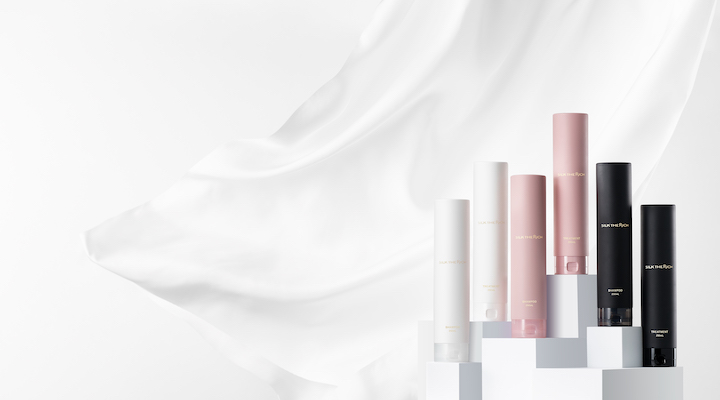
What started with humble beginnings – launching with four SKUs and selling just four bottles in its first month – has become one of Japan’s fastest-growing beauty brands. Today, Silk the Rich has sold more than two million products within its first year and is distributed through more than 10,000 retail doors across 189 countries. Now, the luxury haircare brand founded by Kodai Takahashi is setting its sights on the US market. Its success has been built around an ingredient more commonly a
only associated with fashion than beauty: silk.
When we think about silk in retail, the first thing that typically comes to mind is apparel made from this material, such as dresses or scarves.
However, silk also plays an important role in the skincare and haircare industries.
While many people associate silk with lightweight, luxurious fabrics, scientists, retailers and consumers alike have increasingly recognized its potential as an ingredient in high-quality skincare and haircare products.
Silk is a natural protein fiber primarily composed of two proteins: fibroin, its structural core, and sericin, a gummy outer layer. Although this outer layer has traditionally been considered a waste material in the textile industry, it is now recognized as a high-value by-product that can benefit skin and hair through its antioxidant properties and moisturizing capabilities.
One of the best-known brands in the US beauty industry to incorporate silk into its products is the American-born but Japanese-inspired brand Tatcha, which uses fibroin and sericin to nourish the skin barrier.
According to market research firm Fact.MR, the global sericin market is projected to expand from approximately $361.2 million in 2025 to $638.9 million by 2035, growing at a compound annual growth rate (CAGR) of 5.8 per cent. Much of that growth is expected to come from sustainable cosmetics brands seeking natural, traceable ingredients.
Inside Retail spoke with Takahashi about his unconventional path to becoming a beauty entrepreneur, how he built Silk the Rich from four bottles to millions of sales, and why he believes silk could become Japan’s next beauty export.
From dating app founder to beauty brand builder
These days, it is not unusual for retail entrepreneurs to take a non-linear path before launching a brand. Few, however, have taken a route quite like Takahashi’s.
The would-be brand founder studied computer science and business at Keio University. During his time there, he developed a dating app called For Student, designed for Japanese students looking for love using a unique group-matching system supported by AI recommendations.
After successfully growing the app over the following two years, Takahashi sold the business, giving himself both the capital and the opportunity to pursue his next venture.
Although he wasn’t sure what to build next, he knew he wanted to create a physical product, taking inspiration from globally recognized Japanese companies such as Toyota, Honda and Nintendo.
Around that time, Takahashi returned to visit his grandmother, who lived in rural Japan and owned a small beauty salon.
He said his grandmother, a lively 91-year-old, inspired him to enter the beauty industry.
“She inspired me to make something regarding beauty because she always told me that there are no good shampoos for people over the age of 60 and that there were too many chemicals in them. So I thought, ‘Ok, grandma, I will make something for you.’”
Takahashi also had another connection to the beauty world through his experience working as a model and television personality, including representing Japan at the Mister International 2024 competition.
Using countless hair and beauty products throughout those experiences, he found it difficult to distinguish between many of the brands.
“While I was not working in the beauty industry then directly, I had used a lot of beauty products as a talent. So that inspired me to create something for my friends and myself.”
That experience inspired him to create a haircare brand that would stand out by incorporating innovative silk-based ingredients into its formulations.
Bringing a centuries-old material to modern beauty
After connecting with people in the silk industry, Takahashi became interested in showcasing one of Japan’s historic export industries to a global audience through haircare.
The Silk the Rich founder explained that silk shares many similarities with human hair and skin. Its proteins – specifically sericin and fibroin – naturally contain 18 of the 20 standard amino acids, making silk an effective ingredient for both hair and skin health.
While silk is already widely used in the medical field, particularly for skin wound healing, Takahashi said he and his team spent considerable time educating consumers about its benefits in haircare while building the brand.
That lack of awareness extended beyond consumers. Takahashi said the team also initially struggled to market the brand effectively, resulting in sales of just four units during its first month.
However, after refining its approach and hiring experienced beauty industry professionals, the company quickly gathered momentum, selling more than two million units in Japan alone by the end of its first year.
By the end of its second year, the brand had reached roughly $10 million in revenue, and Takahashi estimates it will reach $25 million by the end of its third full year in business.
Taking J-beauty to the US
In addition to educating customers about the benefits of silk ingredients in haircare, Takahashi said the company’s expansion into the US has also required it to explain the distinctions between J-beauty and K-beauty.
At the same time, he believes the global rise of K-beauty has helped fuel broader interest in Asian beauty brands. That, in turn, has encouraged buyers from major retailers such as Ulta and Sephora to explore emerging J-beauty brands, including Silk the Rich.
“South Korea is really killing it with K-pop and K-beauty, so that has definitely affected [positively] us as a neighbouring country to them. When I do pop-ups, I get asked if we’re a K-beauty brand. I reply, ‘No, we’re a Japanese hair care company. Come try out our product.’”
As Silk the Rich continues to grow in the US retail market, Takahashi and his team are being selective about which wholesale partners they pursue.
Although the brand is positioned as a premium offering, its products retail at a relatively accessible price point of around $30 per SKU. Takahashi told Inside Retail he would prefer to partner with premium retailers such as Blue Mercury or Erewhon.
Beyond wholesale expansion, the brand also plans to open flagship stores that combine retail with salon services over the next few years. The first location is scheduled to open in Tokyo before the concept expands to cities including Singapore, Taiwan and Malaysia.
For now, Silk the Rich is focused on expanding its range across both the haircare and skincare categories. Its skincare lineup already includes three bodywash products, while the company is also exploring entirely new categories, including food and beverage.
Ultimately, Takahashi wants Silk the Rich to become a multi-category lifestyle brand centered on silk, so that whenever people search for the word “silk”, his brand is the first to appear.
If Takahashi succeeds, silk may become known for far more than scarves and dresses. Instead, it could become Japan’s next globally recognized beauty ingredient.
Further reading: How Sephora and Olive Young are building a K-beauty-powered retail alliance