
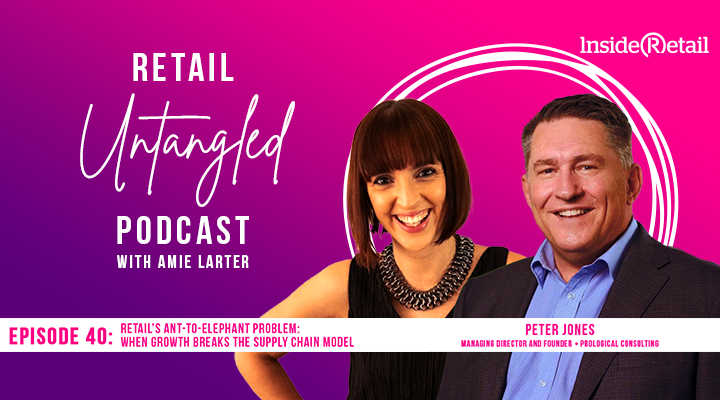
Supply chains rarely break overnight. Typically, warning signs begin with creeping inventory costs, harder-to-control warehouse labor, transport bills that exceed budget, or customers complaining about delayed or incorrect orders.
Peter Jones, MD and founder of Prological Consulting, explains that those factors are often symptoms of a bigger problem: The business has grown beyond the operating model that helped make it successful.
“The business that starts out small, nimble, and flexible can do amazing things, but the fact that it operates that way leads to success, and that success will kill it if it stays an ant,” Jones tells Inside Retail’s Amie Larter in the latest edition of her podcast series Retail Untangled.
The “ant-to-elephant” analogy captures a familiar retail problem. A business can move quickly when it is small, with people relying on experience, workarounds and informal knowledge to keep things moving. But as turnover, product ranges, channels and customer expectations increase, those same methods can become constraints.
“It needs to be reengineered,” Jones says. Instead, many businesses try to evolve incrementally, accumulating “lots of band-aids” rather than stepping back and redesigning how the operation works.
“Quite often you have got to peel those off to find out what’s really going on. Often we see something the size of an elephant that’s got six legs that look like ants’ legs, and the whole thing is shaking and vibrating under the pressure, alive and functioning, but barely.”
The numbers that reveal the symptoms
The first clues often show up in the metrics the CFO or COO watches. A sudden increase in inventory, warehouse labor, import or transport costs can prompt questions about what has changed.
Customer service can provide another warning, particularly when split or delayed orders start to increase. That can indicate issues with inventory accuracy or warehouse operations. But the underlying cause may sit several layers deeper in the supply chain.
Jones points to a Sydney-headquartered retailer that recently moved from a small warehouse into a much larger facility. Its incoming CFO suspected something was not right and asked Jones to investigate.
“Within five minutes of being there, I could see the culture of this place. A couple of young guys had got onto something good. They had gone from nothing to a national retail network and online site and built turnover to around A$45 million a year in a reasonably short period of time, by the skin of their teeth.”
The warehouse, located next to head office, reflected that rapid growth.
“There was stuff absolutely everywhere, inside and outside. If you needed to move a pallet from inside to outside, you needed to move other things to get to it.”
A few employees broadly knew where everything was, but the system depended heavily on their knowledge. Processing imported stock, deciding what to store or move, and allocating products to pick locations took too long, driving up labor costs.
More importantly, the operation had reached its limit, says Jones. “They could not grow any more running that sort of system in that facility.”
The retailer moved into a larger warehouse, completing the transition in six months. The result was not only a better-organised facility, but also the removal of an operational constraint that had begun to impact growth.
“I spoke to the CFO just the other day. How are things going? He said they are hitting better numbers than in their forecast because of the move, and their online business has taken off again because they can meet their online service commitments, whereas previously it was all over the place.”
There is no perfect supply chain
Retailers are tempted to look for the ‘perfect’ supply chain: The right inventory in the right place, arriving at exactly the right time and at the lowest possible cost.
In practice, Jones says, the challenge is making multiple variables work simultaneously.
“The ideal supply chain is where you know what your customer demand is going to be, and you can feed that all the way back to your suppliers with the right lead time so it lands where your customer is, exactly when they want to buy it.”
He illustrates his point with the example of socks: Metadata shows that a retailer sells three pairs of ankle-height brown woollen socks in Australia each year. So, where are those socks needed and when? The store does not want six pairs because it would be carrying two years’ inventory, and it does not want two pairs because it would miss a sale. If the socks are sold in Victoria and Tasmania but were landed in Perth and Sydney, now it has to freight them further to the customer.
“All of those things in theory can be worked out. The challenge is getting it all to dance together at one time.”
That is why Jones sees supply chain improvement as an ongoing process rather than a destination.
“Supply chain in retail is hard work. Retail is a tough industry. It gets blown around by macroeconomic and microeconomic forces all the time.”
His advice is pragmatic: “Pursue progress. Don’t worry about perfection, and each day just try and move things in the direction of your plan.”
For retailers, that means understanding the compromises embedded in the operating model and deciding which ones remain acceptable as the business changes.
Technology increasingly shapes that equation. “Automation needs to be a part of your toolkit because if you are using people and your competitors are using automation, they have a competitive advantage over their operating expenses, as well as their ability to turn orders around.”
The same principle applies to the customer-facing operation. Marketing, digital channels, stores and fulfillment need to work as parts of the same system rather than separate functions.
The challenge, ultimately, is not building a flawless supply chain. It is recognizing when the business has become an elephant – and accepting that an elephant needs an operating model built for an elephant.
As Jones puts it: “Know your compromises, and choose the compromises that will be least impactful for the future you see.”
- Listen to the podcast to hear Jones explain how retailers can mitigate the shock waves that can hit a retail business and disrupt long-term merchandising and marketing planning already committed to; how AI might positively impact the supply chain in future; and the biggest obstacle to change when it gets to the point where external consultants have to be engaged.