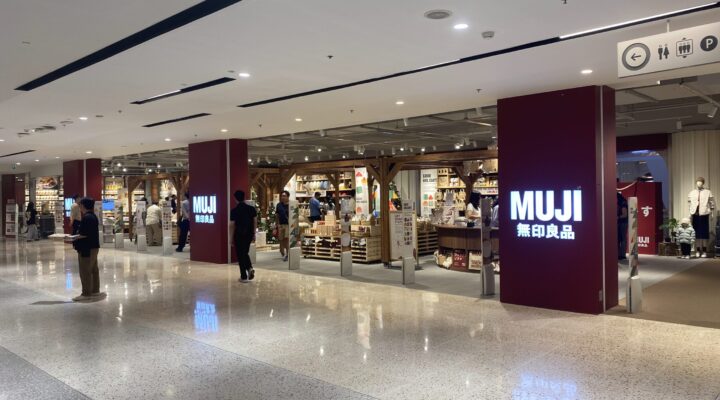
Ryohin Keikaku, parent company of Muji, opened its 40th store in Thailand and its largest in Southeast Asia this month, a sprawling 3,270sqm triumph of design and merchandising on the fourth floor of Central World in downtown Bangkok. Its pre-existing store on the same floor remains open, too. It reopened and expanded its flagship in Ho Chi Minh City on the same day and announced a forthcoming flagship in Paris next year. The Muji store at Central World, though, is much more than just a great st
eat store: it’s another piece of a three-dimensional jigsaw puzzle that Central Pattana’s leasing team has fitted into place in its successful quest to improve on the Isetan department store that vacated the northernmost wing of Central World back in 2020. More about that in a moment, because there is a lot to learn from it.
First, the new Muji flagship itself.
The store frontage is very wide and invites the visitor to go in any one of a number of directions, but let’s assume you are like the overwhelming majority of people whose brain sends you to to the right side when entering a shop and gets you walking counterclockwise, meaning that at Muji the stationery department, which is delightful, is where you start your shopping journey. (As an aside, it is incredible how many retailers seem unaware of this, and don’t merchandise attractively to the right-hand entry point. It is like a baseball coach forgetting that seven of his nine batters are right-handed.)
As visitors cycle through the store, they can enjoy, zone by zone, robust assortments of luggage, footwear, men’s and women’s wear, loungewear, health and beauty, furniture, kitchenware, storage, cleaning products and food snacks. The presentation is immaculate, but lean, functional and earth-toned, in keeping with Muji’s ‘wa-ke’ philosophy of careful materials selection, craftsmanship and simple packaging.
Many would regard the store’s large health and beauty department, including aroma and fragrance products, as one of its highlights. This is no accident, since one of the major growth drivers Muji has identified in its forward-looking strategy is to strengthen its health and beauty business. Accordingly, it is upgrading its skincare department to a core product category across its entire portfolio.
In keeping with the ‘community engagement’ trend, the store also sets aside a limited space for workshops and exhibits called Muji Atelier. The shopping experience is made complete by the availability of friendly, multilingual staff who are quick to interact with visitors who need direction or information.
A bigger story: the re-Japanification of the Isetan wing
The Muji flagship is only part of a larger success story: the extraordinary re-leasing project by mall owner Central Pattana of the old seven-level Isetan department store, which departed in 2020. There were always many Japanese tourists visiting Thailand, and many Thais who love Japanese products, and together they constituted a good market for a Japanese department store. But coinciding with the height of the covid lockdowns and border closures was the end of Isetan’s 30-year lease at Central World, and on a sad day in August, when distraught employees shed rivers of tears, Isetan and Central Pattana parted company.
Thus began a major re-leasing process that has become a poster child for the successful replacement of a department store that had closed in Asia. The ground floor has been retenanted with American casual dining favourites Cheesecake Factory and Shake Shack, along with mini-department store Comma And, Pop Mart, and an H&M that includes a 65sqm H&M Home. The second floor is anchored by Urban Revivo and Playmondo, the latter a learn-through-play concept with four themed geomorphological zones: desert, ocean, volcano, and forest.
The next floor up is where the old Isetan is re-Japanified: here you will find ‘Japan Avenue’, a food court featuring Japanese specialties. There is also a Nippon Market, a premium Japanese supermarket with more than 10,000 imported Japanese products, as well as a small restaurant.
Layered on top of that are the floors anchored, respectively, by Muji, Japanese furniture retailer Nitori, and Japanese bookstore Kinokuniya. Accompanying them at each level is a small tenant space that yields rental income to the mall operator, making the economics of retenanting an old department store box so attractive.
Growth across the global portfolio
Muji in Bangkok is just the latest and most high-profile story in the company’s expansion strategy. It ended the fiscal year ending August 31 with 1412 domestic and international stores, an increase of 107 from the end of fiscal 2024. Of these openings, 47 were outside Japan, bringing the overseas total to 729. The plan for fiscal 2026 is to open another 96 stores, of which 40 will be in Japan and 56 overseas. Most of the overseas stores will open in China and Southeast Asia.
The 2025 openings and strong like-for-like growth lifted full-year revenues to 784.6 billion yen ($5.1 billion), up 18.6 per cent from 2024. The gross profit margin moved up 60 basis points to 51.4 per cent. Net income to owners jumped sharply by 22.3 per cent to 50.8 billion yen ($327.7 million).
In Japan, operating revenue grew 20.9 per cent to 470.1 billion yen ($3.0 billion). Thus, Japan contributed just under 60 per cent to the top line, a slight increase on last year despite the overseas expansion. Same-store sales, including e-commerce, grew by 13.5 per cent, with household goods and health and beauty particularly strong.
In China and South Korea, same-store sales rose in the double digits, while in Southeast Asia/Oceania, results were mixed, with same-store sales growing 4.2 per cent. Again, these results include the online store, so they are not necessarily indicative of how strong selling is on the physical store platform.
Muji’s global strategy also includes boosting the overseas representation of its Japan merchandise SKUs to about 80 per cent by increasing not just the number of Japanese health and beauty products available in overseas stores, but also the availability of other product categories, such as daily necessities and innerwear made from natural materials. Flagships like those in Bangkok and Vietnam will be vehicles for this broadening of assortments.
Further reading: Sentaler crosses the border with NYC flagship