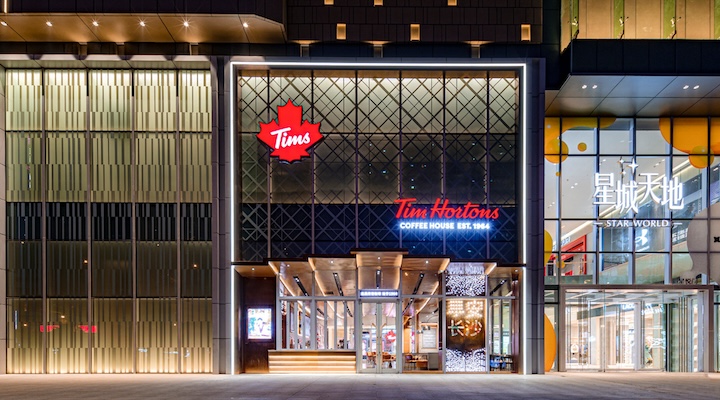
The operator of Tim Hortons in Mainland China, TH International (Tims China), reported revenues of RMB349 million ($48.7 million) for the three months ended June 30, down 4.9 per cent year-on-year, as weaker sales from company-owned stores offset strong growth in its franchise and retail business. Net losses narrowed to RMB75.9 million ($10.6 million) from RMB99.5 million a year earlier, while adjusted net loss fell 16 per cent to RMB39.7 million ($5.5 million). Just as importantly, adjust
usted corporate EBITDA turned positive at RMB2.2 million ($300,000), marking a second return to the black in two years.
Tims China’s CEO Yongchen Lu said the company’s priorities remain expanding its franchise system and driving food-led growth.
The franchise pivot
Tims China has been steadily shifting from a company-owned store model to a franchise-heavy approach. Over the past 12 months, the number of franchised outlets jumped from 333 to 449, while company-owned stores edged down from 574 to 566.
The executive explained that the model is less capital-intensive, shifts risk to local operators and creates more predictable royalty income.
The early returns are encouraging. Franchise and retail revenue climbed more than 50 per cent year-on-year during the period, while profits from “other revenues” more than doubled. Management said that its individual franchisee program, launched in late 2023, has received more than 8100 applications, with more than 400 stores converted by mid-2025.
“We’ll continue to close underperforming stores and aim at improving profitability this year. And we expect to have over 100 net openings this year. We expect 200 to 300 new openings every year in the next few years,” Lu said.
Betting on ‘coffee+food’
Tims China’s differentiation strategy is anchored in food. While competitors like Luckin Coffee or Cotti Coffee thrive on discount-driven coffee sales, Tims is betting on a ‘Coffee + Freshly Prepared Food’ model to capture more meal occasions.
During the quarter, food revenue rose 8.6 per cent year-on-year, reaching a record high of 35.2 per cent of sales. The company credited its ‘Light & Fit Lunch Box’ platform, which includes bagel sandwiches, wraps and energy bowls bundled with beverages, sold at accessible price points.
The concept is working. Lunch traffic has picked up meaningfully, with positive spillover into breakfast and even early dinner hours.
During the quarter, the company launched 43 new items, spanning sparkling cold brews, buffalo milk lattes and a slate of non-coffee drinks designed to appeal to families and younger consumers.
Tims’ efforts come amid intensifying competition in China’s coffee sector. Luckin Coffee has built an empire on volume and affordability, surpassing 18,500 stores nationwide and cementing its lead with ultra-low prices enabled by supply chain efficiency and digital-first operations. Cotti Coffee is also expanding rapidly.
The middle ground is getting more crowded with food-service players pushing aggressively into coffee. Yum China, for example, has been rolling out its K Coffee brand through KFC outlets, offering low-cost beverages bundled with fast food meals, an overlap that could encroach on Tims’ food-and-coffee positioning.
At the same time, China’s macroeconomic environment remains fragile. Sluggish wage growth, a weak property market and subdued consumer confidence continue to weigh on discretionary categories like coffee.
The impact is visible: same-store sales at Tims’ company-owned stores fell 3.6 per cent in the quarter, though transactions rose 3.4 per cent.
Despite macro challenges, Tims is seeing traction in digital and loyalty. Its membership program swelled 22 per cent year-on-year to 26.2 million users, with digital channels now accounting for more than 90 per cent of orders. The company hopes to unlock more value from this base, though CEO Lu admitted monetization is still a work in progress.
“We kind of have a gold mine… we need to dig and derive the value from memberships,” he said. “So we have the mine there, and we need to design good products and campaigns and attract those members to spend more in our stores.”
Brand-building is also underway. In July, Tims appointed singer-songwriter Lars Huang as its ambassador, targeting Gen Z consumers through collaborative campaigns. Whether celebrity tie-ups translate into sustainable traffic, however, is uncertain.
Further reading: Tim Hortons’ executive talks Malaysian expansion strategy.