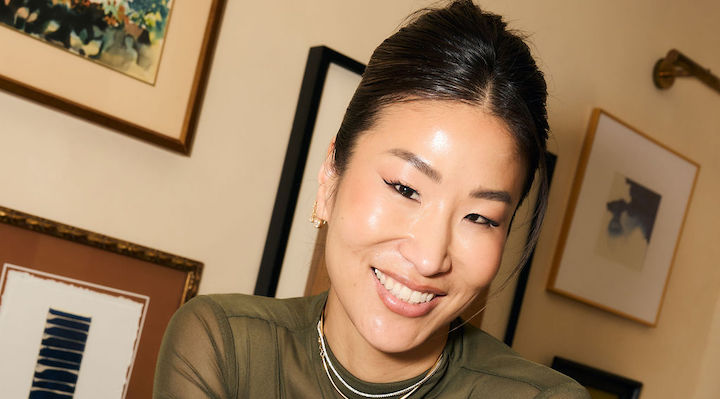
In 2015, Jennie Yoon experienced a personal tragedy when multiple heirloom pieces from her family were stolen from her home. As Yoon told Inside Retail, the unfortunate event took much more than valuable goods from her and her family: it also partially took away a sense of personal identity and some of the stories that represented her family’s journey from South Korea to America. “The idea was to simply replace the pieces that they lost,” Yoon recalled. She would go on to visit various jew
rious jewelry sources in downtown Los Angeles, inquiring about the possibility of recreating the stolen pieces.
Fed up with what she called an “antiquated” market, Yoon decided to take matters into her own hands and build a fine jewelry brand, Kinn, offering modern heirlooms designed to last a lifetime.
From Casetify to Kinn: The start of a new brand journey
In the early stages of Kinn’s launch, Yoon distinctly recalled her frustration with jewelry vendors when she tried to create replacements for beloved family pieces.
“Five different people were giving me five different prices and talking to me about materials that I didn’t entirely understand. Mind you, this is a while back, so the DTC fine jewelry category wasn’t as much of a thing as it is today. As a jewelry consumer, I felt that the system was so broken.”
It was then that Yoon began conducting her own research and, along the way, befriended the owner of a jewelry manufacturer, who took her under their wing. The Kinn founder started by creating pieces for herself and some friends and family, before officially launching the brand in 2017.
What started as a part-time side hustle flamed into a full-time passion that would take over all her existing free time outside of work.
“This was enough of a fire that I decided that I have to take this leap, otherwise I’m going to regret it for the rest of my life,” said Yoon.
In 2020, Yoon decided to step away from her role at Casetify to pursue Kinn’s growth on a full-time basis.
Building a modern fine jewelry brand
One of the biggest challenges Yoon faced at the beginning was being constantly undermined and told that her brand was nothing more than a hobby.
“I was helping people understand how pieces were made and where they came from, explaining things like the difference between plated and solid gold, which I felt nobody else at the time was doing. I constantly had people telling me that this can’t be more than what it was today,” she recollected.
Another issue Yoon faced in the earlier days of building out Kinn was her lack of experience in the fine jewelry space, which operates very differently from the majority of retail operations, such as apparel, on the market.
Yoon explained that fine jewelry, unlike fashion, doesn’t operate with the standard minimum order quantity (MOQ) system.
Even producing a single piece can cost hundreds to thousands of dollars, which makes it difficult for manufacturers to make things for you and invest in you as a returning retail partner.
Yet, it was Yoon’s dedication to the brand and her strong work ethic that ultimately led her to find the partners who would help her build and scale the company.
“I think there’s a little bit of my personality that shone through and had people start trusting that, okay, there’s something different about this girl, she’s thinking differently. The people who took that bet on me are the ones who appreciated that I think differently than your traditional jewelry house.”
In an industry notorious for steep price markups and unfavorable manufacturing practices, Yoon was determined to build a brand that not only offered high-quality products but also used responsible production practices.
One standout feature of the brand is that they use lab-grown or ethically sourced gemstones and recycled 14k gold to ensure product quality and create jewelry more sustainably.
A second differentiator between Kinn’s pieces and those of other fine jewelry brands is the way the brand helps customers breathe new life into old pieces.
In a process dubbed “KinnCycle”, customers can ship their old pure 14k jewelry for Kinn to melt down and use for an existing custom project.
Another major selling point of Kinn, compared to other fine jewelry companies, is the brand’s approach to storytelling and a more intimate connection with customers.
Connecting with customers through culture
As Yoon told Inside Retail, “I do think that there is a competitive advantage for us in knowing how to tell a story and not to market products for the sake of marketing. Some brands have become so big that they may no longer be in a place where you can do this kind of storytelling, but when you are a smaller company that is still growing, you can put your best foot forward.”
This sense of storytelling is well seen in one of Kinn’s best-selling items, the Dear Kaia nameplate necklace, a piece Yoon referred to as a “happy accident”.
Born in South Korea but raised in Los Angeles, Yoon, like many other immigrants, couldn’t find jewelry pieces featuring her Korean name, Hye Jung, let alone come across many people who could pronounce it.
In an effort to assimilate, the Kinn founder decided to call herself Jennie and admitted that it wasn’t until she reached her 30s that she became more proud to state her native name.
However, it wasn’t until she had her daughter, Kaia, that Yoon became outwardly proud of her given name.
Kaia, like Yoon, has both an American name and a Korean name, which Yoon lovingly crafted into a nameplate necklace. Her friends who could read Hangul, the Korean alphabet, inquired about making their own versions of the necklace.
Shortly thereafter, more people started inquiring about creating necklaces in other languages. Today, Kinn offers the Kaia nameplate necklace and several of its other variations in Vietnamese, Chinese, Japanese, and English.
Much like Kinn itself, what started as a personal project has become a more solid business in its own right.
“I call this product ‘Dear Kaia’ because, to me, it’s a love letter to my daughter. Hopefully, one day she will understand the meaning behind it and why I was wearing it. Because I am proud of who I am, where I come from and what made me me.”
What started as a personal pursuit born out of tragedy has since morphed into a thriving DTC business with not one, but two brick-and-mortar stores, the second of which just launched in New York City this February.
Over the next few years, Yoon stated that the goal is to open at least one brick-and-mortar store per year, allowing more customers to get a feel for the product IRL and offering customization appointments.
Over the long run, Yoon’s dream is to turn Kinn into the next heritage jewelry house, like Cartier.
“We believe in building things slowly. This is not for quick growth or quick sale of the business, but rather it’s for the long run.”
Which is part of why Kinn wasn’t named after its founder, Yoon noted, unlike many other heritage jewelry companies.
Instead, the name Kinn, like many of the pieces the brand produces, was inspired by family.
Kinn was partially inspired by Yoon’s mother’s name, Kim, with the “m” broken up, creating two “n”s. The other source came from the phrase “next of kin” – an appropriate name for a modern heirloom brand.
Further reading: Inside Sukoshi’s plan to launch 40 stores in the US by the end of 2026