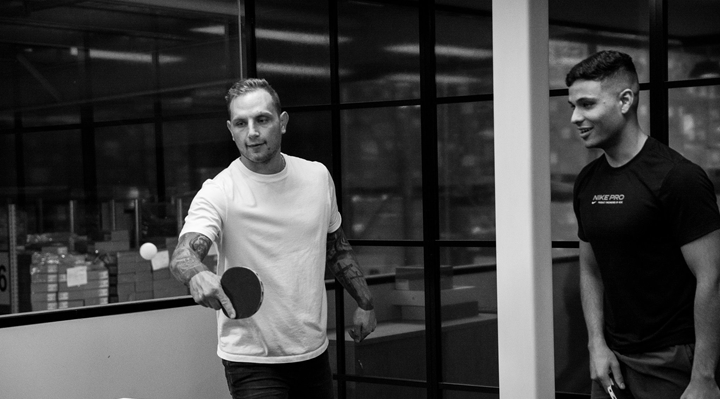
Elite Supplements started small, a store tucked inside a gym in Canberra, Australia, built without a clear sense of what it would become at scale. It now stretches across more than 150 locations, with international expansion underway. In between sits a run of decisions from licensing, franchising and expansion that are made quickly and sometimes under pressure, each one leaving its mark on how the business operates today. CEO Dom Giampaolo brings a background in sport that continues to inf
inform how he leads. The discipline, tempo and accountability that come from football carry through to the business, particularly in how teams are managed and how performance is measured. That influence is visible in a consumer base that prioritises presence, shared responsibility and a priority of collective momentum.
The scale of the business has increased, but proximity to operations remains central. With hundreds of employees across stores and support teams, leadership is grounded in constant decision making, ongoing adjustment and a focus on maintaining standards as the network expands.
Giampaolo spoke to Inside Retail about the early days, how the business grew, and how that growth continues, held together by consistency, capability and a culture built alongside Elite Supplements.
Inside Retail (IR): Take me back to the beginning. How did Elite Supplements evolve from its earliest iteration into the retail network it is today?
Dom Giampaolo (DG): We opened our first store model or retail model in LA and then we were really a distributor at that point. Locally, in Canberra, we opened about six over or five years, although we didn’t do too much for a little while then.
Around 2013–2014 I licensed the brand. That was definitely a lesson in its own right, and we got to about 35 sites with an ownership split of about 50/50.
2019 was a big move, against the shareholders’ advice, against anyone. We went and franchised. From that, the rest is history. As we sit today, we’re on 151 outlets, 70 owned, about another 25 leases signed, and I’m actually off to Manila in 30 minutes for a second master franchise.
IR: As the business grew, how did your role change—from hands-on operator to CEO?
DG: Truthfully, I’d love to give you something romantic. You read these things or you see something in your feed, you know you’re meant to be on strategy. I call bullshit. When I have a breath and I’m up to date, I might get my case easily and talk strategy, and it’s really a beautiful thing, like a blessing, but it happens way more rarely than what you would think when you talk about medium, long-term strategy.
The reality is 550 employees and about 1100 in the network. I am at that size company. I’m still absolutely micromanaging it.
IR: That level of involvement often comes with family-led businesses. How has that shaped the culture?
DG:I think that’s given us a good culture to date and it probably set us up for where we are today. There’s so much camaraderie and even empathy around the office. When the fuel crisis came in, we increased our work-from-home policy but not many of the staff actually took it. They still wanted to get in the office and be there and be part of the group. It’s a really beautiful thing.
IR: You built a physical retail business first, then layered in e-commerce. How do you see that balance today?
DG: We almost pivoted back. The most crazy one regret of mine is we were late to the e-com party, but when we got in, it became really strong.
During the Covid-19 pandemic, every single analyst in Australia said physical retail will die and the malls will die. I’d love to see them circle back now. Physical retail got that big bump post-Covid-19, 12–18 months, but now it’s settling back to traditional patterns.
But what we’re seeing is Australia is such a unique, actually beautiful market. They call it the ‘big 80’ — shoppers growing at eight to nine per cent, ahead of CPI. Australia has a big love for community and the traditional retail store, and that’s what we’re seeing. We’re seeing it in Singapore, we’re about to roll out New Zealand. You can draw a line between Western markets — the UK, the US, Australia — but we are so different. We’ve got a strong sense of community
IR: Is that resilience driven by foot traffic or something deeper?
DG: It’s definitely more of a community thing, you’ve got so much advice to give. That’s the big initiative about a year ago now, where every single staff member that works at retail has to do a nutrition course. They’re nutritionally qualified, and that’s just completely elevated us as a premium brand.
Supplements is a bit of a complex field. I call it specialised retail. So I think that is why those stores have strength.
IR: At your current scale, what’s the hardest part of running the business?
DG: We opened a store every 10 days. I asked the other day, “What are my flaws? They go, you could probably make decisions too fast—slow down a little.
To maintain this scale is honestly so difficult, being privately owned and never having experienced anything like it before. It’s not just maintaining the scale, it’s to grow.
The toughest thing is to have sufficient resources and continue to balance the books, upskilling, onboarding at such a pace and your org chart, which is forever changing. You finally improve your systems and your foundations a little bit, and then all of a sudden you just grow again and it’s broken again. Never-ending. It’s not for everyone.
IR: What did you get wrong about leadership early on?
DG: I had leadership traits through sport, and I think one thing I recognised is that it’s not the traditional boss-employee of 30–40 years ago. It’s so much more than that.
It’s understanding them as a person, their strengths, building them up and reinforcing that. I have a strong bond with my team. It’s probably more than typical employee-type relationships. Whether that’s scalable is another question, but we’re trying hard to maintain that.
We’ve got posters up around the office where it’s a picture of a boss, and then the other one is, that’s not how it works—the boss is in the front line. That’s how you operate in this company.
IR: Looking ahead, where does growth come from next?
DG: Our retail footprint will probably cap out in Australia around 200. That’ll happen quite organically.
We won’t be doing anything horizontally. Years ago, we opened a sub-brand, Elite Organics, and ultimately it didn’t really work. It made us pivot back and triple down on our own space. Even when we got some SKUs into Woolworths, that also made us pivot back to our core business. Private label products aren’t like what they were 10–20 years ago. Our private label products are innovative and there’s so much development that goes into them. And the lucky thing is we get to collate all the data –what’s working and what’s not working—and that goes into product development.
[International expansion] is coming on pretty strong. I once quoted 1000 sites. I actually think it’s genuinely possible within three to five years. Then the logical step for us is big vertical integration. When we do that, I think we’ll be a household name in the next couple of decades.