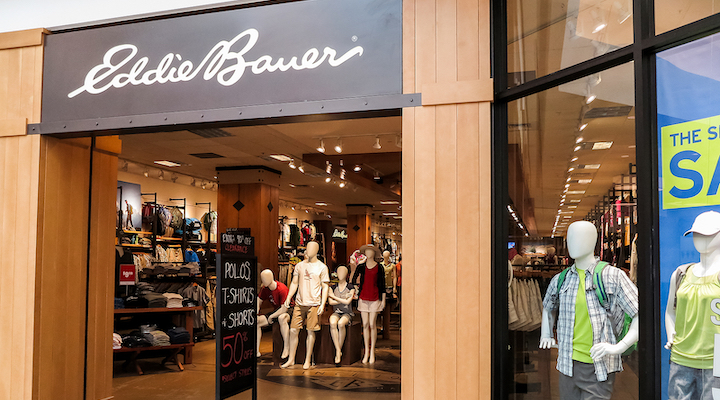
Barely one month into the new year, and the retail industry has already been shaken up by news of multiple Chapter 11 announcements and mass store closures. From DTC darlings like footwear brand Allbirds to department store giants like Saks Off 5th, no singular retail model is safe from the various constraints currently facing the industry. The latest retail legend to allegedly hit the chopping block is the American-born outerwear brand Eddie Bauer. Sources say an entity under Cataly
er Catalyst Brands Group, the retail operator of Eddie Bauer, may be filing for Chapter 11 bankruptcy. A Chapter 11 filing would not impact Eddie Bauer’s manufacturing, wholesale or e-commerce operations, nor would it impact retail operations outside of the US and Canada.
At this time, the filing is not expected to affect the approximately 20 stores the brand has in Japan, nor should it impact the company’s manufacturing, e-commerce, and wholesale operations in the US and Canada.
This latest development follows up on the news of Authentic Brands Group’s agreement finalized in January to transfer Eddie Bauer’s e-commerce and wholesale businesses to licensing platform Outdoor 5. The transition is complete as of February 2nd.
Once Eddie Bauer officially files for Chapter 11, the transition is expected to be completed shortly thereafter.
At the time of the announcement, Jarrod Weber, Authentic Brands Group’s global president of sports and lifestyle at Authentic, stated, “Our relationship with [Outdoor 5] has been built on trust, shared vision and operational excellence. This next chapter aligns Eddie Bauer with a partner with expertise in the outdoor space, while allowing Catalyst to focus on its successful lifestyle portfolio. Together, we’re setting the brand up for long-term, sustainable growth.”
Eddie Bauer’s inevitable decline
While it is always a shame to see a legacy retailer decline, multiple retail experts said they weren’t surprised to see this particular brand fall by the wayside.
As Neil Saunders, analyst and managing director at GlobalData, told Inside Retail, “While the Eddie Bauer name is well-known, the brand has not kept pace with rivals.
“From a consumer perspective, it is nowhere near as exciting as some of the fast-growing players like Fjallraven and Arc’tery. Additionally, for many younger shoppers, the brand is seen as somewhat old-fashioned and a bit irrelevant.”
Agreeing with Saunders’ observation, Christine Russo, the principal of Retail Creative and Consulting Agency (RCCA), added that with consumers facing seemingly endless choices, brands need to matter harder and smarter than ever to hold on to the shopper’s attention.
With the comeback of Carhartt and other workwear brands, Eddie Bauer had ample opportunity to leverage their reputation as a legacy player in this space, Russo noted, but failed to engage this new audience, ultimately losing out to other brands.
Saunders also noted that Eddie Bauer has ongoing issues maintaining quality control, which, for an outdoor brand judged by product performance, is problematic.
Where brands like Arc’tery emphasised the technical aspects of their products and pushed this heavily in customer communications, Eddie Bauer failed to live up to its once-impeccable reputation for outerwear design, in addition to neglecting innovation.
“These missteps have depleted sales, and that, in turn, has impacted the profitability of stores. While newer Eddie Bauer stores do look good, many of the older ones are a bit of a jumble of product without sufficient emphasis on things like education and storytelling – both of which customers want in the outdoor products category,” said Saunders.
Overall, he noted that Eddie Bauer needed very careful brand management to survive in this environment, but this has been somewhat lacking, ultimately undermining the business’s economics.
How letting go of a legacy can lead to a brand’s demise
Ultimately, Russo concluded that Eddie Bauer’s impending bankruptcy announcement and planned store closures reflect an all-too-familiar playbook in retail.
A brand in decline, selling off its e-commerce and wholesale businesses at a discount to larger corporations, such as Authentic Brands Group, is not a new story.
At this point, with massive store closures expected and a diminished IP, largely due to a sluggish approach to innovation, Russo affirmed that Eddie Bauer has been overly “chopped up” to have any chance of a comeback.
This should serve as a lesson to retail brands, especially those with a legacy heritage: keep their image fresh and relevant to new generations of consumers, before they end up on the chopping block and reach a point of no return.
Further reading: Eddie Bauer set to close 200 North America stores in upcoming Chapter 11