If the overriding message of day one of Retail’s Big Show, the National Retail Federation’s (NRF) annual conference and expo, was to learn from yesterday’s mistakes, the theme of day two of NRF was to look ahead to the future.
More specifically, a future in which AI, particularly agentic AI, is no longer an option, but an increasingly vital essential.
Retail executives, including David Lauren, Ralph Lauren’s chief branding and innovation officer; Nadine Graham, Sephora’s SVP and GM of e-commerce; and Lauren Price and Linda Li, COS’s SVP of e-commerce and North American managing director (respectively), extolled the benefits, both fiscal and creative, of incorporating AI into everyday operations.
As Lauren told the audience, full of veteran and newbie retail executives, you have to be clear on your brand’s mission and keep trying new ideas and strategies to bring it to life.
“Even though some may think of us as a traditional, old-world sort of brand, we’re a company that is all about innovation. Ralph Lauren is imbued with a sense of risk-taking and building new ways of shopping.”
Lauren pointed to several of the American apparel brand’s past projects, including being one of the first brands to optimize shopping online via a mobile phone or launching an entire coffee-fueled lifestyle brand with Ralph’s Coffee.
“Taking risks is important, and it all starts with a philosophy of openness and optimism. We’re more than a fashion brand; we are about being part of the cultural zeitgeist and connecting our philosophy in new and fresh ways.”
The future of an icon: Ralph Lauren’s journey of heritage and innovation with Microsoft
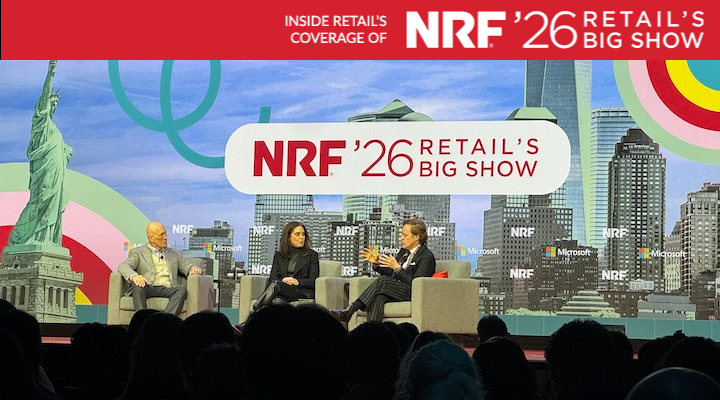
In a panel moderated by the NRF’s president and CEO Matthew Shay, Shelley Bransten, Microsoft’s corporate vice president of worldwide industry solutions, and Lauren touched on the journey of the fashion and tech company’s 25-year partnership.
Since Ralph Lauren first launched in 1967, the apparel brand has not only set trends in fashion but also in technological innovation.
In a discussion with NRF’s president and CEO Matthew Shay, Shelley Bransten, Microsoft’s corporate vice president of worldwide industry solutions, and Lauren touched on the journey of the fashion and tech company’s 25-year partnership.
What started out working together to create one of the industry’s first luxury e-commerce sites has led to the two companies launching “Ask Ralph”, Ralph Lauren’s AI-powered conversational shopping tool.
Even before the idea for the tool was conceived, Lauren recalled that the fashion brand began discussions with Microsoft about retail’s biggest buzzword, AI, several years before it gained the traction it has today.
With “Ask Ralph” now on the market, Lauren stated that the brand, like many others in the industry, plans to further build on the areas of opportunity AI offers.
Before brands consider delving deeper into AI experimentation, Bransten noted five lessons Ralph Lauren and Microsoft learned from the ChatGPT movement, including:
- Don’t dive into AI just for the sake of diving into tech. Go into the exploration with a clear sense of how you want AI to improve and transform your business.
- AI really is only as good as the data you collect, so having a robust collection of consumer data is key.
- Culture, culture, culture. Building a culture of innovation between different departments of a team is essential for exploring new technologies.
- Responsible AI. It is incredibly important to either set your own standards for ethical AI practice or partner with a company that has this in mind.
- Build a productive partnership.
“The theme of all of this is around partnering. Pick your business partners wisely, as in any other aspect of life, to make sure that you pick one who has your best interests in mind. One that will take care of your data and help you with the long-term vision of where you want your brand and your customer to go.”
In retail, it’s all about AI, AI and more AI
There is more to AI than launching tools like “Ask Ralph” or even an entirely AI-powered shopping platform, as Julie Bornstein, the founder and CEO of Daydream, did. Now more than ever, retailers are leaning into the power of AI to reduce time and costs across a range of tasks.
Several executives including Linda Li, COS’s North American managing director, Kristen Sosa, CEO of Zadig & Voltaire; Matthias Haase, vice president of content solutions for Zalando; and Nadine Graham, Sephora’s SVP and GM of e-commerce, discussed the importance of AI in the retail industry, especially for fashion and beauty brands.
In the case of brands like COS and H&M that serve an international audience, Price and Li both noted that AI-assisted searches help consumers find the items they’re looking for, even if there are cultural and grammatical differences in product listings, or help create distinctive content for each market.
Or in the case of smaller brands, such as the French-based luxury apparel brand Zadig & Voltaire, or larger sales platforms, such as the Berlin-based shopping platform Zalando, AI helps create ample aesthetic content for both social and commerce platforms, enabling the brand to be discovered by more consumers.
Haase pointed out that currently 80 per cent of the marketing content on Zalando’s site is generated by AI, which has in turn led to a 70-80 per cent increase in click-through rate.
Even looking away from the power AI has to enable searches or to generate content, Skims’ Emma Grede highlighted how this technology can help the human part of a brand do what they need to do better.
“I came up in the time with a lot of management consultants, where we built these incredible businesses based on what the data is telling us and by being obsessed with our customer and obsessed with the product. But there’s a whole other side of what we do with market research and obsessing over the competition that, quite frankly, AI can do at a speed that no human would ever find manageable.”
“So for me,” Grede elaborated, “it’s not about taking anything human out of what we do. It’s actually leaving ourselves the time to do the stuff that only we can do, so that I can obsess over things like product innovation, and everything else should be left to AI.”
AI, regardless of how one personally feels about this ever-changing technology, is here to stay in the world of retail.
Instead of being afraid to use it or experiment with it, retail’s biggest players are telling brands to go out, explore, and see where the human element can be enhanced, not eliminated.
“For everyone out there, the technology is here. Don’t sit on the sidelines; you have to get in the game. Just start with a great partner and a brand you love,” concluded Bransten.