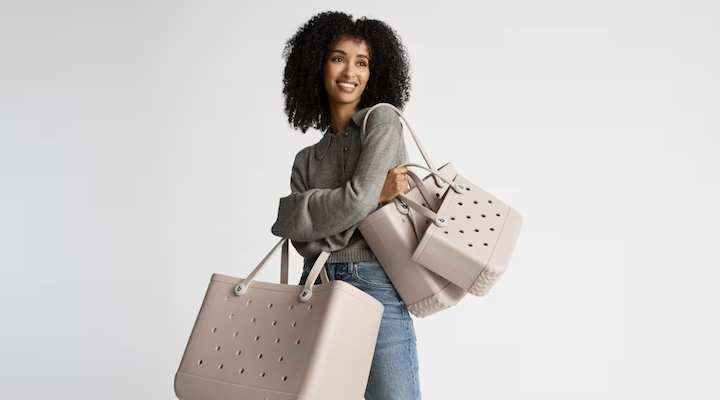
Bogg began with a problem Kim Vaccarella couldn’t find a product to solve. After watching yet another beach tote fall apart following a family trip to the Jersey Shore, she sketched a more durable alternative made from washable, nonporous EVA foam – the material used in Crocs. Vaccarella had no background in product development or manufacturing. At the time, she was working in commercial real estate and spent nearly a decade building Bogg during nights and weekends before leaving her job in
in 2018. Since then, the brand’s sturdy, customizable totes have found an audience well beyond the beach, helping Bogg surpass $100 million in annual revenue and $400 million in lifetime sales.
Now, Vaccarella is seeking to turn that popularity into a broader lifestyle business through new products, selective wholesale partnerships and, eventually, Bogg stores and international expansion. Here, Vaccarella talks to Inside Retail about building the brand patiently, absorbing a $10 million tariff hit and taking Bogg beyond the beach.
Inside Retail: Prior to launching Bogg, can you delve into your career background and how your path led you to becoming a brand founder?
KV: Before Bogg, I spent most of my career in commercial real estate, working my way up at a commercial real estate lending company.
I’d had zero background in product development, manufacturing or consumer brands – Bogg started as a side project I built on nights and weekends while still working full time. I didn’t leave that career behind until 2018, a full decade after the idea came to me, when Bogg had proven it could support us on its own.
IR: How did you first come up with the idea for Bogg and the brand name?
KV: The idea came out of pure frustration: on a family beach trip to the Jersey Shore, I was tired of buying canvas, straw and mesh totes that always fell apart after one season.
I sketched out a bag made of EVA foam – the same washable, nonporous material as Crocs – because nothing like it existed on the market yet.
As for the name, I was playing with words tied to water, frogs and lily pads until “Bogg” just felt right – it doubled as a nod to being a fresh take on “the new bag.”
IR: In an industry as hypercompetitive and saturated as the accessories market, how does Bogg stand out from its competitors?
KV: We built around durability and versatility first – a bag that can go from the beach to the classroom to a sporting event and be hosed off in between. We let that product truth drive word of mouth rather than paid marketing, which we didn’t invest in until 2024.
We’ve also built an entire customization ecosystem around the core tote, from Bogg Bits and dividers to cupholder attachments, so the bag itself becomes a platform rather than a single-use item.
On the dupe and copycat front, we lean on the fact that a real Bogg is built to last for years, so customers who try a cheaper imitation tend to come back to the original when the dupe proves to be low-quality.
We’re also deliberate about retail partnerships – protecting consistent pricing and choosing partners that reflect our core values so we grow without undercutting the independent retailers that have supported us since the beginning.
IR: What were the toughest challenges you faced in the initial stages of launching and running the brand? What strategies did you incorporate to overcome these issues?
KV: My first real inventory investment – funded in part by dipping into my kids’ college savings – came back from the factory with cosmetic defects that made it unsellable, and it took four years before I was in a position to try again.
Hurricane Sandy hit shortly after, and we ended up donating those flawed bags as part of storm-relief care packages, which is actually how we discovered real consumer demand once people started asking where to buy more. The bigger overarching challenge was building the business slowly on the side for nearly a decade while still relying on a full-time paycheck, which meant every dollar had to be watched closely.
My strategy was patience: I moved at the pace the business could sustain rather than chasing outside capital or shortcuts, even when it meant growing quietly for years before anyone outside my community had heard of Bogg.
IR: In recent years, CPG companies have been facing a bevy of operational issues, ranging from tariffs to ever-shifting supply chain routes. How has Bogg shifted course or strategy to keep up with these shifts while maintaining sustainable sales growth?
KV: Tariffs have had a real impact on us – we took a hit of roughly $10 million last year, largely because our manufacturing had been concentrated in China.
In response, we’ve started diversifying production into Vietnam to reduce that exposure. We’ve also had to navigate volatility in the price of EVA foam, our core material, amid broader global supply constraints. Staying disciplined on cash flow and maintaining strong, direct relationships with our retail partners has helped us absorb these pressures without slowing our growth trajectory.
IR: What have been the biggest highlights of running the business thus far?
KV: Crossing $100 million in annual revenue and surpassing $400 million in lifetime sales are milestones I’m incredibly proud of, especially knowing how slowly and deliberately we built to get there.
Being named an EY Entrepreneur Of The Year in 2023, landing on the Inc. 5000 list and being recognized on Forbes’ 50 Over 50 list have been meaningful validations of a path that didn’t look conventional.
Turning down a nine-figure acquisition offer was also a defining moment – it confirmed that I wanted to keep building Bogg on my own terms rather than hand it off. Watching the brand go viral organically, first through word of mouth in mom communities and later on social platforms, never stops feeling surreal.
IR: Your brand has marked its 15th anniversary with a rather large bang, adding six new retail partners and expanding into nearly 200 additional doors nationwide, including fashion-forward retailers such as Anthropologie and Urban Outfitters.
What does this milestone indicate about the company’s plan to extend beyond its origins as a trendy beach bag brand?
KV: Adding partners such as Anthropologie, Urban Outfitters and The Container Store alongside our longstanding sporting goods relationships with Dick’s, Academy and Dunham’s shows that Bogg has grown well past a seasonal beach accessory into a genuine everyday lifestyle brand.
We’re intentional about how we show up in each of these environments – for a retailer such as Anthropologie, that means curating our assortment so it fits their aesthetic rather than forcing our full range in.
This is really about proving Bogg has year-round, cross-category relevance, from the beach to the classroom to the office.
IR: Which retail partners do you plan to add to Bogg’s arsenal and why?
KV Retail remains the foundation of our growth strategy, and my personal focus going forward is increasing our wholesale mix, which currently makes up about 40 per cent of sales versus DTC and Amazon.
We’ll continue to be selective, prioritizing partners where our product genuinely fits the customer base and complements what’s already on their shelves, rather than expanding for expansion’s sake. Beyond our new fashion-forward and specialty partners, sporting goods will remain a core growth channel given how well it has performed for us historically.
IR: What goals do you hope to achieve with Bogg over the course of the next year and the next five years?
KV: We’re focused on deepening the retail relationships we’ve just launched, continuing to expand our specialty and independent retail footprint, and building on the record early results we’ve seen from our recent product collections.
Long term, I’ve talked openly about wanting to open Bogg’s own retail stores and build a genuine international footprint – we’ve barely scratched the surface of where this brand can go. Sustained, profitable growth matters more to me than growth at any cost, so we’ll keep pacing expansion in a way that protects the culture and quality that built this brand.
IR: What is your current favorite SKU from the brand?
KV: From our fall ’26 collection, the Navy Bandana and matching accessories. I just love it!
IR: What is a piece of advice you would give to the day-one version of yourself on your journey as a brand founder?
KV: No one will ever know the brand and products as well as you do, so trust your gut.
IR: What are the items in your metaphorical toolbox?
KV: My original foam sheet prototype from 2008. I look at that often and remind myself to look at what I’ve built.
IR: What is the best and worst piece of advice you’ve received over the course of your retail journey and why?
KV: The worst piece of advice was to leave my job when I wasn’t ready – I’m glad I didn’t listen.
The best piece of advice I have received is, “You know what you’re doing.” Sometimes you need to hear that simple reminder when things get tough and you’re lacking confidence.
IR: What guidance would you give to aspiring entrepreneurs trying to reach your point of success?
KV: Be willing to move at your own pace – Bogg took nearly a decade of nights-and-weekends work before I went full time, and that patience protected both my finances and my ability to make sound decisions rather than desperate ones.
Don’t be afraid to say no to terms or advice that don’t align with your values, even when everyone around you insists it’s how things are done.
Also, expect to make plenty of mistakes; what matters is what you do with them, not whether you avoid them entirely.
Further reading: How Alissa Miky harnessed red algae to create functional beverage brand Oomee