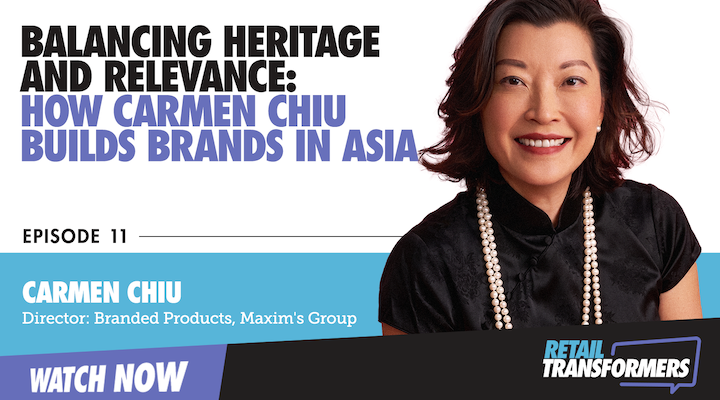
For Carmen Chiu, building global brands in Asian markets starts with a simple question: What makes a brand meaningful to consumers who may not know its history?
The director of branded products at Hong Kong-headquartered Maxim’s Food Group has spent much of her career answering that question, with previous roles at Ferrero, Godiva, Fortnum & Mason and Shanghai Tang.
Speaking with Inside Retail’s Amie Larter in the latest edition of the video series Retail Transformers, Chiu’s approach is clearly built around a ‘superpower’: Curiosity.
Chiu places considerable importance on a brand’s heritage and emotional weight, particularly when bringing established international brands into markets where consumers may have little or no familiarity with their origins.
“These beautiful brands all have their heritage, all have the souls working behind the brand.” For example, Fortnum & Mason has 315 years of history, and “when you go into a shop, every corner tells a story”.
That fascination with heritage has influenced the brands Chiu chooses to work with. She considers herself fortunate to have been selective in her career, prioritizing brands with a legacy and a story because understanding that heritage motivates her.
She also believes that emotional connection matters if a brand is to be represented authentically.
“I’m quite picky in a way. But if I don’t connect with that brand, it is so hard for me to play magic with it. I need to fall in love with it.”
Understanding the local market
That emotional connection is only the starting point. Taking an established brand into a new market requires an understanding of local culture and consumer behavior.
Chiu saw this first-hand at Belgian chocolatier and cafe chain Godiva from 2012-2019. When she joined the company, it had about 30 stores across Asia and was embarking on a five-year expansion strategy that included China. At the time, many Mainland Chinese consumers were only beginning to encounter luxury confectionery.
The challenge was to help consumers understand why the product commanded a premium and what differentiated it from chocolate as a commodity; its value beyond price, drawing on its heritage, craftsmanship and expertise.
Staff education became an important part of the proposition because employees, many of them unfamiliar with the brand and its products themselves, needed to understand the story well enough to communicate it to customers and create a more meaningful connection.
The business also recognized that chocolate consumption in Asia could not simply replicate patterns in Western markets. While Godiva began selling only chocolate, the addition of cafes and ice cream created new occasions for consumers to engage with the brand.
“That is why I go back to the cultural relevance. If we have such a low chocolate consumption per capita, unlike the Western world, then you are never going to drive a huge business: It is only gifting for someone – they may not be tasting the product themselves. But if we build in those consumption locations, allowing them to come into the store for themselves, then it adds another emotional touch.”
Chiu says this highlights why brand expansion is a process: “Once you crack it, then the pace comes along with it.”
In Godiva’s case, that meant reaching a point where the business was opening approximately one new store a week at the peak of its growth.
How Chiu balances legacy and local relevance
The same principle applied to Fortnum & Mason. The British retailer brought more than three centuries of heritage into Asia, but the team quickly learned that local relevance extended beyond simply selecting the right products. Product flavors needed to be considered, including the sweetness and saltiness of products, while the storytelling around the teas for which the brand is known also needed to resonate with local consumers.
“You have to build that into the relevance. Otherwise, they only come once, whereas you want them to be a loyal customer.”
The challenge, then, is not to choose between global consistency and local adaptation. Chiu sees them as complementary.
She describes the balance as 80 per cent staying true to the brand – its look, feel, tone, service and packaging – and 20 per cent local relevance.
Localization, she explains, is not about abandoning elements of a brand to fit a market. It is about understanding consumers well enough to bring the existing brand proposition closer to them.
Keeping brand heritage relevant
At Maxim’s, the branded products business is closely connected to major Hong Kong occasions including the Mid-Autumn Festival, Chinese New Year and the Dragon Boat Festival. Those occasions provide established moments of consumption, but Chiu sees a longer-term challenge in ensuring they continue to matter to younger generations.
“We see big potential in the next 10 to 15 years around how we then build those connections with the next generations: Gen Z and beyond, a child three or five years old. They are already part of that culture, but how can we make sure they keep engaging in celebrations, spending valuable time with their families on those occasions, and creating memories?”
The solution involves different segmentation, different cultural aspects, different distribution, and a careful look at every touchpoint to build those relationships, she explains. Understanding how younger generations engage with social media and use AI, for example.
“The mature generations are very loyal. We had a focus group recently, and they said, ‘We love you guys; don’t change’. That’s great. But what is the future of the business? We really need to start to understand the next generation. They are exposed to so many things, so many industries, so many categories on a minute-by-minute basis, and so if we are not up to date, if we are not relevant and finding the right bridge to connect with them, we will fall behind.”
For Chiu, this is ultimately a question of trust. Brand building is not a one-off transaction or a formula that can be applied indefinitely. It is a relationship that has to evolve as consumers, markets and cultural behaviors change.
“I do not think you can have one formula that fits all. I don’t say you can have one face that fits all markets, all customers.
Chiu returns to the quality she sees as most important to her own approach: Curiosity.
“I am curious. If you are not curious enough, then you’re not learning, and you’re not listening.
“Ever since my first job, it was curiosity that got me to where I am today. If you are not hungry for new information, you are not hungry to learn. No one knows everything. No one.”
- Watch the interview to hear Chiu discuss more issues, including where she sees AI as enhancing the retail customer experience, what she learns from focus groups, and why she leapt at the chance to take up her new role at Maxim’s.