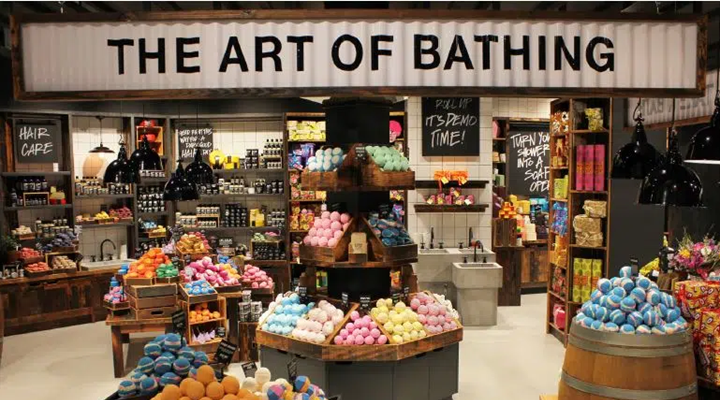
Lush is one of those archetypal brands whose very name transports you. Olive, rose petals, orange zest – a sensory shorthand that conjures place before product.
On the shelves, a black rose-petal bath bomb sits as a study in deliberate abstraction, almost contrarian in its refusal to echo the bright, fizzing colour usually synonymous with the brand. Nearby, staff direct customers toward the olive-grove section with quiet assurance: “This is what we usually suggest to those who aren’t so keen on a strong fragrance.”
Entering one of Lush’s more than 800 stores means encountering a wall of scent that polarises some and delights others, yet the team remains unfazed.
Their customer base – now stretching across 50 countries including the US, Canada and much of the EU – is unwaveringly loyal, hungry for the next bath bomb, body mist or scrub, and often all three. As co-founder Rowena Bird told me during our conversation, “We’re sitting here now having an aromatherapy bath because we’re breathing essential oils. So that’s not happening anywhere else. You’re just breathing in the smell.”
The space buzzes with colour and a cheerful cacophony of staff who seem genuinely enthused by the products they offer. Bird, dressed in monochrome and carrying a quietly magnetic presence, reflects the understated humility she brings into every conversation.
Everywhere, the space is threaded with activist symbolism: “Fighting Animal Testing”, “Ethical Buying”, “Fresh Cosmetics”, “100 per cent Vegetarian”. Not marketing as decoration, but the visible architecture of a brand that has long treated ethics as part of its everyday practice.
Lush’s collaborations have always functioned less as commercial tie-ins and more as cultural interventions. Over the years, the brand has partnered with stories that already carry a strong consumer base, from Super Mario Bros. and Stranger Things to One Piece, and now the theatre-to-cinema universe of Wicked: For Good.
Each collaboration is clearly about expanding Lush’s celebrity footprint but mostly its own language of sensorial storytelling. Bath bombs reflect mood, shower gels are world-building, and body sprays are an after-image of the characters they evoke.
Running parallel to this is the company’s long-standing activism, which has often been louder and more deliberate than its product launches.
Lush has temporarily shut stores in protest, used windows as humanitarian billboards and platformed grassroots groups long before “brand activism” became a marketing category.
If the collaborations tap into the worlds that people escape into, the activist campaigns address the world they must return to. Together, they form a brand practice that insists beauty is not apolitical, and that a bath bomb can be as much a gesture of care as a call to attention.
The founding six
Lush was founded by a small group of renegades from Britain’s early natural-cosmetics movement: Bird, Mark Constantine, Liz Bennett, Mo Constantine, Helen Ambrosen and Paul Greeves. The business has always operated with the improvisational energy of a creative collective, rather than a conventional beauty company.
Each co-founder brought a different sensibility, Mark Constantine’s vision for the brand, Ambrosen’s near-alchemical approach to formulating, Greeves’ technological adeptness, Mo Constantine’s creativity and passion for packaging, and Bird’s instinct for tactility, storytelling and the theatre of retail.
“Each one of us has a different skill set and all of those overlap to create a team that can produce quite a lot of stuff,” Bird said.
Before Lush took its current form, the founders were still recovering from the turbulence of the Cosmetics to Go enterprise they mounted, a period Bird remembered with a mix of fondness and hard-won clarity.
Their entry into mail order was equally improvised, driven more by curiosity than commercial blueprint. “You ordered, it took three weeks to come…We were the first, I would say, to actually send stuff out on the same day and get next-day delivery,” Bird said.
But the instinct to over-deliver became their undoing. “We did too much for the customer; our customer service levels cost us too much money… Then we had a flood…It was just one thing after another,” she recalled.
Bird spoke with the reflective calm of someone who has rebuilt a business from its foundations more than once. When asked how the early failures of Cosmetics to Go informed Lush’s ethos, she answered with characteristic candour.
“I would say we were naive. We didn’t realize we didn’t have to go into a receivership, but that’s what we were advised to do…So the bank really didn’t do us any favours…but Cosmetics To Go was fun.”
The admission of naivety is a revealing line, the sting of institutional misguidance and yet that final insistence on joy. Lush’s philosophy and its willingness to take risks, its appetite for creativity became easier to recognize when I heard the story told plainly.
Few brands can move with equal confidence from mascara to massage bars, from solid shampoo to toothpaste tabs, or from body lotion to hand-pressed henna bricks.
The same radical ideas that shaped Lush in the 1990s provide Lush with continuity that still anchors it today.
Innovation, for Lush, has never meant escalation or complication. It has meant returning to the fundamentals, botanicals, essential oils, food-grade ingredients, and fresh production, and asking how these materials can be shaped into something experiential.
That philosophy radiates through the store: into the colours, the textures, the way products are stacked like patisserie items or scooped like produce at a market. You understand quickly that Lush merchandise is not designed to be merely consumed but encountered.
More than a shopfront
Lush’s activism moves confidently through its shopfront. Its windows have doubled as protest tools, its tills as donation conduits, its soaps and bath bombs as part of long-term partnerships with groups such as Sea Shepherd Australia, where campaigns have supported turtle-habitat protection and anti-shark-finning efforts.
This activism is inseparable from Lush’s identity. To sell something at Lush is to make a statement about ingredients, ethics, the environment and the systems consumers are asked to move through.
The brand’s retreat from social media was a principled withdrawal from an ecosystem it no longer considered safe or sincere, reinforced by the implications social media has for youth.
Bird recalled the decision was the result of sustained internal debate, accelerated by growing concerns about platform accountability.
“It was a big discussion. Then when the Facebook exposé came up, it was just like, ‘Yeah, we don’t want to be part of this’. A lot of our customers are young. We didn’t want them looking for us online and maybe coming across a harmful space.”
She noted that the brand was never reliant on paid social to begin with. The position remains uncompromising, as Lush will not return until the platforms themselves change.
Lush has since been forced to develop different ways to communicate. “Our success online has always been through our customers anyway,” Bird reinforced.
“We’ve built the Lush Club – more community, more conversation. Over 2 million users on the app now.”
Across the conversation, Bird returns repeatedly to integrity as a working practice that sits at the heart of Lush’s longevity. In an industry shaped from sourcing to claims of pseudo chemistry, Lush has chosen the harder road of radical transparency and moral consistency.
Bird is matter-of-fact about it. “Not for us,” she said. “When we started Lush, we wrote our ‘We Believe’ statement. We’ve never moved from that…”
What emerged is a portrait of a business that treats ethics as the basic standard of how things are done, the farmers’ markets, the direct relationships, the refusal to compromise a supplier’s livelihood, the insistence on “ethics warriors” who watch every step of the chain.
And underpinning those systems is a worldview that is simple and stabilizing. As Bird put it, “To be honest. To be kind. To have a conscience.”
Taken together, these strands, the founders’ hands-on inventiveness, Bird’s calm authority, the sensory density of the store, the activist underpinning and the wide span of the product range all form a brand practice that feels less like retail and more like cultural authorship.
Lush exists in that unusual space where cosmetics, yes, are functional, but are also expressions of mood, ethics and self-definition.
It’s a place where a bath bomb can be an aesthetic choice, and a block of henna can be a philosophy.
Further reading: Lush co-founder Rowena Bird talks 30-year business journey and biggest takeaways