
If you’re a fan of French culture or simply take note of French brands making their mark on the American fashion scene, there’s a strong chance you’ve heard of Sézane. For those unfamiliar with the name, it is a direct-to-consumer (DTC) fashion, accessories and lifestyle brand launched in 2013 by Morgane Sézalory. Before starting Sézane, Sézalory curated vintage clothing via her website, Les Composantes, with her collections regularly selling out each month. Sézalory realized th
zed there was a strong market for vintage-inspired pieces. Taking matters into her own hands, she launched what has become a wardrobe staple for many ‘it-girls’.
Today, Sézane operates a global e-commerce site and has a brick-and-mortar presence in Paris, London, Madrid, Los Angeles, San Francisco and New York City.
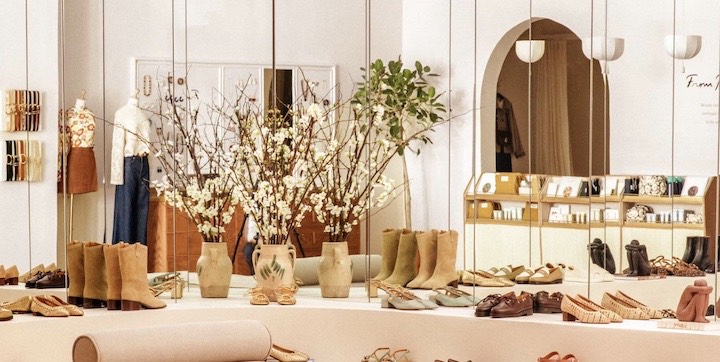
Recently, the brand announced the launch of its first Brooklyn-based “appartement”. Each Sézane location in the EU and US is dubbed an “appartement” to convey the brand’s chic, cosy aesthetic.
The “appartement” will open on September 19 at 155 Wythe Avenue, in the heart of Williamsburg, and will mark the brand’s 10th US-based brick-and-mortar store.
Christine Russo, the principal of Retail Creative and Consulting Agency (RCCA) credits Sézane rapid growth in the US to the three Ps; price, product and Paris.
“These are some of the most impactful contributing factors to the efficient, some would say quiet, growth of DTC brand Sézane,” said Russo.
How Sézane taps into French-girl chic to win over American consumers
As Russo told Inside Retail, “Sézane manages to hit those three Ps perfectly.”
She explained that “the contemporary price is competitive with its peers and also resonates with clients seeking accessible luxury for a value price.”
Additionally, Russo noted that the brand resonates with luxury customers looking to trade down in price, but still have products that convey a strong sense of style.
“As the luxury industry faces spending pullback, accessible luxury brands, such as Sézane and another French-born favorite Polène or the American-born Coach, are benefitting from luxury clients looking to refresh their wardrobes, who wish to spend less but still have access to quality product,” she said.
Aside from luxury or luxury-aspiring consumers, Russo pointed out that Sézane’s style also resonates strongly with mid-tier and upper-middle class consumers.
“Sézane’s product hits several major trends: indie, French and feminine,” said Russo.
This style, in Russo’s opinion, helps fill a void in an aesthetic landscape dominated by more preppy brands like J.Crew.
Not to mention, “the bloom is still very much on the rose when it comes to romanticizing all-things Parisian,” Russo added.
“Wearing product from Sézane can serve as a pleasant reminder of a trip or be part of a pre-trip haul. The stores are inviting and encourage slow shopping akin to a stroll in Paris solidifying an emotional connection.”
How Sézane successfully leans into engaging storytelling narratives
“Sézane’s growth in the US is a masterclass in how to thoughtfully translate a brand’s heritage for a new market,” brand strategist and marketing consultant Bethany Paris Ramsay commented.
“Rather than leaning into clichés of ‘French girl chic’ fashion, Sézane has carved out a space built on authenticity, timelessness, and accessibility that is still elevated and feels cool without the perceived effort of doing so.”
Ramsay remarked that for many American consumers, fatigue has built up from fast trend cycles, which makes Sézane’s easy elegance feels like a breath of fresh air.
“The brand was originally anchored in things like quality fabrics, considered design and sustainability, which felt like a breath of fresh air for many who are tired of the dip in elevation from what feels like all brands,” she said.
With that being said, Ramsay pointed out that over the past few years it would seem that Sézane has been making some compromises surrounding material selection as the brand has further evolved and scaled with investors.
In 2015, US investment fund Summit Partners bought a minority stake in Sézane of around 20 per cent. In 2018, another 20 per cent was bought by private equity giant General Atlantic which now reportedly owns 45 per cent of the company. More recently, in 2022, Téthys, the family office of the Bettencourt-Meyers family, best known as the largest shareholders of L’Oreal, took a minority stake in the French lifestyle brand.
Ramsay pointed to a widely circulated quote in a Reddit thread, asserting that “Sézane fabrics have dropped in quality […] more polyester viscose and less silk or natural fabrics.”
Ramsay said that Sézane should not take this feedback lightly.
“Consumers have access to more and more information and are increasingly advocating for themselves regarding price, material, quality, value and worth in this current economic climate where the vibes are bleak financially for many Americans,” she said.
While many consumers are willing to pay more for quality items, they become frustrated when they pay more for perceived quality, only to be met with a synthetic mix.
“Sézane can truly thrive with real longevity and consumer respect if they go back to their origins and prioritize these crucial elements. At this point, it’s a major brand differentiator since so many are diminishing material quality at this point,” concluded Ramsay.
What can other international brands take away from Sézane’s success?
While many international brands struggle in the US market because they either try to localize too aggressively or, conversely, stay too insular, Ramsay observed that Sézane strikes the right balance between offering Americans a dose of Parisian aspirational lifestyle, with a sense of relatability that makes the experience inclusive rather than exclusive.
“Their brick-and-mortar strategy mirrors that balance with intimate and highly curated spaces that invite ‘community’, not just commerce,” said Ramsay.
“What other retailers can learn here is that cultural cachet alone isn’t enough. The brands that stand out in the US are those that root themselves in a strong sense of identity while still listening to the nuances of the American consumer. Sézane’s success lies in consistency, experience-driven retail and making ‘everyday chic’ feel both attainable and special,” Ramsay stated.