
This summer, Musinsa’s CEO Park Joon-mo made his first public appearance at the company’s press conference at Dongdaemun Design Plaza (DDP) in Seoul, where he hinted at the possibility of an initial public offering. Industry analysts estimate that Musinsa’s IPO could value the company at up to 10 trillion won ($7.2 billion), nearly triple its 2023 valuation of 3.5 trillion won ($1.9 billion) following investments from KKR and Wellington Management. If successful, the listing would
ld not only cement Musinsa’s place among Asia’s largest fashion platforms but also provide fresh capital to fuel global ambitions.
South Korea’s consumer market has cooled in 2024, with household debt weighing on discretionary spending and inflation reshaping buying patterns. Apparel sales, particularly in mid-market segments, have slowed.
According to Statistics Korea, the retail sales index for the second quarter was 101.8, down 0.2 per cent from the previous year, with clothing sales declining by 1.6 per cent. Meanwhile, the Korea Federation of Textile Industries reported spending on fashion products during March and May decreased by 8.2 per cent year-on-year, totaling 26.9 trillion won.
Yet Musinsa’s steady growth suggests resilience. Last year, its gross merchandise value (GMV) hit 4.5 trillion won, supported by an operating profit of 102.8 billion won, placing it among Asia’s top fashion marketplaces by scale.
The company posted a 12.6 per cent year-on-year increase in revenue for the first quarter of this year, with net income surging 104 per cent to $11.4 million.
From a sneaker forum to fashion e-commerce powerhouse
Musinsa’s story began modestly in 2001, when founder Cho Man-ho, then a streetwear photographer, created an online community for sneaker collectors. The site quickly grew into a digital hub for South Korea’s emerging street fashion scene. By curating independent labels and offering a marketplace for new designers, Musinsa bridged the gap between underground style and mainstream retail.
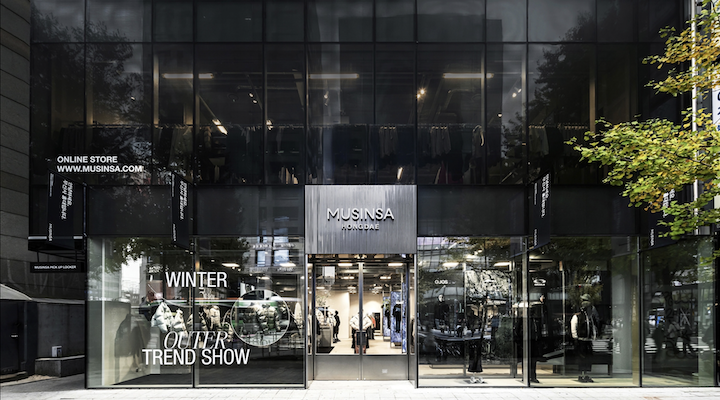
For two decades, the company has built a portfolio of approximately 8000 Korean fashion labels. Its private-label arm, Musinsa Standard, now operates 25 bricks-and-mortar outlets across Korea, while its multi-brand concept Musinsa Store has expanded to three locations.
The domestic engine
South Korea’s fashion market is notoriously fast-moving. Gen Z shoppers in Seoul switch up styles almost season to season, propelled by TikTok aesthetics, K-pop stage outfits and K-drama wardrobes. International giants like Zara and Uniqlo still hold sway, but local consumers are equally excited by niche indie labels.
This is where Musinsa has carved its niche. Rather than focusing purely on efficiency like global e-commerce giants, Musinsa positions itself as a partner to small designers. Through its “one-stop” system, it handles logistics, marketing and payments, giving new brands the infrastructure to scale.
At the same time, the platform engages shoppers with editorial content, community reviews and resale services, creating a digital hub for fashion culture rather than just a transaction site.
Even in a cooling economy, this formula has worked. As Korean households cut back on discretionary spending, Musinsa has maintained growth by leaning into the creativity and cultural relevance of its marketplace.
Meanwhile, in the past year, Musinsa has brought global labels into Korea through Musinsa Trading, its fashion brand business subsidiary.
It recently signed an exclusive deal to distribute Y-3, the high-end sportswear line by Yohji Yamamoto and Adidas, in Korea. The first Y-3 store is slated to open in Seoul in the third quarter. Musinsa Trading has also become the official distributor for Champion, working with Authentic Brands Group to introduce the American heritage brand’s global collections and Korea-exclusive lines to the local market.
The company said it is actively engaged in the official distribution of promising global fashion brands in the Korean market, such as Dickies, JanSport and Havaianas. The company has also partnered with rising designer labels such as 032c, Noah, Marine Serre and Sleepy Jones, supporting their successful entry into Korea. One year after entering into a partnership with Dickies, Musinsa Trading’s domestic sales tripled.
Earlier this year, Musinsa Standard partnered with South Korean convenience store giant GS25 to bring its ‘Musinsa Standard Express’ line to GS25’s 3000 locations. The collection features 12 essential items, including windbreaker jackets, lounge sweatpants, socks, belts and underwear.
“A sizable investment is needed to build logistics infrastructure in the domestic market. An IPO will be a key milestone in our fundraising efforts,” Joon-mo said at the press conference.
Musinsa plans to appoint a lead manager for its initial public offering (IPO) process in the near future, he added, without elaborating.
“Having continuously expanded across categories, sales channels, customer segments, and business models, Musinsa is now fully focused on growth and success in the global domain,” he added.
Gearing up for larger global expansion
The biggest question for Musinsa is whether it can replicate its success overseas, even with the potential IPO.
The company launched Musinsa Global, an English-language platform now spanning 13 Asian markets with 2000 brands onboard and 3 million monthly active users. Since its 2022 debut, sales have grown an average of 260 per cent annually.
Japan has become the company’s most advanced testing ground. Since setting up a Japanese unit in 2021, Musinsa has experimented with pop-up stores, collaborations and brand showcases. Its Japan business has grown 17-fold by 2024 compared to 2021.
Its upcoming Musinsa Tokyo pop-up store 2025 in Shibuya this October is its most ambitious yet. The stand-alone space will span three floors, featuring 80 brands, and even offering cultural tie-ins such as a cafe with Japanese specialty donut shop ‘I’m Donut’. The event will also introduce 13 Korean designer brands that have never before entered the Japanese market.
Earlier this year, Musinsa launched a Chinese subsidiary, with plans to open a curated store in Shanghai by late this year.
“We are pursuing strategic partnerships with top-tier players in key global markets to drive our international expansion,” he said.
By 2030, Musinsa hopes to generate 3 trillion won ($2.2 billion) in overseas GMV, nearly quadrupling its current global business.
To get there, the company plans to expand into three primary regions: Northeast Asia (Japan and China), Southeast Asia (Singapore, Thailand, Vietnam) and select Western markets in Europe and the Middle East.
“We plan to open at least two stores in China, starting with the first in Shanghai in the fourth quarter, and up to three stores in Japanese cities, such as Tokyo, Osaka and Nagoya, early next year,” Joon-mo said at a press conference.
The K-Culture tailwind
If Musinsa is betting big abroad, the timing could hardly be better. The global fascination with Korean culture known as hallyu or the K-wave has reshaped everything from beauty routines to streaming charts. K-pop megastars like BTS and Blackpink are household names; K-dramas dominate Netflix; Korean food has become a global trend.
Fashion is the next frontier. Idols are front-row fixtures at Paris and Milan Fashion Weeks. A single drama placement can cause a designer’s item to sell out overnight. Streetwear brands like Ader Error and Gentle Monster are gaining international recognition.
Musinsa sits at the center of this movement. With thousands of brands under its umbrella, it has the scale to act as a cultural gateway, offering international consumers a curated window into Korean style at the very moment K-fashion is breaking through.
“Now is the perfect time for Korean brands to expand globally, as K-culture goes mainstream and the market is showing unprecedented responses and opportunities,” said the CEO.
Further reading: Musinsa bags $190 million in Series C led by KKR.