One of the first things you notice when you approach the junction of Mulberry and Canal Streets in New York City is a wire block-letter sign declaring “Welcome to Chinatown”. Flanked by two neon-hued dragons, the sign is a marker of one of New York City’s most well-known neighborhoods – home to hundreds of businesses, including restaurants, cafes, and mom-and-pop shops selling everything from porcelain tableware to herbal medications. It is also the name of an ambitious non-profit organi
organization dedicated to saving local businesses and the soul of New York City’s Chinatown.
Businesses on the brink
The organization Welcome to Chinatown was launched in March 2020 during the frantic beginning stages of the Covid-19 pandemic.
At a time when many people were already experiencing heightened anxiety around the health hazards the virus caused, the Asian-American community was also experiencing fear and discrimination caused by hateful and ignorant phrases such as the “China virus” or “Wuhan Flu” being thrown around by civilians and politicians.
In a report conducted by the Center for the Study of Hate & Extremism, while hate crimes dropped by 7 percent overall in 2020, in comparison with the prior year, anti-Asian hate crimes surged by 149 percent, especially in cities like Los Angeles and New York.
Growing xenophobia, combined with the forced closure of brick-and-mortar stores due to Covid-19, brought many Chinatown businesses, some of which had been around for over a century, to the brink. Unfortunately, some businesses didn’t make it.
Wellington Z. Chen, executive director of the Chinatown Business Improvement District/Partnership, has stated that at least 17 restaurants and 139 ground-floor stores in Chinatown have permanently shut down since the pandemic.
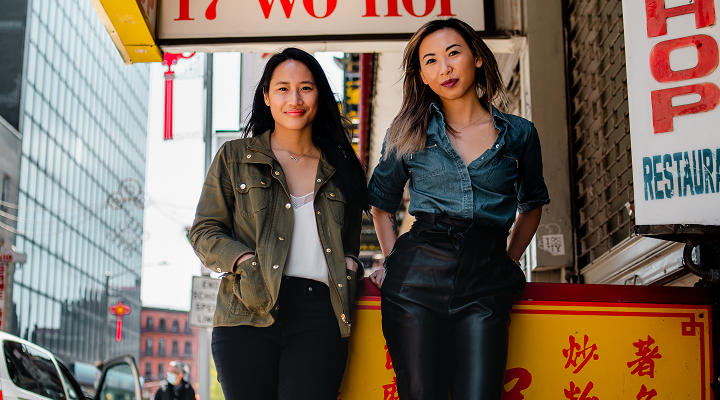
For Victoria Lee and Jennifer Tam, two friends with a deep love for New York City’s Chinatown, standing by and watching this neighborhood fade away simply wasn’t an option.
Lee, a born-and-raised New Yorker, has been visiting the neighborhood since her youth, when her late grandmother had an apartment in Chinatown. Tam, who is from Houston, moved to the neighborhood in the early 2000s, and it inspired her to explore her identity as an Asian-American woman and connect with the area’s vibrant Cantonese culture.
Launching Welcome to Chinatown was their way of giving back to the community that had given so much to them.
“We looked at how much it had given to us – even though the community may not have realized it – as, you know, just your everyday resident. I think that was certainly a driving mechanism for us as we started to get this off the ground,” Tam remarked.
A systemic problem
In March 2020, Lee, whose day job is global travel and meetings director for The Estée Lauder Companies, and Tam, communications and culture lead at VMware, started to discuss how they could use their combined skill sets to save the Chinatown they knew and loved.
Initially, they built a website that listed Chinatown-based businesses that consumers could support by buying electronic gift cards. However, they quickly ran into a major issue. Most businesses in Chinatown weren’t using digital point-of-sale systems. In 2020, only 3 percent of their transactions were digital.
With this in mind, Tam and Lee instead launched a GoFundMe page to raise money to purchase meals from Chinatown restaurants and donate them to essential workers. It was while working with a team to pick up and deliver these meals that they came to fully understand the long-lasting effect ofthe pandemic on the community.
“That’s when we learned more about their challenges and how it had been very prolonged because of the xenophobia, the racist rhetoric that was happening, and how systemic this is. When there is a historical disaster, it continues to impact Chinatown,” Tam explained.
Indeed, even before the pandemic, Chinatown was still recovering from the repercussions of events like Hurricane Sandy (2012), the SARS epidemic (2003), and 9/11 (2001). In times of crisis, Chinatown is often left out of government relief programs due to a variety of factors, including language barriers and its ZIP code.
In 2020, New York City launched a program offering $35 million in zero-interest loans to small businesses in low-to moderate-income areas to help them recover from the pandemic. But because of Chinatown’s proximity to higher-income areas such as Tribeca and SoHo, some businesses in the neighborhood didn’t qualify.
Lee and Tam knew that if they wanted to keep the soul of Chinatown alive, they would need to do more than purchase meals from restaurants. They would need to mobilize the community and help the area’s residents help themselves.
A community effort
Over the past three years, with the aid of more than 100 volunteers, Welcome to Chinatown has evolved from a website where people could simply purchase gift cards, into a multi-layered organization that brings together talented business-people, local artists and craftsmen, and activists to keep the future of Chinatown intact.
For example, the organization has teamed up with small-business owners on collaborations to raise funds for the community, such as Sublima Jewelry’s dragon-inspired signet ring. It has also worked with local neighborhood spots, like Lanterne Candle Lab, to host events to raise funds and boost community morale.
Today, Welcome to Chinatown has three main components:
Meet Chinatown, a digital directory of restaurants, boutiques, clubs and other businesses in the neighborhood.
The Longevity Fund, which provides grants to support locally serving small businesses in Chinatown.
Small Business Innovation Hub, a 2,500sqft space that is currently under construction, where the community will be able to network and receive resources and information, including a start-upaccelerator and incubator program, an artist alley, and meeting rooms for entrepreneurs to rent out.
Run by three full-time and five part-time team members, the organization has amassed a strong social media following, with almost 47,000 followers on Instagram alone, and a number of high-profile celebrity collaborators, such as with actor Simu Liu, who recently appeared in Barbie, actress and rapper Awkwafina, who starred in The Farewell and Crazy Rich Asians, and actor and comedian Ronny Chieng, a senior correspondent for The Daily Show.
To date, Welcome to Chinatown has raised over $4 million dollars for the community, with $1 million dedicated to The Longevity Fund.
Additionally, it has built an e-commerce site for consumers to purchase goods from Chinatown enterprises like Wing on Wo & Co and Grand Tea & Imports. While older generations of business owners remain reluctant to switch to electronic POS systems, businesses that are less than 10 years old have embraced technology and are much more digitally savvy.
The non-profit has also worked with the community to host events, including a Lunar New Year fair and the 88 East fair, both of which were held at East Broadway Mall, an especially meaningful location.
The oldest and largest shopping hub in Chinatown, this once-thriving spot is now fighting potential closure. Lee and Tam hope that by hosting events at this location, they will send a message that Chinatown and its community are not ready to give up without a fight.
“A point that we wanted to make specifically with 88 East Broadway is that we don’t need a big developer to come in and have a ‘savior’ moment to save Chinatown or save that space. So much of that can be done just within the community with the opportunity we’re given,” Tam commented.
Still more work to do
As much as the organization has been able to accomplish in the three years it has been operating, the journey has not been easy. Working full-time jobs and running a non-profit is a mentally and physically taxing experience, though an emotionally rewarding one for the co-founders.
Tam noted that after a few months, she and Lee had to step back and get a view of the bigger picture.
“I got this advice from a co-worker of mine and it’s that you cannot pour from an empty cup,” she said. “When we started Welcome to Chinatown, we were just running on pure adrenaline. On top of the 40 hours at our job, we were pulling another 20 to 40 hours for Welcome to Chinatown, and we were just all systems go.
“We started to recognize, as co-founders and builders of this organization, what things matter to us most – to ensure that we’re not just doing things that we feel are necessary to build the gaps, but things that we genuinely believe are real opportunities for this neighborhood.”
While much has been achieved, there is still more work to be done. Welcome to Chinatown’s 2022 impact report showed that visitation in the area was still down 50 percent from pre-pandemic numbers. Neighborhood favorite bookstore Yu and Me Books experienced a devastating fire in July 2023 and the physical location is expected to be closed for a year while repairs take place.
In the past, the business might have shouldered this burden alone, Welcome to Chinatown immediately spread the word and issued a call to action to help the bookstore raise funding for repairs, workers’ salaries, and events to be hosted before the shop reopens.
Slowly but surely, the community is working together to ensure a bright future for this entrepreneurial neighborhood.
This story first appeared in the September 2023 issue of Inside Retail US magazine.