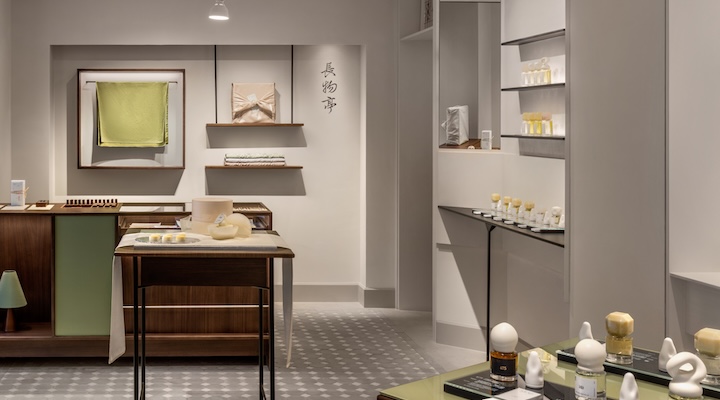
A soft light spills through the glass facade of a newly restored 1960s building at 52 Yun Ping Road in Hong Kong’s Causeway Bay. Inside, the scent of osmanthus mingles with whispers of sandalwood and tea. In contrast to the understated grey facade, the interior opens into a warm, tactile space – mosaic floors, timber tables and gauzy curtains evoking the quiet elegance of a salon. This is To Summer Causeway Bay, the Beijing-born fragrance brand’s first store outside Mainland China. The sto
he story behind the space
Rooted in the concept of “Made in Hong Kong”, the space pays tribute to the unsung women behind the city’s manufacturing boom of the 1960s, particularly in textiles, plastics, printing and publishing.
“Upon our arrival in Hong Kong, we naturally sought to uncover the city’s unique cultural identity,” Elvis Liu, CEO of To Summer, told Inside Retail.
“Our brand ethos is rooted in tracing Eastern heritage and honoring the warmth and legacy imbued by craftsmanship and time. The ‘Made in Hong Kong’ era is a crucial historical marker.”
On the window sits a small journal titled Wandering Her City. Co-written with Hong Kong writer Cheng Jiaoyang in the first-person perspective, it reveals the hidden stories of female artisans and cultural spaces through the two specially curated walking routes.
The store is divided into four sections – the Eastern Ingredients Studio, Changwu Pavilion, Study Room, and Bathroom.
The Eastern Ingredients Studio features the fine mosaic tiles that trace back to the building’s original construction in 1958. Raw materials and essential oils are arranged to resemble an olfactory exhibition.
Meanwhile, a display of archival photographs pays homage to Chang Wai Chun, one of Hong Kong’s first female photographers. Above the product display, a dense bookshelf holds local spice guides, botanical records, and perfumers’ journals, creating a quiet epic of Eastern ingredients told through scent.
Turning left, the Changwu Pavilion, co-created with Hong Kong designer Alan Chan, becomes a tactile dialogue between past and present. Galvanised iron mailboxes recall the Hakka metalworkers who pioneered tin craftsmanship in the 19th century. Silk remnants from Sham Shui Po’s textile market drape softly over wooden surfaces.
Beyond, a beaded curtain leads to the Study Room, where To Summer has curated rare books about Hong Kong’s women and craft history. Here, literature replaces product displays. To Summer said the room honors the unrestrained thoughts of female writers and preserves the emotional connections of Hong Kong’s residents to their streets and shops.
To Summer calls the Bathroom area a “room of ritual” representing women’s private acts of self-care and introspection.
“New Life from Old Soil”
Since its founding in 2018, To Summer has quietly built a cult following across China. Its stores in Shanghai, Beijing, Chengdu and Guangzhou are as much architectural essays with a physical translation of the brand’s motto ‘One Store, One Story’.
In Shanghai, To Summer occupies a century-old Spanish-style mansion on Hunan Road; in Beijing, a quiet courtyard on Guozijian Street; in Chengdu, the former Sichuan Fine Arts Publishing House. Each space reinterprets the local culture and materials of its setting, creating what the brand calls “New Life from Old Soil”.
The Hong Kong store continues this spatial philosophy.
“The ‘Made in Hong Kong’ era is a crucial historical marker,” Liu explained. “The manufacturing boom of the 1960s not only drove economic prosperity but was also built on the tenacious contributions of countless female workers who, in industries like textiles, plastics, and printing, used their own hands to forge Hong Kong’s golden era.”
A dialogue between fragrance and craft
To Summer emerged during a cultural moment in China when homegrown lifestyle and beauty brands began rediscovering their own aesthetic identity. Rather than mimic Western perfumery codes, the brand built its creative universe on a different foundation: Chinese philosophy, material culture and memory.
“Our approach to Eastern scent is fundamentally rooted in artistic conception and emotion,” Liu said. “We believe a scent should engage in a profound dialogue with Eastern memory and local culture. It never stops at a fleeting moment of inspiration; instead, it undergoes countless cycles of refinement and reimagining.”
For example, Osmanthus, one of its most celebrated fragrances, is created to capture a sense of Eastern nostalgia, echoing the sentiment of a classical poem which was roughly translated as “I wanted to buy osmanthus and share wine, but it wasn’t like the days of youth”.
Or in Mongolia, another key fragrance, Liu describes the inspiration as “the tender memory of a grandmother in old Shanghai pinning a magnolia blossom to a child’s lapel.” Traditional magnolia notes can be overpowering, but To Summer’s version blends Chinese white magnolia essential oil with five other florals to evoke delicacy rather than density.
“This three-year development process was dedicated to perfectly aligning the emotion with the scent,” he shared.
Every vessel, including candle jar, diffuser and bottle, is crafted in collaboration with artisans from Jingdezhen, Dehua and Boshan, merging ancient Chinese ceramic and glass techniques with contemporary design. The Scented Wood Wick Moonlight Candle, for example, employs a milky jade glass technique to emulate the soft glow of Hetian jade.
“Artisans hand-pressed the moon’s form at 1400°C, then employed a jade cold-polishing technique to achieve a final lustre, showcasing the resilience and warmth of true craftsmanship,” Liu explained. “In every To Summer product, the vessel itself is a fusion of Eastern artistry and contemporary aesthetics.”
Localization through cultural precision
For To Summer, Hong Kong is its first test for international expansion, where cultural nuance matters as much as commercial success.
“We are concerned not just with sales, but with whether the cultural philosophy behind our brand can be accurately understood by local and international customers. This will determine the depth of To Summer’s internationalization process,” Liu said.
“The complete delivery of this experience is highly dependent on our physical spaces, which function as both content vehicles and scene mediums. This is why we didn’t choose to enter the market through shortcuts like e-commerce or simple channel partnerships.”
According to the CEO, while To Summer’s brand narrative is deeply rooted in local culture and memory, it essentially embodies a form of Eastern aesthetics that transcends regional boundaries.
“This aesthetic belongs not only to China but also to the broader East Asian and pan-Chinese cultural spheres, having already established a wide-ranging foundation of influence internationally. Therefore, our confidence stems not just from our own brand’s aesthetic framework, but from our deep-seated conviction in the profound heritage of traditional Chinese aesthetics.”
To Summer currently operates 15 stores in its home market. From Hong Kong, the brand plans to consolidate in Macau, expand through Asia, and eventually enter New York and Paris.
The Eastern fragrance movement
To Summer’s emergence is also part of a broader reconfiguration of the global fragrance landscape. Once dominated by French maisons and Western niche houses, the market is increasingly being diversified by Asian brands that combine local heritage with global sophistication, such as Documents and Melt Season.
In addition, as Western markets mature, Asia has become the world’s growth engine for beauty and fragrance, fueled by young consumers, rising income levels and renewed cultural confidence.
“Asia is becoming a vital engine of global economic growth,” Liu said, adding the region’s advanced productivity and a massive population base that is set to transform into a powerful consumer force over the next two decades.
“At the same time, Asian culture is on the rise,” the executive continued.
“The East Asian region shares profound cultural commonalities, and the rediscovery and reinterpretation of this heritage provides a rich narrative foundation for the aesthetic realm of ‘Eastern fragrance’. This is also helping to forge a broader Asian cultural identity. As Asia’s economic power strengthens, we believe this cultural influence will inevitably continue to radiate outward globally.”
Liu expects that over the next few years, the Asian fragrance market will enter a crucial period of growth, with diverse development opportunities emerging, whether in Thai naturalistic aromatherapy or East Asian-style fragrances.
“Over the next decade, Asia’s economic development will inevitably propel its culture onto the global stage,” he concluded.
“Eastern culture, with its unparalleled charm, is primed for this moment. To Summer hopes to leverage this trend, capitalizing on this economic uplift and cultural exchange to achieve a global transmission of its brand values and expand its footprint worldwide.”
Further reading: How China’s fragrance scene is reimagining luxury, heritage and global influence.