The Milan-based luxury house Prada Group closed 2025 with €5.7 billion in revenue, up 9 per cent at constant currency, marking its 20th consecutive quarter of growth despite what executives described as one of the industry’s toughest years in recent memory. Prada Group CEO Andrea Guerra said in the earnings call the luxury industry has lost roughly one out of five consumers over the past several years amid tighter economic conditions and the fading of the pandemic-era shopping boom. Ye
Yet Prada Group has managed to sustain momentum.
“We are pleased to report another solid set of results in 2025, with healthy growth and sound profitability, achieved in a challenging macroeconomic and industry context,” chairman Patrizio Bertelli said when announcing the results.
Retail sales, the company’s largest revenue driver, rose 9 per cent year-on-year to €5.1 billion, driven primarily by like-for-like performance and full-price sales rather than heavy discounting or aggressive expansion.
Guerra attributed the resilience to what he described as “meticulous execution” across the organization, from product storytelling to digital tools and store experience.
The group maintained strong profitability even as it increased spending on marketing, retail upgrades and technology.
“We continued investing in our people, in digital technology and AI tools, and in upgrading hospitality in our stores,” Guerra said. “Even if the level of investments has been over-proportionate, we were able to keep a steady profitability.”
The unstoppable rise of Miu Miu
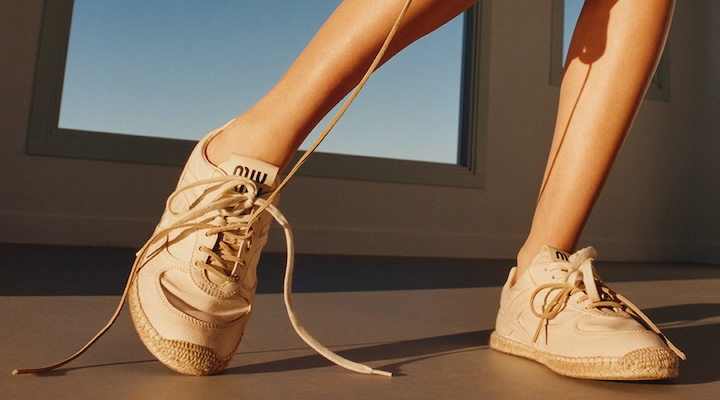
While Prada’s flagship brand remained stable, the real star of the group’s portfolio was Miu Miu. The label delivered 35 per cent retail sales growth last year, even after a spectacular 93 per cent increase the year before.
Executives attribute much of the brand’s success to its ability to merge fashion with culture and entertainment.
“Throughout the year, our fashion shows reaffirmed Prada’s ability to anticipate and shape contemporary culture,” said Lorenzo Bertelli, the group’s chief marketing officer and head of corporate social responsibility.
For Miu Miu specifically, he pointed to “vibrant, disruptive creativity” and a growing cultural dialogue with younger consumers as key drivers of demand.
Financially, the growth has transformed the group’s brand mix. Miu Miu now accounts for 31 per cent of Prada Group’s retail sales, up from 25 per cent a year earlier.
Yet management is already preparing investors for a slowdown.
After four years of extraordinary expansion, comparisons are becoming difficult. The company expects single-digit growth in the first half of 2026, followed by stronger momentum later in the year as the brand settles into a more sustainable trajectory.
“We have begun our growth normalization journey that will continue during 2026,” Guerra said.
Stabilizing Prada
The Prada label itself has faced a more complex environment.
Retail sales declined around 1 per cent for the year, though performance improved steadily throughout 2025 and turned positive in the fourth quarter.
Executives say the brand continues to rely on creativity and cultural engagement to maintain its relevance.
Retail innovation has also become a strategic priority. Projects such as hospitality-focused boutiques in Shanghai and Singapore and new flagship stores in New York and Hong Kong aim to transform shopping into a broader lifestyle experience.
According to Guerra, the goal is to strengthen the company’s relationship with clients by improving both product storytelling and the in-store experience.
“We have significantly upgraded hospitality inside the stores and outside the stores,” he said.
Asia remains central
Geographically, Prada Group’s performance reflects shifting global demand patterns.
Asia Pacific remains a critical market, with retail sales rising 11 per cent over the year. Mainland China, Korea and Japan contributed strongly, although geopolitical tensions and changing travel patterns continue to influence regional spending.
Meanwhile, the Americas delivered the fastest growth, up 18 per cent, driven primarily by domestic demand.
Europe showed more modest expansion, with sales rising 5 per cent, as tourism slowed and comparisons became tougher.
The Versace challenge
Prada Group’s acquisition of Versace was finalized last December. Bertelli described the brand as “a highly complementary addition to Prada Group’s existing portfolio,” highlighting its global recognition and strong cultural identity.
But integrating Versace will be neither quick nor easy.
The brand generated €684 million in revenue in 2025 but recorded operating losses, and Prada expects losses to continue in 2026 as the turnaround begins. Management plans to reposition the business by tightening distribution, reducing discounting and focusing on full-price sales.
“The journey will go through a first phase of channel repositioning, supporting high-quality full-price sales and distribution,” Guerra said.
Creative leadership will also play a central role. Designer Pieter Mulier will join as chief creative officer, with his first collection expected to debut next year.
Until then, 2026 will serve as a transition year, which could temporarily weigh on the group’s profitability.
“We are beginning the journey with Versace – a year of consolidation, a year of synergies and a fantastic start to shape the creative vision,” Guerra said.
A new phase for Prada
After five consecutive years of expansion, Prada Group is entering what executives describe as a “new journey”. The goal remains to outpace the broader luxury market while building a deeper portfolio of brands capable of sustaining long-term growth. In a more volatile environment, Guerra noted, agility and efficiency have become “non-negotiable”.
Further reading: Why Prada’s Lorenzo Bertelli will lead Versace’s most critical turnaround yet.