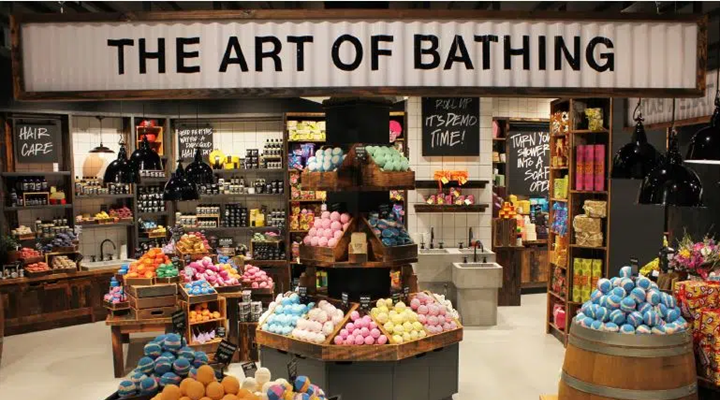
The revival of the flagship is back and with it, Lush is taking center stage. Lush Cosmetics is reopening its Sydney flagship in the Queen Victoria Building (QVB). The store last year drew nearly 280,000 customers and has been transformed into a multi-sensory, sustainable ode to “the magic of retail”. Beyond the allure of bath bombs and handmade body care, the store relaunch reinforces the trend of physical flagships being reborn as immersive epicenters for brand experience in an age defi
efined by digital viability and convenience.
“Our QVB flagship is designed to be more than a beauty store; it’s a space where people can really play with our products in the way they were intended and connect with our brand vision in a way that feels real,” Madeleine Bland, general manager of retail, told Inside Retail.
“We believe that experiential retail is key to the future of brick-and-mortar. People need a reason to leave their homes, and we want to give them one; a shared experience that lives on beyond the visit,” she added.
Brian Walker, chairman and founder of Retail Doctor Group, framed it succinctly in a recent LinkedIn post: “Retailers who understand this know that brand theatre is not frivolous – it is the deep emotional stage where loyalty, advocacy and memory are built.”
Globally, flagships are shifting from transactional spaces to cultural destinations, cultivating narrative, choreographing connection and, as Walker put it, “reviving – as stages, stories and soul”.
The reimagined Lush experience
Inside the redesigned flagship, facemasks sit piled on ice like gelato, handmade soaps are pressed at Lush’s local factory by artisans rather than machines, and the fixtures are crafted from recycled and reclaimed materials.
“You might walk in for a bath bomb and find yourself in a jelly play-off or guided through the fresh innovations in our handmade skincare range,” Bland said.
The effect is not a conventional shop floor but a sensory environment where sustainability, craft and play converge.
“We wanted to reimagine the Lush experience full of color, curiosity and a touch of whimsy,” Bland said. “Every corner of the store holds a surprise. We’ve designed our store to spark awe and wonder and to remind people why Lush is unlike any other beauty experience, our own oasis of kindness amidst the bustle of the city.”
Brick-and-mortar in the digital age
For years, the prevailing notion was that e-commerce would make flagship stores redundant. Evidently, the reverse is happening. As shopping migrates online, the role of physical retail has shifted, with its value lying in the intangible.
What this revival calls attention to is that bricks-and-mortar stores are no longer relics of the pre-digital age and are conversely becoming brand epicenters.
Lush exemplifies a highly curated environment that tells stories, teaches rituals and brings communities together. For Lush, that means personalized scalp consultations, skincare classes and bath-bomb-making workshops.
For other retailers, it may take the form of tastings, design showrooms or interactive product trials.
By re-establishing its Sydney flagship as a site of immersion, Lush is building longer dwell times, organic advocacy and social content, outcomes that extend far beyond the four walls of the store.
This may be crucial in categories where competition is intense and margins are thin. Beauty, like fashion or hospitality, is saturated with alternatives, and differentiation no longer rests on price or convenience but on experiences that inspire, educate and reflect values.
A flagship that embodies sustainability, creativity and kindness cannot be commoditized easily online.
The future of the flagship
Flagships are no longer being defined by their size or scale, as their true function is equal parts experience, emotion and engagement.
In an era of fragile loyalty and relentless digital distraction, the resurgence of flagships reflects a deeper truth in how consumers seek not only access to products but presence within a brand’s world.
Lush’s latest relaunch illustrates this shift with clarity. The role of physical retail is not to compete with digital but to complement it by doing what digital cannot: giving customers a place to step into imagination rather than just a transaction.
For brands looking to grow, that is a space built on strategy, story and community as Bland puts it: “A great flagship is defined by the people in it. Those who turn everyday interactions into unforgettable moments. That’s when we know we’re succeeding, when joy, curiosity and human connection are as much a part of the experience as the products themselves.”