As we walk through a busy corridor on the seventh floor of Miniso’s Guangzhou head office, our guide stops and points out the window to a scaffolded skyscraper under construction. “That’s our new headquarters, where we will move next year,” he explains. The 60-storey building, which will be among the city’s tallest when it opens, is an apt metaphor for Miniso’s rapid growth and global success. Today, it occupies floors 3-19 of Minfeng Plaza, which it has outgrown in just three
ree years.
Founded in 2013 with a single store in Guangzhou, a sprawling industrial city some 160km north of Hong Kong, Miniso now has almost 8000 stores across 112 countries and markets. It was listed on the New York Stock Exchange in 2020 – a remarkably quick progression – and two years later, in the midst of Covid, on the Hong Kong exchange, too.
When it first forayed outside Mainland China in 2015, Miniso made much of commissioning a Japanese chief designer and made clumsy attempts to position itself as “inspired by Japan”, likening itself to homewares and apparel retailer Muji. (Some were quick to note, also, the likeness of Miniso’s logo to that of Japanese apparel company Uniqlo). The company seemed to foster the consumer perception that Japanese brands offer “higher quality, sophisticated, and trustworthy lifestyle products” at affordable prices, as Arab News Japan reported in 2022.
Facing backlash from Chinese consumers, who considered the brand “insufficiently patriotic”, the company apologized on the local social media platform Weibo for its Japanese references.
However, Chinese consumers were very forgiving. Very quickly. The company realized it could embrace its Chinese heritage and champion its Guangzhou base. Since then, it has never looked back.
A year later, it opened a global ‘super flagship’ in New York’s Times Square and, last year, took its place among the European luxury brands lining the Champs d’Elysees, a remarkably bold reputational move for a brand that specializes in inexpensive household consumer products, gadgets and health and beauty consumables.
Miniso now interacts with more than 1 billion consumers worldwide, reaching across most generations, although with a female skew. More than 100 million customers are registered members of its loyalty program, including more than 70,000 core KOCs (key opinion consumers). “These KOCs play an essential role in co-creating products and content with us – serving as a bridge between Miniso and its global community,” explained an executive at the company’s headquarters.
Last year, the company sold 40 million blind-box toys and 50 million plush toys, priced typically between $5 and $49.
Where designs live or die every week
Minutes after pointing out the new headquarters, our guide leads us back to the reception, where a group of Thai visitors are posing for photographs in front of a giant, egg-shaped soft toy, one of Miniso’s own IP characters, Dundun Chicken. “Behind that wall,” he gestures towards an unremarkable painted door, “1000 people are working to come up with new ideas.” Others work in separate locations in South Korea and China, with new hubs in planning for Japan and the US.
Through that grey door and onto the design floor, the first impression is chaos.
Our guide accurately admits the design studio, which now sprawls across two floors, is “usually a mess”. Still, the chaos almost amplifies the authenticity, and there is clearly an organized structure beneath it all. One team is working on blind boxes, another on plush toys, another on plastic brick toys, and more still on household goods, cosmetic packaging, and the vast array of other SKUs Miniso creates for the world. Unsurprisingly, photography was banned inside, but we can share that each designer has their own small cubicle, surrounded by ledges covered with toys, existing stock items, or early prototypes. On one person’s desk, we spotted an assembled Lego McLaren F1 car.
Every week, those designers develop new creative ideas, series, and toys. The selection process for new products is brutal, a strategy management believes is core to its ongoing success.
A rotating pool of 10,000 potential unreleased product designs exists. Every Monday, the leadership team – led by Ye and, if they are in town, executive VP and chief merchandising officer Ada Dou – selects 100 new SKUs from that pool for manufacturing. And every week, at least 200 products they don’t like are axed, with the design team charged with coming up with an equivalent number to replace them. The pressure and pace of product development are relentless; the discipline is robust.
“That’s why so many consumers, whenever they visit a Miniso store – even if they go once a month – always feel that there’s something new, and every visit feels completely different,” says Chen Changxue, Miniso’s PR director. “That fast turnaround is one of our key strengths.”
After a product gets the green light to develop and launch, the company’s quality control system, called One Plus One Plus One, comes into play. One of Miniso’s 1500 contracted manufacturing suppliers presents the finished design, and Miniso checks it internally. If it passes, it goes to a third-party quality assurance partner for assessment; if it passes that stage, another quality assurance team in the product’s ultimate international market reviews it again against local regulations and standards.
The path from a product concept to a store shelf might, on the surface, seem overwhelming to a designer, but the company believes it fosters a culture where staff are valued and rewarded. Every year, Miniso’s HR leaders, joined by their department heads, visit China’s top universities to identify, attract, and cultivate the talent they believe will help the company maintain its leading edge as future leaders.
Across about 10 HR recruitment programs, with catchy names like the Lion King and the Dark Horses, interns are inducted into every department of the business to learn its operations. “The core idea is to cultivate them while they are still students. Professors are asked to nominate their most promising students, and we invite them here, and we try to explain them by rotating them in every single department; hopefully, they will become our future leaders.”
If they make the cut, they are well rewarded by Chinese standards. Eight years ago, Ye ordered the creation of a dedicated in-house Department of Corporate Culture. His mindset, our guide explains, is that talent and corporate culture are Miniso’s most valued assets. “He wants every single person in our business to understand our core business and our principles.”
Those principles, or pillars perhaps, loosely translate into English as: Simplicity, integrity, and positivity. More recently, promotion and efficiency have been added.
Employees are expected to demonstrate devotion to the brand and their work and a long-term commitment to truth and integrity. In return, they receive workplace perks such as on-site massage services and catering. When the new headquarters opens, they can apparently expect even more benefits.
An uncapped baby bonus of 10,000 RMB ($1400) awaits every parent when a child is born, and there is even a complimentary wedding planning service. Staff are encouraged to volunteer and participate in a range of company initiatives, from disaster relief to animal welfare.
Many businesses proclaim commitments to exceptional employee well-being and benefits (especially to visiting journalists), but the atmosphere at Miniso’s headquarters suggests those words have been transformed into deeds.
I’ve toured factories in Asia where workers appear glum, sitting in silence in buildings with poor ventilation while desperately focused on meeting targets. Here, though, staff smile and chat freely, move around with purpose and generally seem to enjoy their work. In all, 3000 people work for Miniso, and their average age is 29.5 years.
Miniso manufactures none of its products. Its entire range of 10,000 current SKUs is sourced from approximately 1500 suppliers, 80 per cent of whom are located in China, many of whom have been with the company for 10 years or more.
Part of the success of long-term suppliers is partnerships. Ye has always strived to never owe a single renminbi to any of its suppliers. Even during the Covid-19 era, it did its best to ensure all partners were paid on time.
Going glocal
As Miniso expanded outside Mainland China, it recruited experts in each overseas market to optimize local opportunities by understanding consumer behavior, preferences, and shopping habits.
“Every single market in the world gives you a different challenge. They require a different perspective to address these challenges. We knew that the Chinese mindset could only take you so far. After that, you need to find professional international talent. That’s what we did, and that’s why we are having success all around the world,” said Changxue.
“Cultural understanding is vital. We collaborate with local celebrities, influencers, and online communities to create content and connect the brand with local culture – reinforcing our storytelling and brand value wherever we operate.”
The company also understands that climate, customs, and shopping behavior can affect sales across different geographies. In hot, humid climates like those in Indonesia, for example, makeup needs to be water-resistant. Scents have different profiles: fruity and fresh in Southeast Asia, deeper and muskier in the Middle East.
“Our globalization strategy combines international scale with local adaptation – what we call glocalization. On the one hand, we manage a centralized global product and logistics network, ensuring efficiency and consistency. On the other hand, we create locally tailored products for different markets,” Changxue explained.
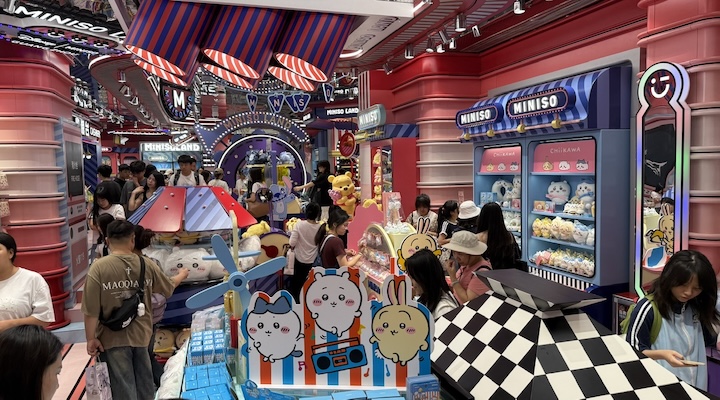
In China, Miniso stores are typically located inside malls, whereas in Southeast Asia, mainstreet stores, such as the co-branded Barbie store in Ho Chi Minh City, Vietnam, perform better.
“Our business mindset has adjusted to the changing global marketing environment. We believe that our customers require a unique shopping experience.”
Miniso’s deepest market penetration is in Indonesia, where it has just under 400 stores. India follows and the US is catching up with more than 320 stores, ahead of Mexico.
The growing focus on IP
When Ye launched Miniso in 2013, his vision was to provide affordable, high-quality products with a focus on simple, natural design. A better life should not be dependent on a high price point, he mused at the time. Later, it would embrace a new direction: To become a tech-driven company.
Last September, Miniso reinvented its mantra a second time. Now its goal is simpler: to become the world’s number one IP operator. It’s a goal that seems well within reach, given that this year it is on track to sell 800 million IP products globally, including its latest range of Zootopia 2 movie tie-ins, which are among its most successful yet. Those products span almost every category imaginable, from plush toys women attach to their handbags or phones to drinking tumblers, metal badges, collectable toys, pet rugs, and even makeup.
Miniso’s first IP partner was Sanrio, maker of Japan’s eponymous Hello Kitty. After strong sales, the company decided to pursue more partners, including Marvel and Disney. Today, the list of IP partners includes 150 brands, such as Barbie, Brillo, Toy Story, Chiikawa, and Harry Potter, as well as characters Miniso has created, including Minipen, Penple Toy, Kumaru, Yoyo, and Hey DunDun.
“Through collaborations with GQ, Chiikawa, Universal, and Sanrio, we gained deep operational experience on how to plan annual release cycles, integrate store displays, and engage fans,” says Changxue.
“During the past year or two, we felt ready to go further – to build our own IPs. This doesn’t mean licensed IPs are less important; in fact, our self-owned IPs make our licensed collaborations even stronger. Owning IP gives us creative freedom. For example, one day, Yoyo-chan could collaborate with Disney or Sanrio. It opens new possibilities. So, rather than replacing licensed IPs, we’re expanding the ecosystem: One plus one is greater than two.”
“When we select product categories for each IP, we consider its character traits and find the most suitable product form. For example, for Chiikawa, we focus heavily on plush toys, keychains, and accessories, as these complement the IP’s soft and playful characteristics.”
Two long-standing Miniso characters are Dundun Chicken and PanPan the Penguin from PampleToy. Both are our self-owned IPs that have been part of Miniso for a long time. In Mexico, for instance, local consumers affectionately call PanPan “Mr Miniso” – they see him as the brand’s ambassador.
“Labubu proves that a Chinese IP can succeed globally. In the near future, there will be two, three, or four more new Chinese IPs following that path,” predicts Changxue.
This aligns with Miniso’s transformation from a traditional retailer that started out selling storage boxes and makeup to a brand that caters to interest-based consumers. “Today’s retail is increasingly about emotional and identity-based value – things that offer social connection and a sense of belonging. So in the future, it’s often the “useless” things – items without direct functional purpose – that bring consumers greater joy and meaning. Retail today is about emotional satisfaction, self-expression, and shared experiences.
“That’s the kind of value a retail company like ours aims to provide. In the past, an IP-themed dog plushie might have included extra features or attachments; now, we see that ‘functionality’ is less important, and emotional design matters more. We’re not abandoning function entirely – but in the IP retail market, high-income consumers are those most likely to pay for emotional or IP value.”
A fan in Indonesia, who was about to get married, wrote to Miniso, inviting PanPan to their wedding, saying that Miniso and PanPan had witnessed their love story. “We were so moved that we made a life-sized PanPan mascot and sent it to Indonesia to appear as a guest of honor at the wedding ceremony.”
The blind box phenomenon and candy-glue plush
Undoubtedly motivated by the roaring success of rival Chinese toy and gift retailer Pop Mart, Miniso quickly pivoted in recent years to blind boxes, featuring many of its IP partners. “We believe that blind boxes promote our brand and our creative ideas.”
He suggests that blind boxes and IP-based toys and collectables are resonating with consumers globally because they speak to consumers’ emotions while appealing to multiple generations.
One product, a Disney 100th Anniversary Stamp Blind Box, combined collectability with functionality, serving as both a fridge magnet and a postcard, allowing users to write messages and gift them to friends.
Last year, Miniso ventured into a new plush subcategory – ‘candy-glue plush’.
“The key advantage of this innovation is that it solves the facial inconsistency issue in traditional plush manufacturing – ensuring every plush face looks identical. That’s why in China, where consumers often ‘pick faces’ when buying plush toys online, candy-glue plush has exploded in popularity: it ensures perfect consistency in expression and shape.”
Meanwhile, the company’s ACG-themed items – like anime-inspired badges, pendants, and accessories – serve as identity markers for fans and are distinct from traditional categories.
The company is also developing Lego-like brick-built toys, aiming to take some of the burgeoning market share of Lego, which one Miniso executive described as overpriced, creating an opportunity for smaller rival brands to eat into its market share.
Why online is less of a priority
In an increasingly online retail environment, Miniso seems to be breaking the mold by prioritizing offline stores over online, primarily because physical stores offer an emotional connection and a richer experience.
“E-commerce is developing rapidly, both in China and overseas. Internally, we’re reorganizing and experimenting to strengthen this channel,” one executive shared. “For instance, our domestic e-commerce team, which includes platforms like Taobao and Jiji, is building its own product team.
“In the past, we simply sold the same products both offline and online. We now realize that each platform serves different consumer groups with distinct expectations. So we customise products for each e-commerce platform. For example, on Douyin (TikTok China), where video marketing is particularly powerful, we might launch larger plush toys at higher prices with stronger visual appeal, which are ideal for video promotion and perform extremely well.
“On platforms like JD and Pinduoduo, the demographics and purchasing habits differ again, so we adapt the assortment and pricing accordingly. We see e-commerce not just as another sales channel but as a personalized, platform-specific ecosystem.
“Overseas, we see tremendous potential. We’re optimizing both our product range and distribution channels. In markets like Malaysia, we’re already managing e-commerce and offline stores as a single business unit, so that pricing and brand positioning stay consistent – online serves as a complement to offline, not a competitor.”
That does not mean that exclusive or first-release products will be launched online.
“Possibly, yes,” says Changxue. “But our core focus remains offline. Everything we do starts from one question: ‘How can Miniso connect products with consumers through the best possible experience?’ That connection is built through physical space: Our stores. Even with something like the Harry Potter collection, what makes it special is not just the product itself but the immersive Hogwarts-style setting in which consumers shop. That kind of emotional, experiential retail simply can’t be replicated online. That’s why we continue to prioritize offline retail, where we can experiment with interest-driven, experiential consumption.”
Growth won’t come recklessly
Miniso says it plans to open 900-1100 stores annually through 2028. That will take the network to around 10,000.
But the brand’s focus on store development has shifted. Changxue says it is pursuing store quality over quantity. “This means that even if the number of new stores grows more slowly, we are ensuring each store’s quality, design, and profitability are superior. The strategy moving forward is to open larger, better stores.”
“Miniso is not after easy money,” another executive shared. “We are not after quick income. We understand that making money is challenging, and we recognize the importance of sustainability in this line of business. This can only be achieved through a strategic partnership. Every man for himself is not going to work out in this line of business. That is why we focus our efforts on local partners and local IPs, as they seek to grow their businesses. We know Miniso is the best option for them to grow their business.
“We will not blindly open stores. Each must operate efficiently. Our goal is high-quality growth. If a store model proves highly replicable and profitable, we’ll still expand it – but growth will always prioritize quality over quantity.”
From plain stores selling inexpensive stationery, gadgets, storage solutions, and makeup a decade ago, Miniso is now a completely different retailer. One can only wonder what the next few years will bring – along with that towering new head office.
Miniso paid for Inside Retail’s flights and accommodation to visit Guangzhou but had no influence over the story.