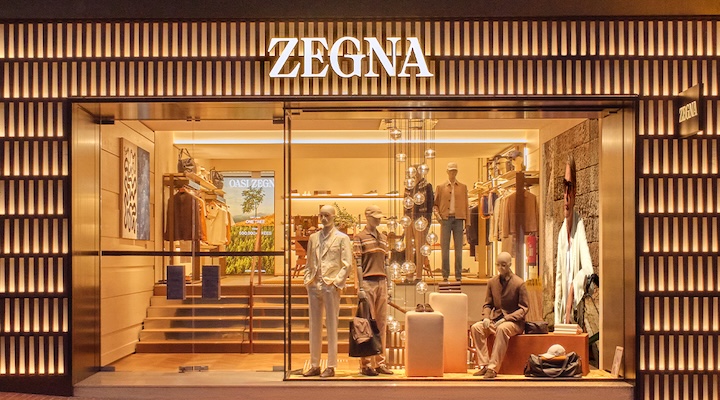
Milan-based Ermenegildo Zegna Group has reported revenues of 1.92 billion euros for the full year 2025, down 1.5 per cent year-on-year on a reported basis. However, sales in the latest quarter were up 4.6 per cent organically, driven by accelerating momentum in direct-to-consumer (DTC) channels across all three brands – Zegna, Thom Browne and Tom Ford Fashion. Direct control over scale The group has set a few strategic priorities to improve sales, including fewer doors, tighter distribut
tribution, and greater control over brand presentation and pricing. Last year, DTC accounted for 82 per cent of branded product sales, up from 78 per cent a year earlier. Group DTC revenues rose 7.9 per cent organically for the full year and nearly 10 per cent in the fourth quarter alone.
The group flagship brand Zegna delivered €1.18 billion in annual revenues, growing 4.7 per cent organically. In the fourth quarter, its DTC sales rose more than 10 per cent organically, a sequential acceleration that management attributed to stronger performance in EMEA and the Americas, particularly the US.
Thom Browne, by contrast, remains in transition. Full-year revenues fell nearly 15 per cent as the brand aggressively trimmed wholesale exposure, especially in department stores. Yet its DTC channel told a different story: organic growth of nearly 8 per cent for the year and double-digit growth in Q4, driven by the Americas and Japan.
Tom Ford Fashion, still being integrated following its acquisition, posted modest organic growth for the year, with DTC up nearly 10 per cent. Q4 performance softened sequentially after a marketing-heavy third quarter, but management maintained its focus on building long-term retail discipline rather than chasing short-term volume.
The common thread is intentional restraint. Wholesale revenues across the group fell more than 20 per cent organically last year – a sharp contraction that reflects not weakening brand desirability, but a decision to limit distribution of certain products and exit lower-quality doors.
The China reset and why it matters
No discussion of luxury today is complete without China. For Zegna, the picture remains challenging. Revenues in the Greater China region fell nearly 12 per cent organically last year, with another high-single-digit decline in the fourth quarter.
Management pointed to a combination of factors, including softer local demand, uneven recovery at Thom Browne and Tom Ford Fashion, and timing issues in wholesale deliveries. However, Zegna’s China business, once heavily dependent on wholesale partners, is being reshaped into a more controlled, DTC-led model, a transition that inevitably depresses short-term numbers.
Meanwhile, the Americas delivered the strongest performance in the group, with revenues up 12 per cent organically for the year and more than 15 per cent in Q4. EMEA also returned to growth in the final quarter, supported by both local clients and travel retail.
Succession as strategy
The financial reset is unfolding alongside a carefully choreographed leadership transition.
“This performance confirms the strength of our vision and the relevance of our strategy: 2025 was also a milestone year for our group and for our family. I have decided to take a step forward as we empower the next generation of leaders,” Ermenegildo “Gildo” Zegna, executive chairman of the Ermenegildo Zegna Group, said in a statement.
From January 2026, third-generation steward Ermenegildo “Gildo” Zegna steps into the role of group executive chairman, while long-time finance chief Gianluca Tagliabue becomes group CEO. At the brand level, fourth-generation family members Edoardo and Angelo Zegna have been appointed co-CEOs of the Zegna brand, dividing responsibilities between brand, digital and image on one side, and commercial and retail execution on the other.
Tagliabue becomes the first non-family CEO in the group’s modern history, formalizing a power-sharing model that separates brand guardianship from operational execution. Gildo Zegna retains oversight of the group’s textile platform, sustainability and external relations.
A quieter luxury playbook
Zegna’s 2025 results will not thrill momentum investors. But they should interest anyone watching how legacy luxury groups adapt without diluting their DNA.
The group is shrinking to grow – exiting wholesale, slowing store expansion, and accepting near-term revenue pressure in exchange for pricing power and brand clarity. It is diversifying away from China dependence while doubling down on the US and select Asian markets. And it is handing operational control to professionals while keeping the family embedded where it matters most.
Further reading: Inside the family succession reshaping Zegna’s 115-year-old luxury empire.