
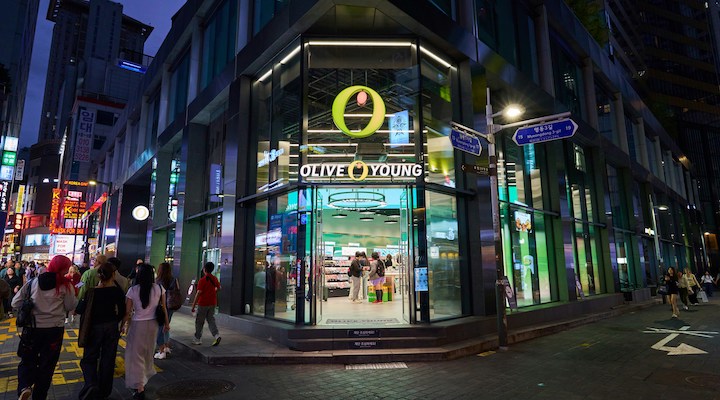
On January 20, French multinational beauty retailer Sephora and South Korean beauty and lifestyle retailer Olive Young announced a strategic partnership to bring the best of K-beauty to Sephora customers worldwide. This retail alliance will provide Sephora customers with dedicated Olive Young zones, both in-store and online, to explore a curated selection of South Korea’s most popular beauty brands. The partnership will debut this fall in specific regions, including the US, Canada, Hong
Hong Kong SAR, Southeast Asia (Singapore, Malaysia, Thailand), with expansion into additional regions like the Middle East, the UK and Australia in 2027.
Leading executives from Sephora and Olive Young have commented that the partnership will allow both retailers to benefit from the growing popularity of K-beauty worldwide.
Priya Venkatesh, Sephora’s global chief merchandising officer, said, “We are thrilled to partner with leading Korean beauty retailer Olive Young, bringing their expertly curated assortment of Korean beauty brands to our beauty fans globally. Their differentiated assortment, coupled with Sephora’s unique point of view on the beauty shopping experience, will bring an unrivalled and inspiring offer for all beauty lovers who are keen to explore the most sought-after Korean beauty products.”
Experts discuss the pros of the Sephora x Olive Young partnership
According to multiple retail experts, including Neil Saunders, analyst and managing director at GlobalData, this partnership combines an excellent blend of cultural cachet (Olive Young) along with optimal global operational ability.
“K-beauty is still a very fast-growing and trendy part of the market, so it’s not surprising that Sephora wants to double down on it,” Saunders told Inside Retail.
“While Sephora could have done this on its own, the partnership with CJ Olive Young adds credibility and authenticity to the offer. It will also help Sephora stay on top of all the latest developments, as Olive Young is at the heart of Korean beauty trends.”
Versus Sephora’s in-house K-beauty section, which was first established in 2010, Saunders noted that an Olive Young-branded area may be more interesting and attention-grabbing to consumers.
“What’s also significant here is that competition from players like Olive Young in South Korea is one of the reasons why Sephora failed to cut through in the country. However, this probably also made Sephora respect the retailer and is one of the reasons why it is now happy to partner.”
Coinciding with Saunders’ points about Sephora’s failure to penetrate the South Korean market, Kimber Maderazzo, a professor of marketing at Pepperdine Graziadio Business School, commented, “I think this is a brilliant and very strategic move by Sephora.”
When Sephora tried, and failed, to establish a physical retail presence in South Korea, it confirmed that company size alone would not be enough to tap into the hypercompetitive K-beauty sphere.
Maderazzo explained that, rather than trying and potentially failing again to force expansion into this market, Sephora’s partnership with Olive Young allows the company to leverage the strength of the South Korean beauty ecosystem without having to build it from the ground up.
Olive Young brings deep category expertise, brand relationships and cultural credibility in one of the fastest-growing segments of global beauty, especially skincare, while Sephora brings scale, data and a strong US consumer base.
“Together, this partnership allows Sephora to offer highly relevant, in-demand K-beauty brands while learning directly from a market that is leading innovation in formulations, routines, and consumer behaviour. It’s a smart example of how international retailers can collaborate to accelerate growth, share knowledge and stay culturally relevant in a rapidly evolving beauty landscape,” said Maderazzo.
Factoring cultural authority in business strategy
“This partnership can be highly effective precisely because it acknowledges where Sephora fell short in South Korea and where Olive Young has excelled,” said Naomi Omamuli Emiko, founder and owner of TNGE, a marketing agency and growth studio built to accelerate beauty and wellness brands.
Emiko explained that Sephora’s previous market entry into the South Korean beauty market struggled not because of a lack of scale, but because of a lack of local cultural authority. Whereas, Olive Young has already built deep credibility as a K-beauty tastemaker through speed, merchandising instinct, and an unparalleled understanding of emerging skincare trends.
“What’s interesting here is that this isn’t a traditional market entry or wholesale play, but rather Sephora effectively outsourcing discovery and curation to the strongest K-beauty intelligence engine in the world. For Sephora, that accelerates relevance in a category where innovation cycles move faster than most Western retailers can keep up with internally. For Olive Young, it enables US expansion at scale without diluting its identity.”
More broadly, Emiko noted, this signals a shift in international retail collaboration: success is no longer driven by who owns the customer relationship in-market, but by who controls cultural signal and taste.
This is especially relevant in light of Saks Global’s recent bankruptcy announcement, in which several powerful retail players collapsed under a flawed partnership system.
“Retailers are becoming taste brokers, not just distribution channels, and partnerships like this are likely to become a blueprint rather than an exception,” Emiko concluded.
Further reading: How Olive Young should make a strategic play for the US retail scene