
Air freight rates have risen by as much as 70 per cent on some routes since the start of the US-Israeli war on Iran, data shows, as the conflict limits flights, blocks some ocean shipments and pushes up jet fuel costs. Rates on routes between South Asia and Europe have been the most affected by Middle Eastern airspace closures and security issues, industry experts said, after the conflict stranded more than 100 container ships in the area around the critical Strait of Hormuz oil export corridor.
or.
Products like inexpensive generic medicines from India, destined for the European Union, Africa, and some Arab countries such as Saudi Arabia and the United Arab Emirates, typically move on container ships through the strait, said pharmaceutical supply chain expert Prashant Yadav.
“The main shift I’ve heard about involves companies moving generic medicines from ocean freight to air cargo,” said Yadav, a senior fellow at the Council on Foreign Relations.
The shift to air cargo is significant because air freight accounts for about one-third of global trade by value, making rate spikes a potential source of inflationary pressure on goods ranging from fresh food to pharmaceuticals and electronics.
“Customers are shifting freight from ocean to air. However, it is extremely expensive – typically 5x to 10x higher – and those costs are climbing as capacity tightens,” said Steve Blough, chief supply chain strategist at logistics software firm Infios. “More often, shippers are moving a limited quantity by air to bridge a gap.”
Jet fuel price doubles
The price of jet fuel has doubled since the start of the conflict, and Danish container shipping giant Maersk said this week that its own air cargo service is now applying fuel surcharges and war risk levies.
The airspace closures have also cut cargo capacity in freighters and passenger planes as airlines take longer routes to avoid the conflict zone, further pressuring rates.
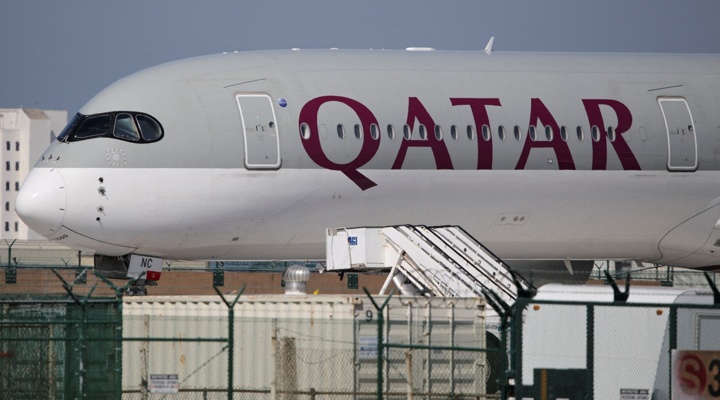
Dubai and Doha are normally among the world’s busiest air cargo hubs, but the Middle Eastern conflict has severely limited operations at those airports.
Niall van de Wouw, chief air freight officer at transportation pricing platform Xeneta, attributed higher air cargo rates to a “dramatic reduction” in capacity at key Middle East transhipment hubs, more than higher fuel prices.
Ronald Lam, the CEO of Hong Kong’s Cathay Pacific Airways, said many of its freighter flights to Europe normally stop in Dubai to refuel and pick up more cargo.
“But because of the situation in Dubai, we’re now skipping that stopover, and we are flying direct from Hong Kong to Europe with some payload restriction, because we couldn’t uplift fuel in between,” he said on an earnings call on Wednesday.
According to an air freight index from freight booking and payments platform Freightos, off-contract spot rates from South Asia to Europe have soared 70 per cent to $4.37 per kg from $2.57 per kg just before the war began. South Asia-North America rates are up 58 per cent to $6.41 per kg, and Europe-Middle East rates have risen 55 per cent to $2.79 per kg. A significant share of air cargo exports from South Asia usually travels through Gulf hubs, and some have had to reroute through East Asia, said Judah Levine, Freightos’ head of research.
“That being said, we have seen the price increases on many of these lanes slow, level off or even decline slightly in the last couple of days,” he said.
“These trends may reflect Asian and European carriers adding capacity to these long-haul lanes to make up for the missing Gulf capacity, and they may also reflect some of the Gulf carriers – most importantly Emirates – having restarted operations and increasing the number of flights that are now leaving and arriving at these important Gulf hubs.”
Reporting by Allison Lampert in Montreal and Lisa Baertlein in Los Angeles. Additional reporting by Julie Zhu in Hong Kong. Editing by Jamie Freed. All courtesy of Reuters.
Further reading: How retailers can navigate Iran war’s supply chain disruption