Facegym founder Inge Theron has come a long way from offering free facials to passersby on the beauty floor of Selfridges in 2014. Today, the British journalist-turned-skincare and hospitality consultant and entrepreneur is at the helm of a global wellness business that recently picked up investment from India retail giant Reliance Retail Ventures. Inside Retail spoke with Theron about the lightbulb moment that led her to launch Facegym, growing the brand to 15 locations, her five-year vis
vision for the business and her advice for aspiring entrepreneurs.
Inside Retail: Prior to launching Facegym, can you delve into your career background and how your path led you to become a brand founder?
Inge Theron: I was a well-being columnist at the Financial Times for over a decade.
I traversed the planet and tried everything the industry had to sell and wrote about it as a reader would, with a healthy dose of suspicion. That led to spa consulting work in hospitality, and from there to designing my first spa at Faena Miami Beach.
What people don’t realize is that designing and curating spaces that transform the people who walk into them was my craft long before I launched Facegym.
I’d also started a branding agency and launched a board game with Hasbro, so I knew the distance between a good idea and something a customer actually pays for.
Facegym pulled all of it together. I was the ultimate customer, a super user and a designer who knew what a results-led room should feel like, and a writer who could explain it clearly in a sentence.
IR: How did the idea for Facegym first come about? How does this business fill a gap in the hypersaturated world of beauty?
IT: I was seeing the impending convergence of beauty and fitness.
Fitness classes like SoulCycle were taking off, and I saw such great results. On the other hand, the facials I got offered more short-lived results.
I noticed the market had split in two: there was the traditional facial, lovely and largely pointless, and there were needles and lasers with downtime and the look that comes with them. Nothing lived in between.
We all accept that the body has muscles you train. The face has more than forty of them, and the industry had quietly decided they weren’t its concern.
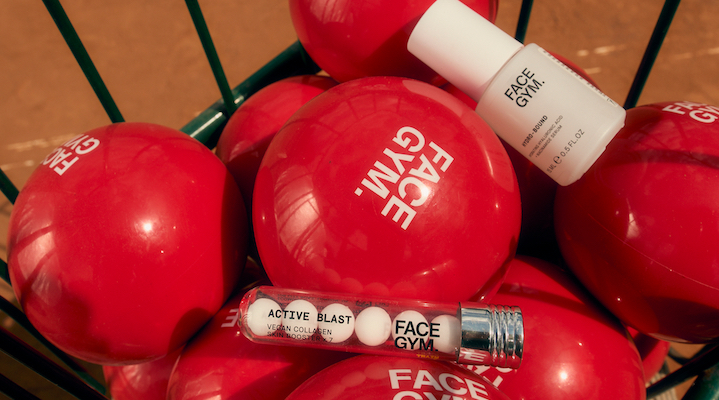
Facegym treats the face the way a trainer treats the body, with muscle work, serious skincare, tools and technology, delivered as a workout.
You get up from the chair and you can see it. In a market drowning in product, the gap was a service that produced visible results.
IR: Facegym initially launched as a studio concession at Selfridges in London in 2014. What was it like expanding the business in the earlier days, especially within the US market?
IT: The first year nearly broke me. I was seven months pregnant, standing on the Selfridges shop floor, stopping people who had come in for a handbag and asking them to let a stranger knead and slap their face. However, it was not long before we found that we had a great success on our hands.
A key learning was that male consumers loved it. Women who wanted to shop would drop their husbands off with us like we were a daycare for kids. At certain points, we would have just men in the studio!
Our American expansion started at Saks. We opened on their new beauty floor in May 2018, and I wanted it that way. A department store let us learn more about the American customer before we’d signed a single lease. This type of customer was quicker to commit than Londoners and, once we’d earned their trust, were far more loyal.
Then we opened our own doors on Bond Street in NoHo at the start of 2019, and expanded to Los Angeles that spring, inside 1 Hotel on Sunset.
Heading to Hollywood ahead of awards season was not an accident on our part.
What I learned in those years is that a reputation doesn’t cross the Atlantic with you.
You win each city on its own terms, with the right trainers, the right block and the right people talking about you.
IR: In 2026, what does the brand’s current retail expansion trajectory look like? How do you and your team aim to reach these new milestones?
IT: We were first to market with facial fitness, and Facegym remains the category killer in the industry.
What’s different about 2026 is that the model has been fine-tuned and is ready to roll out. It’s been a long time coming. We operated 15 studios ourselves before we let anyone else open one. London, Manchester, New York, Los Angeles and now Tribeca and Studio City. A Facegym is a small room, a tight team and members who book every month, so the numbers can work quickly.
Franchise is the big focus. Cambridge, Richmond, Liverpool Street and our first standalone studio in Manchester are the opening wave, with 28 franchised studios planned over three years.
India followed. Reliance Retail Ventures took a minority stake. We opened our first shop-in-shop with Tira in Mumbai, and a standalone studio, with 25 more planned over five years. Rolling out a franchise in the US would be the ultimate dream.
IR: What were the toughest challenges you faced in the initial stages? What strategies did you incorporate to overcome these issues?
IT: Getting people to try it.
“A gym for your face” sounds great until you ask someone to pay for it from a brand they’ve never heard of. I had no advertising budget, so I gave the treatment away on the Selfridges floor until the results did the talking. The clients who came back brought their friends, and a few of them happened to be famous. That did more than any campaign.
Also, finding the right talent. The treatment is only as good as the hands delivering it, so I built the academy before we could really afford one. It’s still the most valuable thing we own and the reason we can franchise now.
Then in 2020 we had to shut down every studio. We went online within weeks, grew our community and used this time to launch skincare and tools, which expanded the retail side of our business.
Lesson for any service founder: if you don’t own a product, you’re only as strong as your leases.
IR: What have been the biggest highlights of running the business thus far?
IT: Hearing “facial fitness” said by people who’ve never heard of us.
The first American client who told me she’d canceled her Botox. Sephora, who got us into homes no lease could reach. Then launching in Sydney with our introduction into Mecca.
Also this year, we partnered with Reliance, a large-scale Indian retail firm, that is building a market with us, rather than just stocking our products.
And the one highlight that matters most but gets talked about least is the clients who’ve been with us since 2014.
Launches get press; retention tells you whether you built anything.
IR: What goals do you hope to achieve with Facegym over the next year and the next five years?
IT: Next year is about growing in both directions. Opening new doors and deepening our community in the studios that are already open, so every location keeps getting stronger as we expand. That’s the foundation for the next five years.
In five years, Facegym is the name you reach for in any city in the US when you want results without a needle. A franchise network in cities we’d never reach on our own capital. A product business that stands up alone in the best retailers. The ambition hasn’t changed since inception.
IR: How has the beauty industry shifted since you first launched Facegym? What adjustments have you made?
IT: The customer got more clever. They read ingredients, ask for evidence and want to see the result before they leave. Good for us. We were always a results-focused business.
Also, wellness swallowed beauty. The woman who trains three times a week now treats her face as part of the program, which is what I was saying in 2014 when people thought it was a gimmick.
We followed that customer by introducing products and tools so the workout can carry on at home.
A business is built to grow through partners, because owning everything got us to fifteen studios and would never get us to a hundred locations.
IR: What is a piece of advice you would give to the day-one version of yourself?
IT: Build the training system before the second studio. Everything else can be fixed later; inconsistency can’t.
Also, stop worrying about whether people will get it. I spent a year convinced the idea was too strange. Customers understood it in four minutes; the experts took longer.
Further reading: Tomorrow-Today Beauty’s Indianna Roehrich discusses building a brand with community