
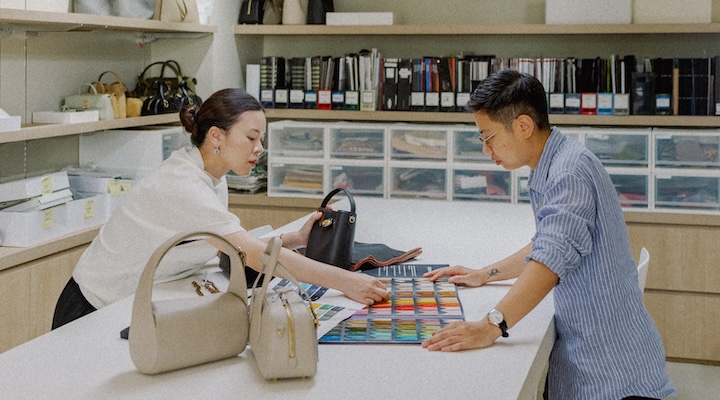
Struggling to find her dream bag after a long search, Queenie Fan decided to build one herself. Founded in 2015 alongside her lifelong friend Day Lau, Cafuné began as an idea shaped by two perspectives – Fan’s background in handbag design in New York and Lau’s experience in marketing and communications. Nearly a decade later, Cafuné has grown from a Hong Kong start-up into a brand with presence in Japan and Taiwan, known for its structured silhouettes and understated approach to empowerm
erment. In conversation with Inside Retail, the founders discuss friendship, commercial discipline, and why longevity, not hype, defines their vision of modern luxury.
Inside Retail: Cafuné was founded in 2015. What made you decide to start a handbag brand together? What gap did you see in the handbag market at the time?
Queenie Fan: It was difficult for me to find a handbag that is affordable, high-quality, and designed for modern women like me. Hence, I decided to start Cafuné. Prior to Cafuné, I worked as a handbag designer in New York for several years. Around 2014, I began noticing the rise of digitally native, direct-to-consumer fashion brands in the US. They were building strong identities, owning their customer relationships, and succeeding without relying on traditional wholesale structures. It was an interesting business model that was not found in Asia at that time. In Asia, the accessories market was still largely dominated by established luxury labels. There were no contemporary brands offering thoughtful design and quality at an accessible price point.
That contrast made me feel that there was an opportunity to build something new – a brand that combined design integrity with a modern, digital-first approach. I shared the idea with Day, who was working in marketing and PR in Hong Kong at the time. Given her understanding of brand building and communications, it felt like a natural partnership. The two of us spent time researching, refining our positioning and preparing the foundations before officially launching Cafuné in 2015.
IR: When you first launched, what did you want Cafuné to stand for, beyond just selling bags?
Queenie Fan: From the beginning, we didn’t want to build a “product-first” brand. We wanted Cafuné to represent modern women – their independence, confidence and evolving life. The brand name itself reflects intimacy and emotional connection, and that philosophy guides how we design. Our bags are created to support women in their daily lives – from work meetings to travel to personal milestones. Functionality is essential, but so is emotional value.
We were also intentional about building a brand rooted in longevity rather than short-lived trend cycles. That meant focusing on timeless silhouettes, balanced proportions and subtle detailing. Our goal has always been to create pieces that feel personal, enduring and relevant across different stages of a woman’s life.
IR: You’ve been lifelong friends. How did your friendship shape the foundation of the business?
Day Lau: Being lifelong friends created a foundation of trust, and we were able to support each other, especially at the beginning stages, where there were lots of uncertainties and challenges. Because we’ve grown up together, our values and vision for the brand are aligned. The strong relationship allowed us to make decisions quickly and remain consistent as we scaled.
IR: Have customers ever shared stories that reminded you why you started the brand?
DL: We receive a lot of encouraging feedback, especially during our pop-ups in Hong Kong, our hometown. Many customers tell us how proud they are to introduce Cafuné as a Hong Kong-founded brand. That sense of shared identity and support is incredibly meaningful to us, particularly as an independent brand from the region.
At the same time, we often hear that a Cafuné bag was purchased to commemorate an important milestone – a promotion, graduation or personal achievement. Knowing that our pieces become part of those defining moments is deeply rewarding.
IR: In a saturated handbag market, what makes a design commercially defensible rather than just aesthetically pleasing?
QF: At Cafuné, our philosophy is rooted in balance. We focus heavily on proportion, structure and details – elements that are less visible at first glance but ultimately determine whether a bag feels timeless or temporary.
IR: Is there one design that encapsulates the brand’s DNA?
QF: We believe the Stance Bag encapsulates our DNA most clearly. The style is inspired by vintage briefcases – structured, purposeful objects traditionally associated with authority and professional life. Historically, briefcases were symbols of the professional and corporate world and, in many ways, of male-dominated spaces. We were drawn to that language of structure and strength, but wanted to reinterpret it through a modern, feminine lens.
The Stance Bag retains that architectural frame and clean lines, but is scaled and refined for contemporary women. The structured body and signature C-Lock hardware give it presence, while the proportions and versatility make it suitable for everyday use. For us, the Stance Bag quietly symbolizes empowerment. It reflects the evolution of women’s roles in society – leadership, independence and ambition.
Its continued relevance across seasons and markets reinforces our belief that empowerment in design does not need to be loud. It can be expressed through form, balance and intention.
IR: How did you grow from a Hong Kong-based start-up into a brand with presence in Japan and Taiwan?
DL: We launched with an e-commerce platform from day one, which allowed us to build a global audience early and gather direct customer insights across different markets. Rather than expanding aggressively, we paid close attention to where organic demand was emerging and allowed data to guide our next steps.
Japan, in particular, responded strongly to our emphasis on craftsmanship, structure and sophisticated designs. In 2021, we were invited to host a pop-up at Isetan Shinjuku, which became a pivotal moment for the brand. The reception exceeded expectations and opened the door to further retail partnerships and long-term opportunities in the market.
As we scale, we remain disciplined in our approach to market entry. Each new region is carefully evaluated – from pricing and localization to operation partners – to ensure we maintain brand consistency while building depth rather than surface-level presence. Our focus has always been sustainable, strategic growth rather than rapid expansion.
IR: What barriers exist for independent Asian accessories brands when trying to globalize?
DL: Perception is one challenge. European brands still dominate the luxury narrative globally, and independent Asian brands often have to work harder to establish authority in craftsmanship. Scale is another barrier. Marketing costs, retail leases and inventory commitments can strain independent brands. Without careful capital management, rapid expansion can dilute both finances and brand positioning. However, e-commerce has leveled the playing field. Strong product, clear positioning and disciplined growth can now travel globally too.
IR: Where do you see Cafuné in the next five years? Do you plan to expand beyond handbags?
DL: In the next five years, we see Cafuné strengthening its position in Asia while expanding into new international markets. We remain focused on handbags as our core category. There is still significant opportunity to deepen within that space – through material innovation, new silhouettes and refined functionality. Our priority is building a brand that endures, rather than expanding for the sake of scale.