From grocery stores like Trader Joe’s creating snacks for watch parties to fashion brands launching NFL-affiliated collections, few retailers missed out on the opportunity to tap into the fanfare surrounding this week’s Super Bowl. According to the National Retail Federation’s annual Super Bowl Spending Survey, 213 million adults planned to tune in to the big game. Of these viewers, approximately 121 million planned to host or attend a watch party, and another 18 million planned to watch
tch the game at a bar or restaurant. Total spending on food, drinks, apparel, decorations, and other purchases for the day was expected to reach a record $20.2 billion, or $94.77 per person.
This high figure does not account for the potential return on investment brands participating in the football-focused fanfare will receive in the month following the Super Bowl. In 2024, Kantar, a global data and insights company, found that Super Bowl ads delivered an average return on investment of $8.60 for every $1 spent, making them 20 times more effective than regular TV ads.
While a Super Bowl commercial is not a lightweight advertising project to budget for, when done well, it can deliver a strong ROI for participating brands.
Even for the retail players that didn’t pay for a Super Bowl commercial, which was reported to cost $10 million for a top-tier 30-second spot this year, there were plenty of brands on the ground delivering IRL activations to tap into the football fever.
How brands Béis and Abercrombie & Fitch engaged with football fans IRL
According to Nielsen’s 2024 Annual Marketing Report, over 85 per cent of consumers who attend a live brand experience are more likely to purchase from the brand thereafter.
Taken together with the social media reach generated by Super Bowl-related posts and user-generated content (UGC), it helps explain why so many brands – including luggage and lifestyle label Béis – hosted IRL activations in the lead-up to, and on, Super Bowl day.
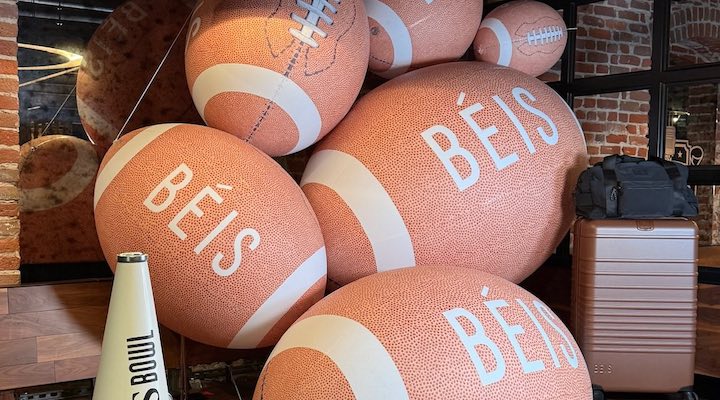
From February 6-8, Béis hosted a pop-up in a venue transformed to mimic a football field, where attendees could purchase various products, including limited edition pieces and items from the brand’s recently launched sports collection, play games, like sports trivia, and take selfies with slash commune with fellow football enthusiasts.
Liz Money, Béis’s SVP of brand and creative, explained that the pop-up’s purpose was not only to engage female sports fans but also to connect with its male audience on the ground. Although there isn’t a clear ROI from pop-up-to-sales conversion, Money explained that positive social media engagement typically creates a halo effect on both brand image and sales afterwards.
Going a step further, Abercrombie & Fitch went above and beyond for the Super Bowl, as the NFL’s first official brand partner.
The American apparel and lifestyle company’s partnership began three years ago with a licensing deal covering five football teams. Today, that partnership has expanded into a deal that allows the brand to create merchandise for all 32 franchises and host several activations during Super Bowl weekend, including a pop-up at the NFL Shop in San Francisco’s Moscone Centre and an exclusive, invite-only fashion presentation featuring both athletes and their WAGs.
While the retail players that participate in activations like these will certainly experience a boost in profit from sales on the ground, more importantly, these types of activations, both with product and pop-ups, help establish a brand as cool and culturally relevant.
As Neil Saunders, analyst and managing director at GlobalData, explained to Inside Retail, “Super Bowl advertising and sponsorship is less about trying to sell specific products in the moment – though that can happen – and more about brand positioning. A brand like Abercrombie & Fitch benefits from exposure, which can potentially widen its customer base – there are a lot of people who may now take a fresh look at the brand.”
How Levi’s leaned into the power of brand positioning during the 2026 Super Bowl
In addition to Abercrombie & Fitch, Saunders noted that Levi’s, a San Francisco-born brand, also strongly benefited from multiple Super Bowl-centred activations, which included a “Home Turf” pop-up activation in San Francisco’s 1 Montgomery building from February 5-7, 2026 and a Super Bowl commercial, its first one in over 20 years.
In an aptly-named commercial titled “Backstory”, several pop-culture figures, including American musician Doechii, K-pop star Rosé and even Woody from Toy Story, were shown to be dancing in Levi’s denimware from the back angle. The cheeky commercial’s choreography showcased the brand’s playfulness, while the celebrity cameos helped demonstrate Levi’s as a culture-centred player.
“For a label like Levi’s, it is about embedding itself into a cultural moment and using that to tell the story of the brand and its values,” said Saunders.
Ultimately, while a Super Bowl commercial or an in-person activation might be the stage for brands to present themselves to new and returning customers alike, there is a broader purpose to participation. It is a way for brands, including Abercrombie & Fitch and Levi’s, to set themselves apart as brands that move the needle, ultimately boosting profits long after the end of the football season.
Scale is no longer the differentiator
When it comes to the true winners of retail marketing, Naomi Omamuli Emiko, founder and owner of TNGE, a marketing agency and growth studio built to accelerate beauty and wellness brands, explained that it was the brands that leaned into the power of communication to generate conversion.
“Super Bowl 2026 was a reminder that scale is no longer the differentiator – conversion is,” she said. While the game still delivered more than 125 million US viewers, Emiko added that what separated the winners from the rest was what happened afterwards. “The brands that will benefit long-term weren’t just present during the broadcast, but focused on continuity. Take Dunkin’, Donuts for example: nostalgia-driven creative paired with a clear post-game retail hook allowed them to turn cultural attention into foot traffic. Or Apple Music, which extended halftime visibility into sustained conversation, reinforcing how entertainment moments – if activated effectively – can ladder seamlessly into brand relevance.”
What didn’t work as well was relying on novelty alone.
“Several AI-led ads generated initial buzz but underperformed on sentiment, reinforcing a pattern we’re seeing across categories: attention without emotional payoff doesn’t compound anymore,” said Emiko. “At this scale, gimmicks burn incredibly fast. At the same time, storytelling, especially when it feels human, familiar, and anchored in how people actually consume brands day to day, continues to have the upper hand.
“Over the years, the Super Bowl has shifted from a single-event awareness play into a multi-week brand activation system. The smartest brands treat it as a launchpad. They engage early and connect broadcast, social, retail and IRL activations into one cohesive arc. Of course, the reach of the event is still unmatched, but reach without a next step will remain expensive noise.”
Further reading: How Levi’s wove itself into music history – and what comes next