Retailers such as Sephora, Ulta Beauty, and Target are all trying to tap into the secondary K-beauty wave currently influencing US consumers. In fact, a 2025 report from global marketing research firm NielsenIQ confirmed that K-beauty sales in the US surged to $2 billion, up 37 per cent year-over-year, with facial skincare leading the charge and hair care seeing the fastest growth. Just this year, Sephora and South Korean beauty and lifestyle retailer Olive Young announced a strategi
rategic partnership to bring the best of K-beauty to Sephora customers worldwide.
This retail alliance will provide Sephora customers with dedicated Olive Young zones, both in-store and online, to explore a curated selection of South Korea’s most popular beauty brands.
This partnership is expected to debut this fall in specific regions, including the US, Canada, Hong Kong SAR, Southeast Asia (Singapore, Malaysia, Thailand), with expansion into additional regions like the Middle East, the UK and Australia in 2027.
In the meantime, there is another lesser-known yet rather mighty beauty retailer making its mark on the US beauty retail scene: Sukoshi Mart.
Sukoshi is a Canadian-born Asian beauty and lifestyle goods retailer that first launched onto the retail scene in 2018.
What began with a modest 355-square-foot convenience store in Kensington Market in downtown Toronto, Canada, has morphed into a national retail chain with 20 stores, and counting, across the US and Canada today.
But how does a relatively indie Canadian retailer achieve momentum this quickly and, more pressingly, how does it stand a chance to compete alongside America’s biggest beauty retailers?
Through pointed product curation, aesthetic interior design and an incredible in-store shopping experience, answered Linda Dang, Sukoshi’s CEO and co-founder.
From restaurateur to beauty retail mogul
Dang, like many other brand founders before her, didn’t start out in the specific career field that she would later end up building a business in.
Before coming up with the concept for Sukoshi, the company’s co-founders, Dang was running multiple restaurants and a sake bar in Canada.
It was a personal interest in skincare, partially stemming from some personal experience dealing with eczema, that helped lead Dang down the rabbit hole to discover the white space that was present in the K-beauty retail space in North America.
Similar to other K-beauty converts, Dang wasn’t a fan of the often harsh, alcohol-based toners that were available on the market and turned to K-beauty’s softer, more skin-sensitive formulations.
However, in seeking out products for herself, Dang noticed there weren’t really any retailers carefully curating Asian beauty products, K-beauty, C-beauty, J-beauty, or otherwise, that she and other consumers were searching for. Nor were these retailers providing a realistic breakdown of skincare products to include in one’s routine; instead, they were overly relying on the 10-step beauty routine that had been over-popularised in the States in the early 2010s.
As Dang told Inside Retail, “At that time, Asian beauty was a very foreign concept [to consumers]. There wasn’t a lot of awareness or education around it, so it was a very intimidating category for a lot of people seeing Asian beauty for the first time.”
With that being said, the CEO said that she hadn’t had high expectations for Sukoshi Mart’s first store opening, but was happily surprised to discover a long line of customers winding down the block.
About half a year down the line, Dang recalled being approached by a property officer for a larger Canadian shopping centre and asked whether there was interest in an available 3,000sqft space.
Even though it was quite the jump in store size, from 355 to over 3,000sqft, Dang was confident about the potential of Sukoshi Mart’s ability to tap into the North American consumer’s desire for Asian beauty goods.
“Fast forward from there, eight years later, we’re in this very rapid expansion phase across the US, and are continuing to build out brick-and-mortar in Canada as well,” said Dang.
In 2023, after opening its fifth store in Canada, Sukoshi Mart took an investment from its longstanding Korean beauty distributor, Silicon2.
Since 2023, the Canadian-born retailer has doubled its store count each year.
How Sukoshi Mart fills a white space in the North American K-beauty market
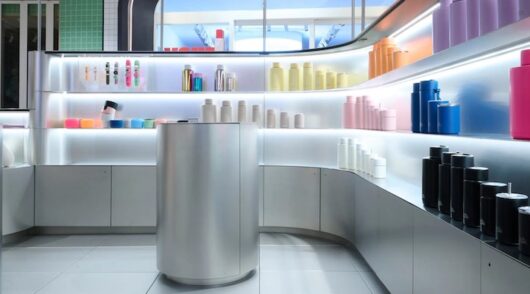
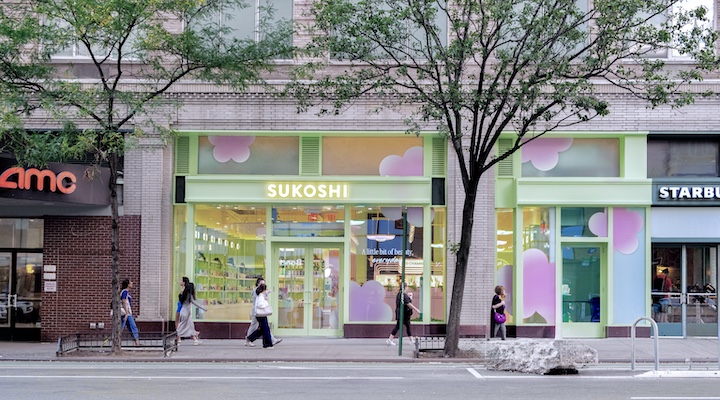
In fall 2025, Sukoshi Mart opened one of its most impressive stores yet, a pastel pink and green dream located on New York City’s Upper East Side on 1542 Third Ave, between 86th and 87th.
It is the brand’s whimsical color palette, along with a few other key in-store and merchandising offerings, that will ensure Sukoshi Mart’s success amongst other major North American beauty retailers, Dang promised.
In addition to carrying better-known beauty brands, like Medicube, Sukoshi Mart also carries well-known (to the North American consumer) brands like Purito and Unleashia, as well as a bevvy of beauty and C-beauty brands like Canmake and Judydoll. As of 2026, Sukoshi Mart has over 5,000 stock-keeping units from more than 500 brands.
The store’s bright coloring, wide aisles, well-trained sales associates, in-store brand events (ranging from brand activations to educational classes) and tools, like an in-store skin analysis machine, were all thoughtfully designed to help out the curious and often-overwhelmed beauty consumer, Dang explained.
This is especially important for younger consumers, often referred to as ‘Sephora kids’, who have been overwhelmed by skincare content on platforms like TikTok.
“One of the issues that we always run into as a retailer is with young teens coming in for anti-ageing. Sometimes it’s not about educating the consumer, because that demographic is very educated, but re-educating them because there’s just so much information.”
What’s next in store for Sukoshi Mart
Dang, Sukoshi’s co-founder and CEO, disclosed to Inside Retail that as of 2026, the company is on track to surpass $100 million in sales this year.
Additionally, there are plans to open 40 new locations, both in malls and in freestanding stores, in the US by the end of the year.
“Right now we’ve been doubling our store count year-over-year, and the last year has been about refocusing on our operations, making sure our foundations are right, and building to really grow quickly and just to expand the store’s offerings [which may include products from other Asian countries like Vietnam and Thailand].”
“We have developed a playbook detailing steps, from site selection to launch store, and now there is so much opportunity in the US, Canada, and honestly in Europe as well, to go and try to position ourselves as the specialty category leader in this market.”
Further reading: How Sephora and Olive Young are building a K-beauty-powered retail alliance