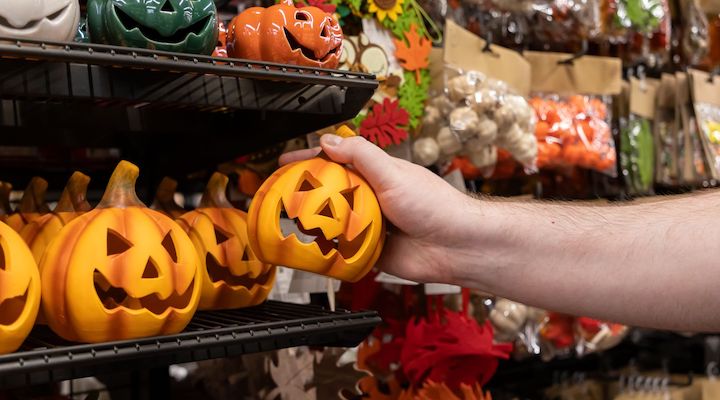
Halloween spending is expected to hit a record $13.5 billion this year, but shoppers are still watching their budgets. For retailers, the opportunity lies in making the holiday feel worth spending on, with reusable products that last beyond the big day just as important as competitive prices. That opportunity is opening up well before the big day. According to the National Retail Federation, the percentage of consumers shopping before October has grown from 34 per cent in 2016, highlighting how
ow Halloween has expanded from a single-day event into an extended shopping season. Already, major retailers including The Home Depot, Michaels and Spirit Halloween have launched their Halloween promotions, while Victoria’s Secret launched a “Summerween”-themed apparel and beauty collection in early August.
The longer season does not mean shoppers are spending much more individually. Average spending is expected to reach $115.14 per person, in line with $114.45 in 2025. “Consumers continue to make Halloween a spending priority, but they are also approaching the season with affordability in mind,” said NRF VP of industry and consumer insights Allison Zeller.
For retailers, winning a share of that spending means understanding both how customers find inspiration and what persuades them to buy.
How customers are shopping for Halloween this year
An NRF survey offers some clues about what shoppers will do if prices are higher than expected. Nearly one-third (31 per cent) said they would compare prices, while 26 per cent said they would look for coupons or sales.
Another 34 per cent of shoppers said they would seek out items they can reuse in future years or repurpose for other occasions or settings to maximize value.
Alongside those efforts to stretch their budgets, shoppers are finding new ways to plan their celebrations. A record number of consumers – nearly 47 per cent – reported using AI platforms and tools to support their Halloween shopping this year, according to NRF’s annual report. Top use cases include brainstorming ideas during planning (34 per cent) and seeking recommendations during product research (32 per cent).
“AI is becoming an increasingly common part of the consumer shopping journey,” said Prosper’s EVP of strategy Phil Rist. “As consumers prepare for Halloween, many are using these tools to brainstorm costumes and decorating themes, explore production options and find inspiration that help bring their celebrations to life.”
What customers are buying for Halloween
Those new routes to inspiration are leading shoppers to familiar purchases. The items they plan to buy remain largely consistent with last year’s patterns, NRF confirmed.
Candy remains the most popular purchase, with 96 per cent of consumers planning to buy it, accounting for $4.1 billion in spending. Decorations follow at 78 per cent and will account for $4.3 billion in spending, while 71 per cent of shoppers are expected to spend $4.4 billion on costumes.
Greeting cards are more popular this year, with planned purchases increasing to 42 per cent from 38 per cent in 2025. Spending is expected to total $800 million. Pets are also part of the festivities, with consumers planning to spend $920 million on pet costumes.
Discount stores remain the top destination for Halloween purchases, accounting for 39 per cent of sales, followed by specialty Halloween/costume stores (32 per cent) and online (27 per cent). Local and small businesses are also attracting more interest. Some 13 per cent of consumers plan to shop at these stores for Halloween, almost double the seven per cent recorded in 2016.
How Pacsun is gearing up for spooky season
The appetite for costumes also gives fashion retailers a way into the market. Spirit Halloween is operating 1575 pop-up stores this year, but dedicated Halloween retailers are not the only ones gearing up for the holiday. Pacsun is building its offer around customers’ individual style.
The youth-focused fashion retailer is bringing back its Halloween storefront this year, bigger and more customizable than ever. Pacsun’s expanded shop spans women’s and men’s styles, bringing together 67 costumes, apparel and accessories and giving customers plenty of ways to build their own Halloween look.
“Halloween has become a real fashion moment for our customers, and we’re seeing them approach it with the same individuality they bring to getting dressed every day,” said Richard Cox, Pacsun’s chief merchandising officer.
“It’s less about wearing a costume exactly as it comes and more about interpreting a character, a reference, or an idea through your own style. That shift felt very natural for Pacsun, because our role has always been to give young people the freedom to discover what resonates with them and make it their own.”
That approach offers a starting point for other retailers, including resale businesses. A Halloween storefront can show shoppers how existing products fit their plans, even without themed merchandise. Retailers can help customers create a look of their own while giving them reasons to see value beyond a single night.
Further reading: Target scraps Halloween costume over ‘racist’ controversy