Someone once asked me why developed countries’ economies, consumer spending, retail sales and the like needed to grow. We already have a good standard of living, so why is it so important for all of those economic indicators to keep going up and up? She was a psychologist by profession and had little patience for economists like me. However, what she was forgetting is that as long as populations keep growing, if economic activity does not keep pace, then, on average, our standard of living in
material terms will not just stay the same or get better – it will fall. Thus, we need growth just to maintain the same per-capita level of welfare.
By this reasoning, Singapore’s retailers are doing better than you might think, despite the obsessive focus of the business media on what happened in the last month or the last year. There is a bigger picture, so let us take the long view and see what we get.
Over the past 10 years, retail sales in Singapore, adjusted for inflation (using the retail price index), have increased by 12.3 per cent, while the population has risen from 5.535 million to 6.111 million. So you are looking at a real per-capita increase of 1.6 per cent, or about 0.16 per cent annually over the space of the decade. Retail ‘standard of living’ has therefore not been declining, but it has not been stellar by this measure.
However, this number includes motor vehicles, and sales values for non-automotive categories are not published by the Singapore Statistical Bureau (Singstat) for years before 2019. Over the six years since 2019, inflation-adjusted non-auto retail has grown by 11.8 per cent, or 4.3 per cent per capita. That is a fairly healthy annual rate of 0.7 per cent. By this metric, Singaporeans and Singapore’s retailers have not been doing too badly. The retail ‘standard of living’ has been advancing steadily.
And actually, it is even better than that. We also need to account for tourism, and we may assume that tourists have accounted for less of the growth in the past six years than previously. According to the Singapore Tourism Board, the country hosted 16.9 million arrivals in 2025, compared with a peak of 19.1 million in 2019. This suggests that tourists have contributed less and Singapore residents more to retail sales growth over the six years. This makes perfect sense if you take into account the tourism blockades during Covid and the fact that tourist arrivals are still well below their pre-Covid levels. For Singapore’s resident population, the momentum in their retail ‘standard of living’ appears favourable.
Singapore’s malls are thriving
Taking the short-term view, headline sales growth as reported by the Singapore government in recent months has been somewhat weak, but the island nation’s mall operators do not seem to have got the memo.
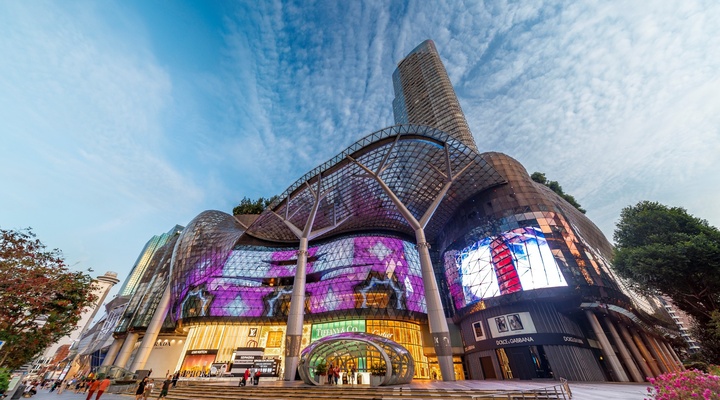
One of the most important is CapitaLand’s real estate investment trust, CICT, which has a portfolio of 12 malls and five mixed-use developments with major retail components. It reported that both gross revenue and net property income improved strongly in the second half of 2025. Revenues amounted to S$831.5 million in the second half, an increase of 4.7 per cent over the second half of 2024. For the whole year, revenues were up 2.1 per cent to S$1.619 billion. Net property income increased by 6.8 per cent in the second half, aided by a massive contribution from the trophy ION Orchard mall on Orchard Road that was not added to the portfolio until October 2024. Net property income for the year rose 3.1 per cent, to S$1.190 billion. The portfolio was revalued upwards to S$27.4 billion as of 31 December.
‘Rent reversions’ (also known as ‘leasing spreads’, defined as the difference between average rent on new leases and average rent on expired ones) were +6.6 per cent. Tenant retention was just under 84 per cent.
Sales per square foot in 2025 were up 14.9 per cent on 2024, and shopper traffic rose by 20.5 per cent. These numbers flatter, however, because of the exceptional contribution of ION Orchard. Without ION Orchard, productivity rose by a more modest 1.2 per cent.
Limited new mall openings and strong demand for space
Retail occupancy in the CICT portfolio stands at 98.7 per cent (scraping 100 per cent in the suburban malls). Moreover, only one new project in Singapore – the Marine Parade Underground Mall – opened in 2025, and a relatively minor 280,000 new square feet are due to come online in 2026. New supply of space will amount to approximately 350,000 square feet in each of 2027 and 2028. However, these additions are low by historical standards and the new space will only just meet demand by retailers, much of which will come from the food and beverage, health and beauty, and fashion accessories sectors. For retailers, that means rents can be expected to remain upwardly pressured.
Frasers Centrepoint
Frasers Centrepoint Trust is another important REIT in Singapore that owns 10 malls, many of them with a community flavour and correspondingly heavy weighting towards food and beverage tenants, which account for about one-third of floorspace and almost 40 per cent of the company’s rental income. The company’s malls do not pitch much to tourists – they are primarily about belonging to the local communities they serve and acting as social and entertainment hubs. Thus, special local events are critically important to its marketing strategy.
Its tenant sales increased by 2.7 per cent year on year in the fourth quarter. Occupancy in its malls remains close to 100 per cent across the island, and it is signing more than 30 new tenants in the first quarter that have not previously been in its portfolio.
Fighting a downturn
The Singapore government is wary of the reduced GDP growth outlook for 2026 (the forecast is for just 1–3 per cent growth, a big downsizing from the almost 5 per cent growth in 2025) and has been implementing a series of stimulus measures to keep consumers coming to the shops. Among the benefits are CDC (digital currency) vouchers, with a second tranche of $300 already paid to households in January. A one-off cost-of-living payment will come in September. Then there are the ‘climate vouchers’ that will subsidise the purchase of energy-efficient appliances. This is Singapore’s response to the appliance trade-in scheme launched by the Chinese government in mid-2024. The Singapore voucher subsidises up to $400 for the purchase of an energy-efficient fridge that will take an old clunker offline and also reduce household power consumption (and bills).
Singapore is a very well-run country compared to some others in the region, and its government is acutely aware of the perils of a squeamish consumer sector. The future is unpredictable, but you can be sure that the retail standard of living in Singapore will continue to rise steadily. That is great news for retailers and for mall operators too.
Further reading: How Lululemon is testing a new store model in Southeast Asia through community