It’s easy to cover up collapsing sales if a government steps in and starts a massive subsidy scheme, as China did in 2024 and continued to do in 2025 with its $40 billion appliance trade-in scheme. The Ministry of Commerce stated that, in exchange for new, gleaming energy-efficient appliances, Chinese consumers traded in nearly 78 million worth of their old ones in the first five months of this year alone, from inefficient, noisy fridges and washing machines to old jalopies in the garage. The
The program propped up retail sales beautifully: Sales peaked in May with a 6.4 per cent year-on-year increase, at stark odds with the prevailing narrative that the Chinese economy was tottering. For retail, though, the writing really was on the wall: The buoyancy just couldn’t last.
Subsidy money started to run out mid-year and was suspended in some regions. It is now being reflected in the retail trade growth numbers, which continued to trend downward in August. Sales still rose by 3.4 per cent, year on year, but it represented the third consecutive month of declining growth after the May peak.
For the whole January-August period, sales were up by 4.6 per cent. Non-automotive sales (a less relevant concept now that cars are sold in virtually every possible channel from malls to e-commerce sites) are up 3.7 per cent in August and 5.1 per cent, year to date.
Panic in the food court
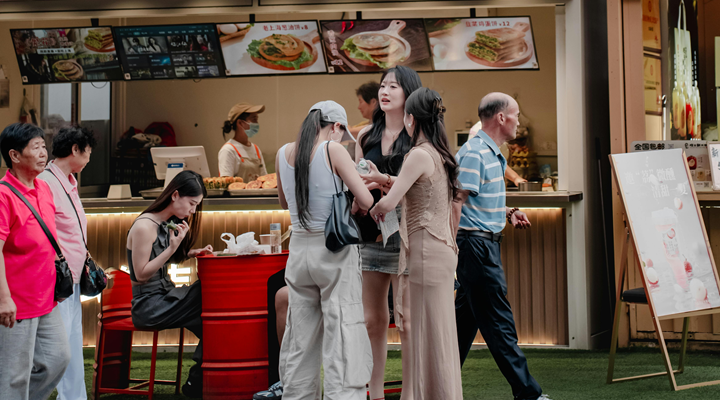
The spending woes are not just affecting sales of consumer goods: Income from food and beverage is being pared down, too. After 5.9 per cent year-on-year growth in May, this metric fell off a cliff, growing by little more than a single percentage point since then.
The Chinese restaurant sector is massive and dining out is an important part of the culture, so the tightening up in this segment signals serious problems for the broader economy: consumers usually do two things first when they are seriously cash-strapped: They stop buying big-ticket items and they stop eating out.
The first of these has been masked by the trade-in program, which not only enables the upgrade of old appliances but also reduces energy consumption and power bills. The shift away from dining out is also reflected in a corresponding lift in food sales for consumption at home, which rose by 5.8 per cent in August.
Some other winners among the retail categories were gold, silver and jewellery (+16.8 per cent), which are, of course, the old go-to items for shoring up savings in uncertain times. (And gold prices have been going through the roof, reaching record highs this year.)
Sport and recreational articles were up 16.9 per cent (see more on that below). Although appliances and audio-visual equipment sales were up 14.3 per cent, thanks to the lingering trade-in program, it’s not as good as it looks because it is exactly 50 per cent of the January-August average growth rate.
Likewise, with cultural and office appliances (+14.2 per cent, again a beneficiary of the trade-in program but well down on the year-to-date average). Furniture sales were up 18.6 per cent, which is an anomaly and it isn’t clear what is driving it.
Walmart: an alternative bellwether
A broad alternative forecaster for the general health of Chinese retail is Walmart, which has now reported results through the end of July. For Walmart, the key growth engines in China are Sam’s Club and e-commerce, suggesting a value-conscious consumer, even despite the fact that the company reeled in same-store sales growth of 21.5 per cent in the quarter ending July 31.
Thus, Walmart’s results really aren’t at all inconsistent with the ‘stressed consumer’ thesis, and to the company’s credit, they also reflect superior execution and market share gain. In its e-commerce business, Walmart has done a brilliant job, leveraging increasing densification of its customer base to make last-mile delivery faster and more efficient.
The sport and fitness trend is becoming a growth driver
Sporting goods is a category that never had the benefit of any government trade-in program but has blossomed anyway this year, with more than 20 per cent growth in retail sales in the year through August. On September 4, the Chinese government released its detailed strategic plan for stimulating growth in the sports industry. It was suitably titled “Opinions of the General Office of the State Council on Unleashing the Potential of Sport Consumption and Further Promoting the High-Quality Development of the Sports Industry”.
Brands will be heartened by a perfect storm of sales drivers, including this valuable attention from the government, which wants to make sport a trillion-dollar industry in China by the end of this decade. That would be no mean feat, considering that government estimates put the industry’s value at not much more than $200 billion in 2023, so we are talking about a quintupling of value over a seven-year period. Achieving that target will require significant investments in sports infrastructure and high-profile events.
It seems feasible, though, as incomes and participation rates climb from a relatively low base. One of the chief beneficiaries will be the mall operators, who have been perpetually scavenging for new tenant categories to be the heroes that lead the industry forward after the long-term contraction of store growth by the traditional mall mainstays (particularly apparel and home furnishings brands). While more food and beverage and entertainment tenants have sprouted in malls, the emergence of sporting goods as a space-taker is timely.
The whole ecosystem being built for the sector promises to be even more of a godsend for the mall business than it already is: it will include an increasing number of retailers of sports apparel and footwear, nutritional products and fitness accessories, more gyms, more specialized sport facilities (for example, targeting the elderly), more sport-related events and training programs, and so on.
Government: economy ‘generally stable’
When a government like China’s, whose economic statistics have never been particularly trustworthy anyway, characterizes the economy as “generally stable”, as it did in June and then again on September 15, you can be sure that the problems run deep.
Still, if you believe the numbers are at least in the ballpark and you take the bureaucratic prose in the latest economic releases as a little bit truthful, then the economy is far from disintegrating.
Retailers continue to struggle at the high end, but for those in specific sectors like sporting goods and groceries that execute well, the registers are set to continue humming.
Further reading: Why Southeast Asia is Anta Group’s strongest testing ground