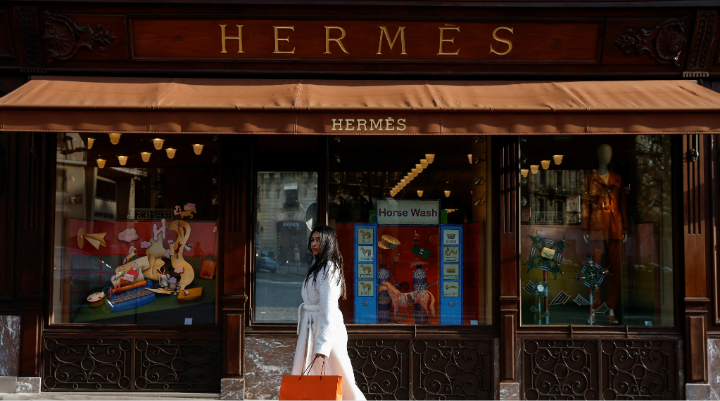
French group Hermès led a slump in luxury shares on Wednesday after weak sales showed the war in Iran was weighing on demand in the Middle East and tourism in Europe, dealing a blow to hopes of a revival for the sector. Shares in the Birkin bag maker sank as much as 14 per cent in early trade, amid falling sales in the Middle East and fewer tourists buying designer items in Paris and London. The widespread impact of the conflict has been felt from Dubai mall sales to soaring energy prices, whic
hich have hit consumer confidence.
Shares in Gucci owner Kering fell more than 9 per cent on Wednesday after reporting the war had hurt spending, chiming with Louis Vuitton owner LVMH, which said on Monday it had suffered a sharp slowdown in the region.
Hermès, which carefully controls production and sales to maintain exclusivity, had been the most resilient luxury group in a years-long industry-wide slowdown, but even it was not immune to the conflict’s impact. Its shares dropped as much as 14 per cent to their lowest since January 2023 before recovering slightly to be down 9 per cent at 0850 GMT, bringing losses so far this year to 24 per cent.
Luxury stocks have been increasingly volatile as hedge funds have ramped up bets in the sector.
Abrupt halt to Mideast sales growth in March
First-quarter sales of products including handbags, silk scarves and perfume rose by 5.6 per cent in currency-adjusted terms, Hermès said, lower than a Visible Alpha analyst consensus of 7.1 per cent growth.
Deutsche Bank analysts said the result suggested “zero underlying volume growth” – no increase in the number of items sold – given Hermès raised prices by 6 per cent at the start of the year.
The overall impact of the conflict, denting shoppers’ appetite from Dubai to Paris, took 1.5 percentage points off Hermès’ quarterly sales growth, finance chief Eric du Halgouet said.
In the Middle East region, sales fell 6 per cent in currency-adjusted terms to 160 million euros ($188.59 million), from 185 million euros in the first quarter last year.
“We had very good growth, double-digit growth in January and February and then the month of March was an abrupt halt,” said du Halgouet, adding that sales in luxury malls in Dubai and other Gulf shopping hubs dropped by 40 per cent in March.
Though only accounting for 4.4 per cent of sales, the Middle East was the fastest-growing region for Hermès last year.
But du Halgouet said the impact on profitability from the Middle East slowdown was “not significant” for the moment.
“It will depend on whether this lasts another month or two… if it’s a two-month affair, I think we can still absorb this impact without too much trouble,” he said.
The strength of the euro has also become a major headache for luxury firms. It took 290 million euros ($342 million) off Hermès’ revenue in the quarter, leading to a 1 per cent drop in reported sales to 4.07 billion euros, from 4.13 billion euros a year ago.
Weaker tourism hits airport sales and European luxury hubs
Hermès, which caters to the ultra-wealthy with handbags over $10,000, said a drop in tourist numbers had hit sales in concession stores at airports and in the Middle East, as well as in France, Britain, Italy and Switzerland, where Gulf shoppers are a key driver.
In France, where more than 50 per cent of Hermès sales are to tourists according to du Halgouet, revenue declined 2.8 per cent. In Asia, the biggest region by sales for Hermès, revenue grew by just 3.5 per cent in currency-adjusted terms, as air travel disruptions also affected stores there, particularly in Singapore and Thailand.
The US was a bright spot, with currency-adjusted sales up 17.2 per cent.
Editing by Mark Potter and Elaine Hardcastle. All courtesy of Reuters.
Further reading: Inside Hermès’ strategy for profitable growth in a slower China