
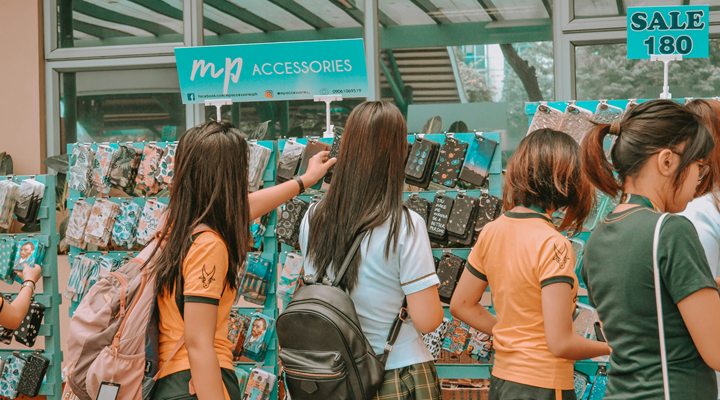
As a heatwave descends across the country, a certain segment of the retail market is also heating up: those catering to back-to-school shoppers. The back-to-school shopping season marks a major period of growth for retailers in many different categories, from school supply brands to fashion labels. The latter group is expected to witness increased sales this year, with Coresight Research confirming that apparel and footwear are set to see the biggest increase in back-to-school spendi
spending this year, with net 47.0 per cent and 34.3 per cent of respondents, respectively, expecting to spend more on these two categories than in previous years.
According to market research company, eMarketer, back-to-school will generate sales of more than $81 billion in 2024, up from $78.68 billion last year.
A survey conducted by Jones Lang LaSalle, a commercial real estate services and property investment strategy company, affirmed that parents expect their back-to-school spending to increase 21.8 per cent to $475 per child, as opposed to $390 spent in 2023.
In this study, respondents said that the retailers where they plan to shop the most are Walmart (46.4 per cent), Amazon (35.4 per cent), Target (32.6 per cent), Costco (6.5 per cent), Old Navy (3.8 per cent) and Dollar General (2.8 per cent).
However, as much room as there is for retailers to capture a portion of the back-to-school dollar, there are also several potential pitfalls if they don’t have the right strategy.
As Nikki Baird, the vice president of strategy and product at Aptos, explained to Inside Retail, “There’s an unmatched opportunity for retailers to play a special role in elevating the sentimental moment that takes place between child and parent in preparation for a strong school year. [However], if retailers deliver a subpar experience during the back-to-school season, it will negatively impact their standing when consumers consider their holiday shopping plans.”
How does this year’s back-to-school shopping season differ from previous years?
Sensormatic Solutions, a retail operations research firm, confirmed a few interesting trends for this year’s back-to-school shopping season in its annual US Back-to-School Consumer Sentiment Survey.
While back-to-school shopping traditionally begins in mid-to-late August, prior to the start of the US school system in September, this year, shoppers are planning to or have already started shopping for school supplies and related paraphernalia in June and July.
In 2023, 42 per cent of the survey’s respondents stated they would begin back-to-school shopping in August, but this year, that number has decreased to 36 per cent.
According to Sensormatic Solutions traffic data, the busiest back-to-school shopping periods are expected to continue to align with the academic calendar in each region, peaking two weeks before the start of the academic year:
South: July 28-August 3
West: July 28-August 3
Midwest: August 4-10
Retailers should also be aware that in-store shopping will remain the primary choice for back-to-school prep, with 39 per cent of Senormatic’s respondents stating that they plan to do the majority of their in-store shopping at free-standing stores and strip centers, followed by open-air shopping centers (25 per cent), enclosed malls (21 per cent) and outlets (12 per cent).
As Grant Gustafson, head of retail consulting and analytics at Sensormatic Solutions, warned, “With the rise in in-store traffic this time of year, it is critical that retailers look at their store operations and staffing to ensure they are meeting and exceeding consumer expectations by creating an environment that truly delivers.”
How should retailers approach the upcoming back-to-school rush?
The US Bureau of Labor Statistics confirmed that the consumer price index rose 3 per cent in June 2024, marking a decline from 3.3 per cent recorded in the year prior, and the first year without an increase in prices since the beginning of the pandemic.
However, consumers, especially those within the middle-to-lower income brackets, are exhibiting a calculated approach to back-to-school shopping.
As John Mercer, Coresight’s head of global research, commented, “We [had] expected 2024 to be a transition year from a weaker, inflation-impacted economy to greater resilience amid low inflation and reduced interest rates. However, that transition is proving slower than initially expected. Overall inflation has stuck at 3+ per cent and the cuts to interest rates have been delayed, impacting the housing market and consumers’ ability and need to spend.”
To entice lower-to-middle income shoppers to shop with them, retailers should lean into offering sales promotions and alternative payment methods, such as buy online, pickup in-store (BOPIS).
Sensormatic’s survey confirmed back-to-school shoppers expressed growing interest in using this payment method, with 43 per cent of shoppers planning to BOPIS for back-to-school purchases in 2024, up from just 34 per cent in 2023.
Several major big box retailers are already offering sales promotions to entice the stressed-out, price-conscious back-to-school shopper. This includes players like Target, Walmart and Shein, all of which started their back-to-school promotions several days earlier than last year. Amazon has its Prime Day sales events taking place from July 16-17.
In addition to time-specific sales promotions, Matt Pavich, the senior director of strategy and innovation at Revionics, pointed out that “clearance is an often-overlooked element of [back-to-school] pricing strategy, but it can be the difference for retailers between a highly successful and a poor-performing [back-to-school] period.”
Neil Saunders, managing director and retail analyst at GlobalData, also noted that “alongside value, convenience remains top-of-mind so mass merchants like Target and Walmart will be key destinations, as will online players like Amazon. In fashion, off-price will probably take some further market share as parents look to save money.”
Another way that retailers can stand out is by placing more of a focus on sustainability, which is a growing concern for back-to-school shoppers, according to Sensormatic’s survey.
Eighty-three per cent of the survey respondents confirmed that sustainability will play a role in their shopping habits this season, a notable increase from 77 per cent in 2023.
Some examples include using reusable shopping bags (45 per cent), choosing sustainable packaging and avoiding materials like plastic (41 per cent) and purchasing goods from second-hand stores (26 per cent).